


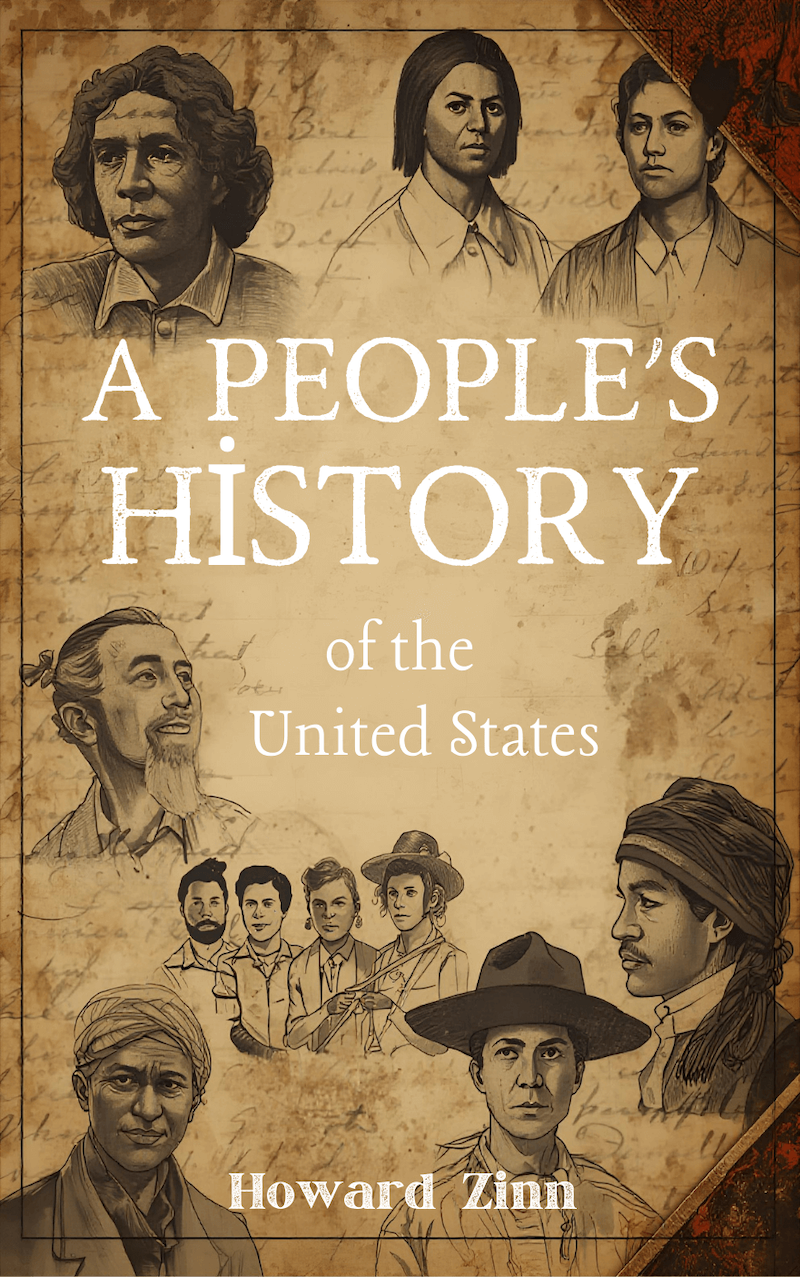
Prefer the print book? Buy on Amazon
As an Amazon Associate, Sumizeit earns from qualifying purchases.
A People’s History of the United States Book Summary
This A People’s History of the United States Book Summary covers the key ideas, lessons, and takeaways in about 20 minutes.
Short Description:
A People’s History reveals progress comes from protest, not top-down power.
Helps with these goals
Preview the A People’s History of the United States book summary
Below is a preview of Sumizeit’s comprehensive human-written summary of A People’s History of the United States by Howard Zinn. The full summary is 15-20 minutes long and covers the book’s key ideas in text, audio, visual, and video formats. Unlock the full 20 Minute Summary
Most U.S. history books center on the powerful: presidents, war generals, wealthy industrialists, and other decision-makers. Howard Zinn rewrites that narrative from the bottom looking up. Rather than treating the masses as background characters to elite ambition, he tells American history through ordinary people—Indigenous nations, enslaved Africans, laborers, immigrants, women, soldiers, activists, and all those whose lives reveal how progress often came from struggle rather than benevolence. His approach questions not only what happened, but who paid the price for those events, and who resisted them. His narrative shows that most turning points in the United States were shaped by conflict between those who had power and those who were denied it.
Zinn’s story is therefore less about heroic founding fathers and more about exploited workers building railroads, enslaved people fueling plantation economies, women agitating for rights, soldiers sent to fight wars they did not choose, and social movements trying to claim dignity. In this telling, America is not a smooth tale of gradual freedom, but a constant negotiation between control and resistance, privilege and rebellion, growth and injustice.
The Colonial Foundation – Conquest, Class Hierarchy, and the Birth of Inequality
The United States begins not with democracy but with conquest. European explorers arrived driven by desire for wealth and expansion. Indigenous societies—organized, communal, linked to land spiritually and economically—were forced into a violent collision with an economic system that valued property and resource extraction above all. Columbus’s arrival marked a period in which European powers enslaved, killed, or displaced Indigenous people on a massive scale, establishing an economy built on their suffering.
Colonial society quickly hardened into hierarchy. A small elite owned land and capital; merchants and plantation owners profited from crops and trade; small farmers and artisans made up a modest middle; and below them were indentured Europeans, enslaved Africans, and Indigenous people with almost no rights. Slavery became the defining labor institution, not only economically but ideologically: racism was cultivated deliberately to justify enslavement and to stop poor whites from joining enslaved Africans in rebellion. After early uprisings threatened elite control, lawmakers strengthened racial divisions to divide the lower classes.
Women lived under patriarchal laws that denied political participation and property ownership. Their labor—raising children, producing household goods, and working informally—was essential yet unseen. Despite silencing, women challenged their condition through writing, protest, and labor actions.
The American Revolution – Freedom for Whom?
Schools often present the American Revolution as a unified colonial struggle for liberty. Zinn paints a more complicated picture. Many wealthy colonists rebelled not out of universal principle but because British taxation and trade restrictions threatened their profits. Poor whites, who faced debt, hunger, and rising inequality, were persuaded to fight through promises of freedom, wages, or patriotism. For elites, war diverted unrest away from inequality at home by focusing anger on Britain.
Enslaved Africans largely sided with the British after being offered emancipation. Indigenous groups often opposed colonial forces because the British restricted westward settlement and colonists constantly invaded their lands.
Want the complete 20-minute summary?
- Full structured summary
- Video Summary
- Podcast Summary
- Audio summary
- Key takeaways
- Exercises
- Quiz
- Highlights and notes
- Ask the book with AI
Who should read A People’s History of the United States?
This book is essential for anyone seeking a deeper understanding of American history beyond textbook narratives. It appeals to students, educators, activists, and citizens who want to understand how ordinary people shaped the nation through struggle and resistance rather than accepting the elite-centered version taught in schools.
Why does A People’s History of the United States matter?
A People's History of the United States challenges the dominant narrative by centering the experiences of workers, enslaved people, Indigenous nations, and social movements that have been historically marginalized. Understanding these overlooked stories is crucial today for recognizing ongoing patterns of inequality and recognizing that meaningful change comes from grassroots organizing and sustained resistance, not from institutions granting rights from above.
What are the key themes in A People’s History of the United States?
- History told from below: centering ordinary people rather than elites
- Power and resistance: the constant struggle between those who control and those who resist
- Structural inequality: how racism, class divisions, and exploitation are built into American systems
- Social movements as agents of change: progress through organized protest and collective action
- Broken promises and incomplete victories: reforms that fall short of true equality
- Economic systems and their human costs: how profit motives drive displacement and suffering
How can you apply ideas from A People’s History of the United States?
- Question official narratives and seek out marginalized perspectives when studying history, current events, or social issues
- Research the actual origins of rights and protections you benefit from to understand that they came through organized struggle, not institutional generosity
- Recognize how divisions along race, ethnicity, and nationality benefit those in power and actively build solidarity across these lines in your organizing
- Examine who bears the costs and who benefits from policies, wars, and economic systems rather than accepting surface-level justifications
- Support workers' rights to organize and demand better conditions, recognizing labor movements as essential to building a more equitable society
- Engage in sustained activism knowing that change is slow and partial, but that collective action has historically forced important concessions and shifts
- Teach and share alternative histories with others, especially younger people, to counter dominant narratives taught in schools
What common mistakes do readers make with A People’s History of the United States?
- Assuming America progresses inevitably toward greater freedom rather than understanding that gains are contested, temporary, and constantly threatened by those who benefit from the status quo
- Accepting the framing of activists, protesters, and dissidents as dangers rather than recognizing them as citizens exercising democratic participation
- Treating historical movements as completed rather than understanding they continue today in different forms with ongoing struggle required
- Focusing only on famous leaders and heroes rather than examining the millions of ordinary people whose collective action actually drove change
Sumizeit Exercises Apply what you've learned
Turn ideas from A People’s History of the United States into action with a short guided reflection: identify the biggest takeaway, connect it to your life, and commit to one step you can take in the next 24 hours.
What is the expert analysis of A People’s History of the United States?
Overview
A People’s History of the United States by Howard Zinn stands as a seminal work in American historiography, notable for its radical reorientation of the national narrative. Rather than celebrating political elites and traditional power holders, Zinn foregrounds the experiences of marginalized groups—Indigenous peoples, enslaved Africans, laborers, women, and activists—whose struggles and resistances have shaped the country’s trajectory. Published in 1980, this book challenged prevailing historical orthodoxies by emphasizing conflict, exploitation, and grassroots agency. Zinn, a historian and activist, brought to this work his deep commitment to social justice and a critical perspective shaped by his own experiences in war and civil rights activism.
Core Thesis
Zinn’s central argument is that American history is best understood from the perspective of those oppressed and exploited by dominant power structures. He contends that the nation’s progress was rarely benevolent or inevitable but was won through persistent struggle against entrenched elites. The traditional celebratory accounts of founding fathers, wars, and political milestones obscure the realities of class conflict, racial oppression, and systemic inequality. By retelling history “from below,” Zinn reveals that freedom and justice have been hard-fought and remain incomplete, shaped by ongoing resistance rather than top-down benevolence.
Strengths
- Innovative Perspective: Zinn’s bottom-up approach revolutionizes the way American history is taught and understood, giving voice to groups often omitted from mainstream narratives.
- Comprehensive Scope: The book covers a vast chronological span, linking colonial conquest, slavery, labor movements, imperialism, and modern political developments into a coherent critique of power.
- Engagement with Social Movements: By highlighting activism and resistance, Zinn connects historical events to contemporary struggles, inspiring readers to consider their own role in social change.
- Accessible and Provocative Style: The narrative is compelling and clear, making complex historical dynamics understandable without sacrificing analytical depth.
- Ethical Commitment: Zinn’s work is grounded in a moral imperative to expose injustice and empower ordinary people, lending the text a passionate urgency.
Critiques & Counterarguments
- Selective Use of Evidence: Critics argue that Zinn sometimes prioritizes anecdotal or activist-friendly sources over a balanced range of evidence, potentially skewing interpretations.
- Oversimplification of Complex Events: The dichotomy of oppressors versus oppressed can flatten nuanced historical realities, underplaying internal divisions within groups and the multiplicity of motives among historical actors.
- Neglect of Institutional Progress: Some historians contend that Zinn underestimates the significance of institutional reforms and legal advances that, while imperfect, contributed to social improvements.
- Opposing Schools of Thought: Traditional political historians emphasize the importance of state-building, diplomacy, and elite decision-making as drivers of historical change, challenging Zinn’s focus on popular resistance as the primary engine.
- Real-World Evidence of Stability: The persistence of American democratic institutions and economic growth can be seen as contradictory to Zinn’s portrayal of a nation in constant conflict and exploitation.
Who Should Read This
This book is essential reading for scholars, students, and engaged readers interested in a critical re-examination of American history. It appeals particularly to those in social sciences, humanities, and activist circles who seek to understand the intersections of power, race, class, and resistance. Educators looking to diversify historical curricula and readers eager to challenge dominant narratives will find Zinn’s work both provocative and enlightening. However, readers should approach the text with an awareness of its interpretive lens and consider it alongside other historiographical perspectives for a fuller understanding of the United States’ complex past.
Frequently asked questions about the A People’s History of the United States book summary
What is A People's History of the United States about?
A People's History of the United States by Howard Zinn retells American history from the perspective of ordinary people—enslaved Africans, Indigenous nations, workers, women, and activists—rather than focusing on presidents and elites. The book argues that meaningful change came through struggle and resistance from below, not through benevolence from above, and that American history is marked by continuous conflict between those with power and those denied it.
Who should read A People's History of the United States?
Anyone seeking a deeper, more honest understanding of American history should read this book, including students tired of textbook narratives, educators wanting to teach alternative perspectives, activists seeking historical precedent for their work, and citizens interested in understanding ongoing patterns of inequality. Zinn's accessible writing makes the book valuable for general readers across education levels.
What are the main takeaways from A People's History of the United States?
The main takeaways include: official history glorifies elites while erasing ordinary people's contributions; racism and class divisions were deliberately constructed to prevent unified resistance; freedom and rights were won through struggle, not granted from above; progress is not inevitable and gains can be reversed; and understanding this history empowers people to recognize their own capacity for change today. Zinn argues that recognizing how ordinary people shaped the past suggests possibilities for building different futures.
How does Zinn's history differ from traditional American history?
Zinn centers the experiences, struggles, and perspectives of working people, enslaved people, Indigenous nations, and social movements rather than focusing on political leaders and military victories. He emphasizes conflict and resistance rather than presenting progress as inevitable, and he asks who paid the price for historical events, not just what happened. This approach reveals how exploitation and inequality are woven into American institutions.
What does Zinn argue about the American Revolution?
Zinn argues that the American Revolution, while framed as a fight for universal liberty, primarily benefited wealthy colonists seeking freedom from British trade restrictions. Enslaved people largely sided with the British when offered emancipation, Indigenous nations opposed colonial expansion, and poor farmers returned from war unpaid and heavily taxed. The resulting Constitution protected wealth and limited democracy rather than achieving the universal freedom its rhetoric promised.
How does Zinn explain the persistence of inequality in America?
Zinn argues that inequality persists because both major political parties largely serve corporate and military interests, reforms are designed to prevent revolution rather than achieve equality, and those in power use crises, patriotic appeals, and media control to suppress challenges to their authority. While social movements have won important legal rights, deeper structural inequalities in wealth and power remain intact because they are fundamental to how American institutions operate.
What is Zinn's view on war and American expansion?
Zinn argues that wars and territorial expansion primarily serve the interests of elites seeking profit and power, while the human costs fall on working-class soldiers and displaced populations. He contends that wars are justified through nationalistic rhetoric that obscures their economic motivations, distract from domestic inequality, and that patriotic appeals are weaponized to silence dissent about whether wars actually serve the public good.
About Sumizeit
Sumizeit is a profitable Scomy LLC company based in Miami, Florida. Our founders, Clemens Raemy and Weina Scott, are successful entrepreneurs with several exits. Sumizeit is a popular book summary app / micro learning app used by busy professionals and entrepreneurs with over 2,500 non-fiction book summaries and 10,000 podcast summaries in text, audio, visual, podcast, and video format. We also have stellar retention tools to make ideas stick - such as flashcards with spaced repetition, quizzes, streaks, highlighting and notes, daily challenges, riddles, mini-courses, meditation, and more. You won't only learn the idea, but also remember it. Over 90% of our users change their habits with Sumizeit.
Upgrade Now
Here's why readers love Sumizeit
Join thousands of learners getting smarter every day
"Great experience. Detailed summaries. Loved the gamification feature. Makes learning fun. Good customer service. I recommend Sumizeit to anyone. You'll learn a lot."
"I always felt busy but still wanting to keep up with the book discussion in my friend group. This was a great supplement to help me keep reading the books I find fun while keeping up with important books."
"I love this website. Instead of scrolling social media, I find myself learning a lot. I use it everyday. I recommend this app for anyone who is too busy and wants to get up to speed with their favorite books."
A People’s History of the United States Book Summary PDF
Looking for a A People’s History of the United States Book Summary PDF you can save and revisit offline? Our A People’s History of the United States Book Summary PDF captures the book’s core ideas in a clean, printable format — the key frameworks, takeaways, and structure without the fluff. Download the A People’s History of the United States Book Summary PDF when you want a reference you can annotate, share with your team, or review on the go. Get your A People’s History of the United States Book Summary PDF from the download page below.
Download A People’s History of the United States Book Summary PDFPeople also liked these summaries
Readers who explored A People’s History of the United States often enjoyed these titles next.





Ready to read the whole thing?
- Full structured summary
- Video Summary
- Podcast Summary
- Audio summary
- Key takeaways
- Exercises
- Quiz
- Highlights and notes
- Ask the book with AI
Featured Book Titles
Popular Book Summaries at sumizeit, leading book summary app