


As an Amazon Associate, Sumizeit earns from qualifying purchases.
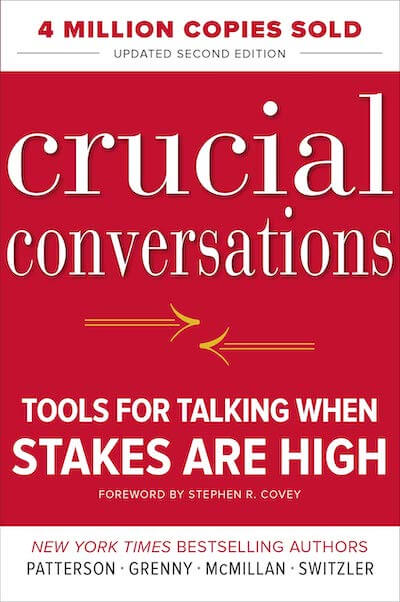
Crucial Conversations Tools for Talking When Stakes Are High Book Summary
This Crucial Conversations Tools for Talking When Stakes Are High Book Summary covers the key ideas, lessons, and takeaways in about 20 minutes.
Helps with these goals
Want the complete 20-minute summary?
- Full structured summary
- Video Summary
- Podcast Summary
- Audio summary
- Key takeaways
- Exercises
- Quiz
- Highlights and notes
- Ask the book with AI
What is in the Crucial Conversations Tools for Talking When Stakes Are High book summary?
Below is a preview of Sumizeit’s expert-written summary of Crucial Conversations Tools for Talking When Stakes Are High by Kerry Patterson. The full summary covers the book’s key ideas in text, audio, and video.
Ok, let’s admit it, sometimes it’s hard to have those tough conversations.
Like, how do you even bring up those heavy topics that make want to scream in frustration and lash out in anger?
Seriously, there are just some topics that make people lose it on one another, even if they’re usually pretty level-minded individuals.
So, how do we deal with these issues? What is the right way of approaching these problems?
In “Crucial Conversations”, Kerry Patterson lays the basis for how to have these tear-jerking fist-throwing conversations in a healthy way.
“This is the first principle of dialogue—Start with Heart. That is, your own heart. If you can’t get yourself right, you’ll have a hard time getting the dialogue right.”- Kerry Patterson
You’ll go from steaming from the ears to calm as a cucumber with Kerry’s high-valued advice.
Irrational Responses From Crucial Topics
If you’re like many of us, you’ve had what has started out with a conversation with your significant other and halfway through, you realize you’re actually in the midst of an argument. This is what we call a crucial conversation because it is drenched in intense emotion.
If we don’t manage these crucial conversations they can be destructive to our relationships.
It is hard to think rationally when you are bombarded with one of these hard-to-deal-with topics. A rush of adrenaline is automatically sent through the body, which heightens our responses. The body goes into fight-or-flight mode because of the intense energy, which leads to super speedy decision-making and eliminates rational thinking.
People who can master crucial conversations are better able to lead because they are trained to think rationally under stress. And, similarly, couples who can have those tough conversations calmly together, are more likely to stay together for the long-haul.
Freely Share Information
When you are participating in a crucial conversation, it is most important to share freely without the fear of hurting another person’s feelings or being criticized.
“The mistake most of us make in our crucial conversations is we believe that we have to choose between telling the truth and keeping a friend.”- Kerry Patterson
Sharing this information freely leads to more informed, rational, and ‘right’ decisions because both parties have all the information laid out in front of them.
When information is shared freely, people are more likely to commit to making solutions and exploring all available options. It becomes problem-solving rather than a shouting match.
And, even if the solution to the problem chosen, you don’t fully agree with, you will give it a try because you were part of the decision-making process.
Stay Focused On Your Goal
Anytime that you are bombarded by an opposing idea, you must remember your goal. Just getting angry from the initial attack will not solve anything!
Take a moment to breathe and remember what you want to get from the words you’re about to put into the conversation. Make sure they align with your goal and are not stemming from anger.
Also, be…
Want the complete 20-minute summary?
- Full structured summary
- Video Summary
- Podcast Summary
- Audio summary
- Key takeaways
- Exercises
- Quiz
- Highlights and notes
- Ask the book with AI
Who should read Crucial Conversations Tools for Talking When Stakes Are High?
Crucial Conversations is essential for anyone who struggles with difficult conversations—whether you're a manager navigating workplace conflicts, a partner addressing relationship issues, or a team member needing to speak up about problems. This book is particularly valuable for leaders and professionals who want to influence outcomes without damaging relationships or resorting to avoidance.
Why does Crucial Conversations Tools for Talking When Stakes Are High matter?
High-stakes conversations shape careers, relationships, and organizational cultures, yet most people handle them poorly by either shutting down or escalating into conflict. In today's polarized environment where clear communication is increasingly difficult, mastering these skills directly impacts personal well-being, team performance, and relationship longevity. The ability to speak truthfully while maintaining respect has become a differentiator in professional and personal success.
What are the key themes in Crucial Conversations Tools for Talking When Stakes Are High?
- Creating psychological safety in conversations
- Managing emotional responses under pressure
- Balancing honesty with respect for relationships
- Free flow of information and dialogue
- Shared purpose and mutual respect as foundations
- Moving from conflict to collaborative problem-solving
What are the key lessons from the Crucial Conversations Tools for Talking When Stakes Are High book summary?
Start with Heart
Before entering any crucial conversation, examine your own motives and emotional state. If you can't get your own heart right, you'll struggle to conduct healthy dialogue.
Recognize the Fight-or-Flight Response
When conversations become heated, your body floods with adrenaline, shutting down rational thinking. Understanding this biological response is the first step to managing it.
Choose Truth Over Comfort
Don't assume you must sacrifice honesty to preserve relationships. The real mistake is believing you have to choose between telling the truth and keeping a friend.
Establish Mutual Respect First
Mutual respect must be established before the conversation begins, not during it. It's the foundation upon which safe dialogue is built.
Define a Common Purpose
Both parties need to align on a shared end goal. Without common purpose, conversations remain adversarial rather than collaborative.
Create Psychological Safety
When people feel unsafe, they either withdraw silently or become aggressive. Psychological safety—built on respect and shared purpose—enables open sharing.
Separate Facts From Interpretations
Misinterpretations can derail conversations quickly. Take time to verify facts before reacting emotionally to what you think you heard.
Stay Focused on Your Desired Outcome
In the heat of conflict, remember what you actually want to achieve. Align your words with your goals, not your anger.
Identify What You Don't Want
Being clear about undesired outcomes prevents you from accidentally creating them through poorly chosen words in high-emotion moments.
Make Others' Opinions Valued
When people feel their views matter, they're more likely to share freely and feel safe. This opens pathways to real understanding and solutions.
Listen to Understand, Not to Fight
Shift your mindset from defending your position to genuinely understanding the other person's perspective. This transforms dialogue from debate to discovery.
Ask Questions and Listen Actively
Questions signal genuine curiosity and create space for others to contribute. Active listening shows respect and gathers the information needed for good decisions.
Share Information Freely
When all relevant information is on the table, decisions are more informed, rational, and likely to be supported by all parties involved.
Commit to Collaborative Problem-Solving
Transform the conversation from a battle over opinions into a shared mission to find the best solution together.
Clarify Decision-Making Authority
Explicitly state who has the power to make the final decision and how that decision will be made—whether by one person, consensus, or voting.
Assign Clear Responsibilities
Once a solution is chosen, spell out who does what and by when. Vague action plans fail; clear accountability ensures follow-through.
Deadlines Turn Intentions Into Reality
Goals without deadlines are just wishful thinking. Specific timelines transform decisions into actionable commitments.
Secure Buy-In Through Participation
People are more committed to solutions they helped create. Even if the final decision isn't exactly what you wanted, participation increases ownership.
Manage Silence and Violence in Conflict
When people feel unsafe, they either clam up (silence) or become aggressive (violence). Recognizing these patterns helps you address the underlying safety issue.
Transform Conflicts Into Connection
With the right approach, difficult conversations become opportunities to deepen understanding, build trust, and strengthen relationships rather than damage them.
Want the complete 20-minute summary?
- Full structured summary
- Video Summary
- Podcast Summary
- Audio summary
- Key takeaways
- Exercises
- Quiz
- Highlights and notes
- Ask the book with AI
How can you apply ideas from Crucial Conversations Tools for Talking When Stakes Are High?
- Before a difficult conversation, pause and examine your true underlying motive and emotional state to ensure you're not driven purely by anger
- Explicitly establish mutual respect and identify a shared purpose with the other person before diving into the controversial topic
- When you feel your emotions rising during a conversation, take a breath and consciously reconnect with your desired outcome, not your emotional reaction
- Ask clarifying questions to verify facts before responding to what you think someone said, preventing misunderstandings from escalating conflict
- Actively solicit and value the other person's perspective by asking open-ended questions and genuinely listening to understand their viewpoint
- Document agreed-upon solutions with clear assignments of who does what and specific deadlines to ensure accountability and follow-through
- Use group decision-making methods like voting when the decision affects multiple people, creating shared responsibility for the outcome
What common mistakes do readers make with Crucial Conversations Tools for Talking When Stakes Are High?
- Entering conversations while still emotionally flooded, leading to reactive rather than intentional communication
- Assuming you must choose between being honest and preserving the relationship, when in fact honesty within mutual respect strengthens bonds
- Failing to establish psychological safety before expecting someone to share openly, then being surprised by their defensive responses
- Treating solutions as final without clarifying who is responsible for what and by when, resulting in unclear expectations and failed follow-through
Sumizeit Exercises Apply what you've learned
Turn ideas from Crucial Conversations Tools for Talking When Stakes Are High into action with a short guided reflection: identify the biggest takeaway, connect it to your life, and commit to one step you can take in the next 24 hours.
What is the expert analysis of Crucial Conversations Tools for Talking When Stakes Are High?
Overview
Crucial Conversations: Tools for Talking When Stakes Are High is authored by Kerry Patterson, a distinguished figure in leadership development and corporate training. Patterson’s background as a professor at Brigham Young University’s Marriott School of Management and his role in founding VitalSmarts lend significant credibility to his insights on communication. The book stands out as a seminal work in the self-improvement and business communication genres, addressing the perennial challenge of navigating high-stakes conversations with emotional intensity and potential conflict.
Core Thesis
Patterson’s central argument is that the ability to engage in “crucial conversations” — those charged with emotion and high stakes — is a critical skill for personal and professional success. He posits that mastering dialogue under stress requires creating a safe environment characterized by mutual respect and a shared purpose. By managing one’s own emotional responses and encouraging open, honest information sharing, individuals can transform potentially destructive confrontations into productive problem-solving discussions.
Strengths
- Practical Framework: The book provides a clear, actionable methodology for managing difficult conversations, from “starting with heart” to ensuring mutual respect and common purpose.
- Psychological Insight: Patterson adeptly explains the physiological and emotional dynamics at play during high-stakes interactions, such as the fight-or-flight response, grounding his advice in human behavioral science.
- Emphasis on Safety and Respect: The insistence on creating a safe conversational space is a nuanced and vital contribution, recognizing that emotional safety is foundational to effective communication.
- Broad Applicability: The principles are applicable across diverse contexts—personal relationships, workplace leadership, and group decision-making—making it a versatile resource.
- Integration of Decision-Making: The book’s focus on not just conversation but also on clear action steps and accountability enhances its utility in real-world scenarios.
Critiques & Counterarguments
- Oversimplification of Emotional Complexity: While the book provides a useful framework, it may understate the depth of emotional and cultural complexities that can influence communication, especially in diverse or deeply entrenched conflicts.
- Limited Engagement with Power Dynamics: The model assumes a level playing field where mutual respect is attainable, but in many real-world situations, power imbalances or systemic inequalities complicate the creation of “safe” spaces.
- Potential Overreliance on Rationality: The emphasis on rational problem-solving may neglect scenarios where emotional expression and catharsis are necessary for genuine resolution, as argued by some psychological schools.
- Competing Research on Communication Styles: Alternative approaches, such as nonviolent communication (Marshall Rosenberg) or narrative therapy, challenge the book’s focus on information sharing by prioritizing empathy and storytelling over problem-solving.
- Real-World Evidence of Limitations: In highly adversarial or toxic environments, the strategies may be insufficient without broader organizational or relational change, suggesting that the book’s tools are necessary but not always sufficient.
Who Should Read This
Crucial Conversations is ideal for professionals in leadership roles, managers, and anyone seeking to improve interpersonal communication under pressure. It is particularly valuable for those in corporate environments where collaboration and conflict resolution are daily challenges. Additionally, couples and individuals interested in enhancing personal relationships through better dialogue will find the book’s insights practical and transformative. Readers who appreciate structured, psychologically informed self-help with a focus on actionable strategies will benefit most from this work.
Frequently asked questions about the Crucial Conversations Tools for Talking When Stakes Are High book summary
What is Crucial Conversations Tools for Talking When Stakes Are High about?
Crucial Conversations by Kerry Patterson is a guide to navigating high-stakes discussions where emotions run high and the conversation could significantly impact relationships or outcomes. The book teaches readers how to manage their own emotional responses, create psychological safety, and engage in honest dialogue that leads to collaborative problem-solving rather than conflict escalation.
Who should read Crucial Conversations Tools for Talking When Stakes Are High?
This book is essential for managers, leaders, professionals, and anyone who regularly faces difficult conversations in work or personal relationships. It's particularly valuable for people who either avoid confrontation or tend to escalate conflicts, as well as those seeking to influence outcomes while maintaining trust and respect with others.
What are the main takeaways from Crucial Conversations Tools for Talking When Stakes Are High?
The main takeaways include: start by examining your own emotional state before conversations, establish mutual respect and shared purpose before discussing controversial topics, create psychological safety so others feel comfortable sharing honestly, manage your fight-or-flight response through conscious focus on your desired outcome, and turn solutions into action with clear assignments and deadlines. Together, these principles transform potentially destructive conflicts into opportunities for deeper connection and better outcomes.
How does Kerry Patterson suggest managing emotions during crucial conversations?
Patterson teaches readers to recognize when their body enters fight-or-flight mode, which shuts down rational thinking. The key is to pause, take a breath, and consciously reconnect with your actual goal for the conversation rather than acting on anger. He emphasizes starting with your own heart—getting your internal emotional state right before attempting to conduct healthy dialogue with others.
What does psychological safety mean in the context of crucial conversations?
Psychological safety is the foundation of honest dialogue, built on two elements: mutual respect and shared purpose. When people feel safe—meaning they believe you respect them and you both want the same positive outcome—they're willing to share openly without fear. Without this safety, people either withdraw (silence) or become aggressive (violence), both of which derail productive conversation.
How should decisions be implemented after a crucial conversation?
Once a decision is made, clarity is essential. Clearly identify who has the decision-making authority, specify who is responsible for each action item, and assign concrete deadlines. As Patterson notes, goals without deadlines are merely directions, not actionable commitments. This structure ensures accountability and prevents solutions from remaining theoretical.
Why does Kerry Patterson emphasize sharing information freely in conversations?
When all relevant information is openly shared, decisions are more informed and rational, and both parties are more likely to commit to solutions. Additionally, people feel more invested in outcomes they helped create. Free information flow turns conversations from battles over opinions into collaborative problem-solving, which leads to better decisions and stronger relationships.
About Sumizeit
Sumizeit is a profitable Scomy LLC company based in Miami, Florida. It has been helping readers learn from nonfiction books for 7 years with expert-written summaries in text, audio, podcast, and video.
Want the complete 20-minute summary?
- Full structured summary
- Video Summary
- Podcast Summary
- Audio summary
- Key takeaways
- Exercises
- Quiz
- Highlights and notes
- Ask the book with AI
Here's why readers love Sumizeit
Join thousands of learners getting smarter every day
"Great experience. Detailed summaries. Loved the gamification feature. Makes learning fun. Good customer service. I recommend Sumizeit to anyone. You'll learn a lot."
"I always felt busy but still wanting to keep up with the book discussion in my friend group. This was a great supplement to help me keep reading the books I find fun while keeping up with important books."
"I love this website. Instead of scrolling social media, I find myself learning a lot. I use it everyday. I recommend this app for anyone who is too busy and wants to get up to speed with their favorite books."
Crucial Conversations Tools for Talking When Stakes Are High Book Summary PDF
Looking for a Crucial Conversations Tools for Talking When Stakes Are High Book Summary PDF you can save and revisit offline? Our Crucial Conversations Tools for Talking When Stakes Are High Book Summary PDF captures the book’s core ideas in a clean, printable format — the key frameworks, takeaways, and structure without the fluff. Download the Crucial Conversations Tools for Talking When Stakes Are High Book Summary PDF when you want a reference you can annotate, share with your team, or review on the go. Get your Crucial Conversations Tools for Talking When Stakes Are High Book Summary PDF from the download page below.
Download Crucial Conversations Tools for Talking When Stakes Are High Book Summary PDFPeople also liked these summaries
Readers who explored Crucial Conversations Tools for Talking When Stakes Are High often enjoyed these titles next.



Want the complete 20-minute summary?
- Full structured summary
- Video Summary
- Podcast Summary
- Audio summary
- Key takeaways
- Exercises
- Quiz
- Highlights and notes
- Ask the book with AI
Featured Book Titles
Popular Book Summaries at sumizeit, leading book summary app