


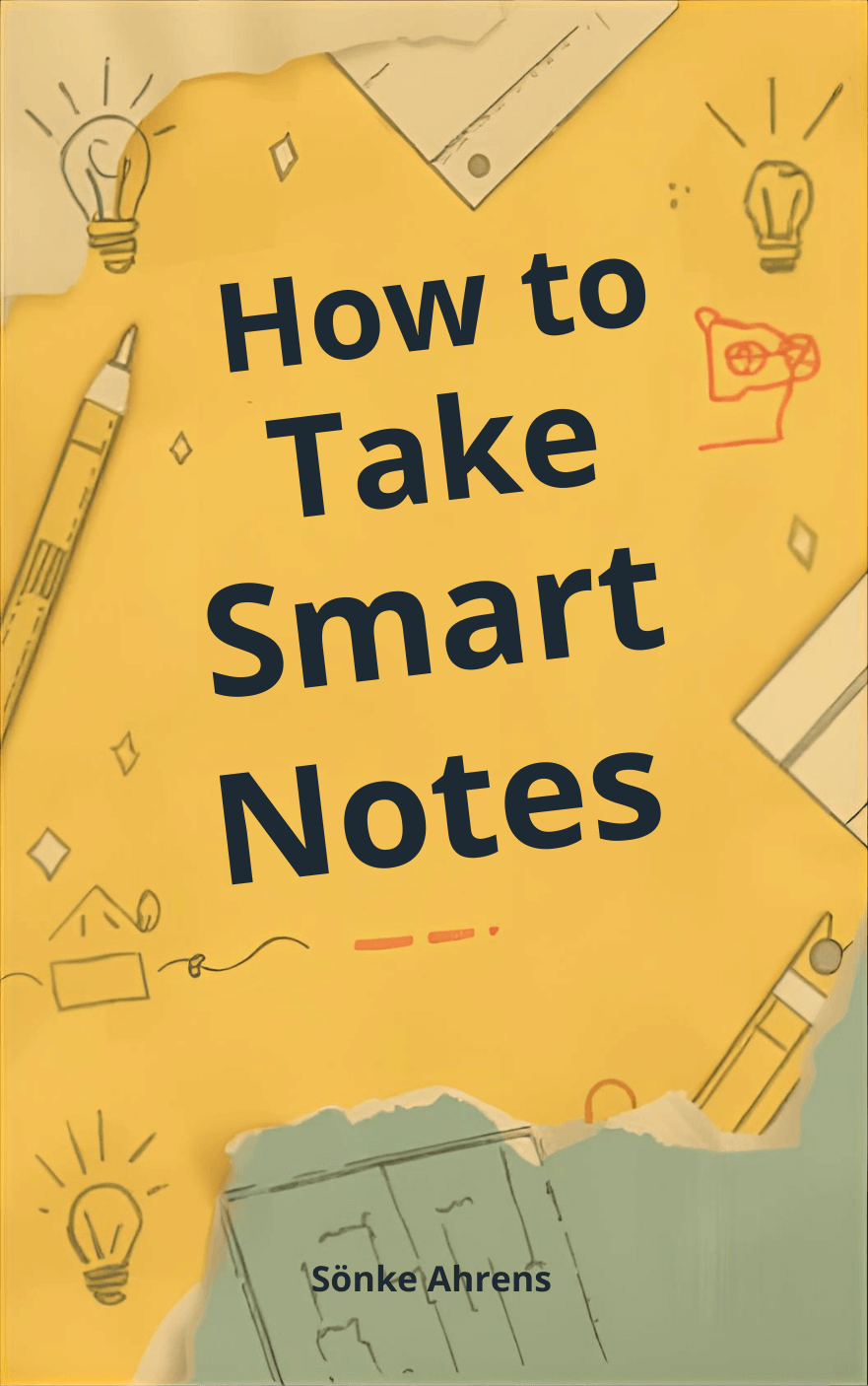
Prefer the print book? Buy on Amazon
As an Amazon Associate, Sumizeit earns from qualifying purchases.
How to Take Smart Notes Book Summary
This How to Take Smart Notes Book Summary covers the key ideas, lessons, and takeaways in about 20 minutes.
Short Description:
How to Take Smart Notes builds creativity through interconnected note-taking.
The Slip-Box eliminates writer’s block because writing becomes the natural result of incremental thinking rather than a heroic act of creation. It prevents confirmation bias, encourages creativity, exposes gaps in reasoning, and makes complex projects manageable. Instead of starting from zero each time, thinkers build upon years of accumulated understanding. As ideas interact, unexpected breakthroughs emerge. Knowledge compounds. Creativity becomes predictable, not accidental.
The system shows that learning is not about storing information—it is about generating insight.
Helps with these goals
Want a Free Weekly Read?
Get a free summary every week straight to your mailbox.
Preview the How to Take Smart Notes book summary
Below is a preview of Sumizeit’s comprehensive human-written summary of How to Take Smart Notes by Sönke Ahrens. The full summary is 15-20 minutes long and covers the book’s key ideas in text, audio, visual, and video formats. Unlock the full 20 Minute Summary
“How to Take Smart Notes” by Sönke Ahrens presents a radically different method for learning, reading, thinking, and writing—one that transforms note-taking from passive information collection into an active process of knowledge creation.
Most people struggle with writing because they treat writing as something that happens after thinking and research are finished. They spend weeks or months gathering material, highlighting texts, bookmarking pages, and copying quotations, only to sit in front of a blank screen with no idea where to begin. Ahrens argues that this struggle is not caused by lack of skill, motivation, or discipline, but by a flawed process.
The Slip-Box method, originally developed by the sociologist Niklas Luhmann, integrates reading, note-taking, thinking, and writing into a single continuous workflow. Instead of separating research, analysis, and writing into distinct phases, the Slip-Box treats writing as a constant activity that develops ideas incrementally. The result is a system that converts knowledge into interconnected insights and eventually into publishable work, eliminating writer’s block and dramatically increasing originality and productivity.
The Slip-Box functions like an external brain that accumulates and develops insights over time, allowing understanding to deepen and ideas to evolve long after they were first recorded. This makes it equally valuable to students, academics, researchers, lawyers, journalists, nonfiction authors, entrepreneurs, designers, software engineers, and lifelong learners.
The Three Types of Notes That Power the Slip-Box System
The Slip-Box relies on three types of notes, each playing a distinct role in the thinking and writing process. These types prevent confusion between raw ideas, extracted knowledge, and integrated understanding.
Fleeting notes capture spontaneous thoughts, curiosities, questions, observations, or ideas that occur throughout the day. These notes are quick, informal, and temporary, meant only to save ideas before they disappear.
Example:
While cooking dinner, you suddenly think: “People make healthier choices when ingredients are visible rather than hidden inside sealed packaging. Is transparency itself a driver of better decisions?” You jot it down quickly so it can be processed later.
Other examples include:
• A surprising comment overheard in conversation
• A question that emerges while driving
• A phrase that could become an opening paragraph someday
• A connection between two concepts from different books
Fleeting notes are emptied daily. Some are converted into more permanent insights; others are discarded if unhelpful.
Literature notes summarize key ideas from books, articles, lectures, videos, podcasts, or research sources in full sentences and in your own words. They prevent passive reading and force comprehension.
Example:
Reading Daniel Pink’s Drive, you write:
“Pink argues that extrinsic rewards can reduce intrinsic motivation by shifting focus from learning to compliance. Autonomy, mastery, and purpose create stronger long-term performance (Pink, 2009, p. 45).”
This is far more valuable than a highlight or copied quote because it reflects your interpretation and understanding.
Literature notes include:
• Full sentence explanations
• Only one idea per note
• Bibliographic details for easy citation
• No verbatim copying unless essential for quoting later
These notes are stored in a reference system…
Want the complete 20-minute summary?
- Full structured summary
- Video Summary
- Podcast Summary
- Audio summary
- Key takeaways
- Exercises
- Quiz
- Highlights and notes
- Ask the book with AI
Who should read How to Take Smart Notes?
How to Take Smart Notes is essential for anyone who writes, researches, or learns regularly—students, academics, authors, journalists, lawyers, entrepreneurs, and knowledge workers of all kinds. Whether you struggle with writer's block, feel overwhelmed by information overload, or want to develop deeper thinking habits, this book provides a practical system to transform how you capture and process ideas. It's especially valuable for people who want to move beyond passive note-taking into active knowledge creation.
Why does How to Take Smart Notes matter?
In an age of information abundance, the problem isn't finding ideas—it's organizing them into coherent, original thinking. How to Take Smart Notes by Sönke Ahrens solves the fundamental disconnect most people face: the gap between research and writing, between gathering information and generating insight. By introducing the Slip-Box method, Ahrens reveals that writing productivity and creative breakthroughs aren't products of inspiration or willpower, but of systematic thinking. This approach has proven invaluable for academics, professionals, and lifelong learners who want to compound their knowledge over time rather than starting from scratch on every project.
What are the key themes in How to Take Smart Notes?
- Writing as a thinking tool, not a communication tool
- Interconnected knowledge networks vs. siloed information storage
- Bottom-up discovery instead of top-down thesis-driven research
- Continuous, incremental learning integrated with writing
- Escaping confirmation bias through systematic note-taking
- Transforming fleeting ideas into permanent, actionable insights
How can you apply ideas from How to Take Smart Notes?
- Capture fleeting ideas immediately using your phone or notebook, then process them within 24 hours into permanent notes
- When reading books or articles, write literature notes in your own words with full citations instead of highlighting or copying
- Link new permanent notes to 2-5 existing notes in your system to build a web of related ideas
- Write permanent notes so they make sense without any context, forcing you to articulate complete, standalone thoughts
- Review your Slip-Box weekly to identify clusters of connected notes that suggest writing topics or research directions
- Use digital tools with strong linking features (Obsidian, Roam, Logseq, Notion) to make connections visible and searchable
- Start writing projects by gathering related note clusters, then arranging them into an argument structure before drafting
What common mistakes do readers make with How to Take Smart Notes?
- Treating notes as a filing system where ideas are sorted into fixed categories, which prevents unexpected connections
- Copying verbatim quotes instead of summarizing in your own words, which skips genuine comprehension
- Writing vague notes without context or connections, making them useless weeks or months later
- Waiting until research is 'complete' to start writing, instead of writing incrementally as ideas develop
Sumizeit Exercises Apply what you've learned
Turn ideas from How to Take Smart Notes into action with a short guided reflection: identify the biggest takeaway, connect it to your life, and commit to one step you can take in the next 24 hours.
What is the expert analysis of How to Take Smart Notes?
Overview
How to Take Smart Notes by Sönke Ahrens stands as a seminal work in the realm of knowledge management and academic productivity. Drawing on the pioneering Slip-Box method of sociologist Niklas Luhmann, Ahrens offers a transformative approach to note-taking that transcends mere information collection, positioning it as an active, generative process integral to thinking and writing. Ahrens, a respected researcher and educator in academic writing and learning science, synthesizes decades of cognitive research and practical application into a method that appeals broadly—from students and academics to professionals in diverse fields such as law, software development, and entrepreneurship.
Core Thesis
The central insight of Ahrens’s work is that writing and thinking are deeply intertwined processes that flourish when supported by a systematic note-taking workflow. The Slip-Box method, by integrating reading, note-taking, thinking, and writing into a continuous, bottom-up process, enables the gradual development of ideas through interconnected permanent notes. This method not only prevents common pitfalls such as writer’s block and confirmation bias but also fosters originality and intellectual growth by allowing knowledge to compound over time. Writing, in this framework, is not a final stage but an ongoing act of discovery and refinement.
Strengths
- Innovative Integration: Ahrens’s articulation of the Slip-Box method elegantly unites disparate cognitive activities—reading, note-taking, and writing—into a seamless workflow, challenging conventional linear models.
- Practicality and Accessibility: The book provides concrete, actionable guidance on different types of notes (fleeting, literature, permanent) and their roles, making the abstract concept of knowledge creation tangible and replicable.
- Cross-Disciplinary Relevance: By illustrating applications across varied professions, Ahrens underscores the method’s versatility and broad utility beyond academia.
- Emphasis on Intellectual Rigor: The system’s insistence on writing notes in one’s own words and linking ideas encourages critical thinking, synthesis, and the identification of contradictions or gaps.
- Addressing Cognitive Biases: The bottom-up approach is a robust antidote to confirmation bias, promoting open-minded inquiry and evidence-based thesis formation.
Critiques & Counterarguments
- Potential Oversimplification of Creativity: While the Slip-Box method excels at incremental knowledge building, it may underplay the role of spontaneous insight or serendipity in creative breakthroughs, which some cognitive scientists argue are less structured and more emergent.
- Evidence Base and Empirical Validation: Although inspired by Luhmann’s prolific output, the book relies heavily on anecdotal and conceptual arguments rather than extensive empirical studies demonstrating the method’s superiority over other note-taking or writing workflows.
- Digital vs. Analog Debate: Ahrens acknowledges both analog and digital tools but may underestimate the cognitive load and distraction potential of digital environments, as highlighted by research on digital multitasking and attention fragmentation.
- Competing Models of Writing and Thinking: Alternative frameworks, such as top-down writing approaches or freewriting techniques, emphasize different cognitive strengths—such as holistic vision or emotional expression—that the Slip-Box’s incremental method might constrain.
- Accessibility for Novices: The method demands a disciplined, consistent practice that may intimidate or overwhelm beginners, potentially limiting its adoption without substantial guidance or coaching.
Who Should Read This
How to Take Smart Notes is essential reading for anyone engaged in sustained intellectual work that involves reading, writing, and knowledge synthesis. This includes:
- Academics and Researchers: Those seeking to deepen their analytical rigor and manage extensive literature effectively.
- Graduate Students: Particularly those navigating thesis or dissertation writing who need a structured yet flexible system to develop ideas over time.
- Nonfiction Authors and Journalists: Professionals aiming to transform scattered research into coherent, original narratives.
- Knowledge Workers and Creatives: Entrepreneurs, designers, software engineers, and lawyers who benefit from linking complex ideas and evolving insights.
- Lifelong Learners: Individuals committed to continuous intellectual growth and efficient knowledge management.
In sum, readers who value disciplined, methodical thinking and seek to overcome the common barriers of procrastination, writer’s block, and fragmented knowledge will find Ahrens’s book a powerful catalyst for enhanced productivity and creativity.
Frequently asked questions about the How to Take Smart Notes book summary
What is How to Take Smart Notes about?
How to Take Smart Notes by Sönke Ahrens presents the Slip-Box method, a systematic approach to taking notes, reading, thinking, and writing that transforms knowledge into interconnected insights. The book explains how to use three types of notes—fleeting, literature, and permanent—to build a living knowledge network that grows continuously and eliminates writer's block.
Who should read How to Take Smart Notes?
This book is essential for students, academics, researchers, authors, journalists, lawyers, entrepreneurs, and anyone who writes or learns regularly. It's particularly valuable for people struggling with writer's block, information overload, or procrastination on writing projects.
What are the main takeaways from How to Take Smart Notes?
The core takeaways are: writing is a thinking tool that reveals understanding gaps; interconnected notes create breakthrough insights that isolated information cannot; bottom-up, evidence-driven note-taking prevents confirmation bias; and consistent, incremental writing through the Slip-Box method eliminates writer's block and compounds knowledge over time.
What is the Slip-Box method?
The Slip-Box is an interconnected note-taking system where permanent notes are linked based on conceptual relationships rather than topic folders. Developed by sociologist Niklas Luhmann, it integrates reading, note-taking, thinking, and writing into a continuous workflow that generates original insights and publishable work.
How does the Slip-Box prevent writer's block?
Writer's block typically occurs from facing a blank page with no starting point. The Slip-Box eliminates this by building abundant organized material that writers arrange into arguments rather than invent from nothing. Writing becomes assembly and refinement of existing notes instead of creation from zero.
Should I use analog or digital tools for the Slip-Box?
Digital tools like Obsidian, Roam, Logseq, or Notion offer searchability, instant linking, and scalability advantages. Analog handwritten notes may enhance memory retention but lack flexibility. Many people use hybrid systems: capturing fleeting notes on paper, then converting to permanent notes digitally.
How long does it take to see results from using the Slip-Box method?
Basic productivity improvements appear within weeks as writing becomes faster and easier. More significant benefits—unexpected insights, original ideas, and compounded knowledge—emerge over months and years as your network of interconnected notes grows larger and more complex.
Can the Slip-Box method be applied to non-academic fields?
Yes. The Slip-Box method works across all disciplines: software developers use it for architectural patterns, lawyers for legal precedents, designers for creative insights, entrepreneurs for market patterns, and scientists for hypothesis refinement. The core principle of converting information into interconnected insights applies universally.
About Sumizeit
Sumizeit is a profitable Scomy LLC company based in Miami, Florida. Our founders, Clemens Raemy and Weina Scott, are successful entrepreneurs with several exits. Sumizeit is a popular book summary app / micro learning app used by busy professionals and entrepreneurs with over 2,500 non-fiction book summaries and 10,000 podcast summaries in text, audio, visual, podcast, and video format. We also have stellar retention tools to make ideas stick - such as flashcards with spaced repetition, quizzes, streaks, highlighting and notes, daily challenges, riddles, mini-courses, meditation, and more. You won't only learn the idea, but also remember it. Over 90% of our users change their habits with Sumizeit.
Upgrade Now
Here's why readers love Sumizeit
Join thousands of learners getting smarter every day
"Great experience. Detailed summaries. Loved the gamification feature. Makes learning fun. Good customer service. I recommend Sumizeit to anyone. You'll learn a lot."
"I always felt busy but still wanting to keep up with the book discussion in my friend group. This was a great supplement to help me keep reading the books I find fun while keeping up with important books."
"I love this website. Instead of scrolling social media, I find myself learning a lot. I use it everyday. I recommend this app for anyone who is too busy and wants to get up to speed with their favorite books."
How to Take Smart Notes Book Summary PDF
Looking for a How to Take Smart Notes Book Summary PDF you can save and revisit offline? Our How to Take Smart Notes Book Summary PDF captures the book’s core ideas in a clean, printable format — the key frameworks, takeaways, and structure without the fluff. Download the How to Take Smart Notes Book Summary PDF when you want a reference you can annotate, share with your team, or review on the go. Get your How to Take Smart Notes Book Summary PDF from the download page below.
Download How to Take Smart Notes Book Summary PDFPeople also liked these summaries
Readers who explored How to Take Smart Notes often enjoyed these titles next.


Ready to read the whole thing?
- Full structured summary
- Video Summary
- Podcast Summary
- Audio summary
- Key takeaways
- Exercises
- Quiz
- Highlights and notes
- Ask the book with AI
Featured Book Titles
Popular Book Summaries at sumizeit, leading book summary app