


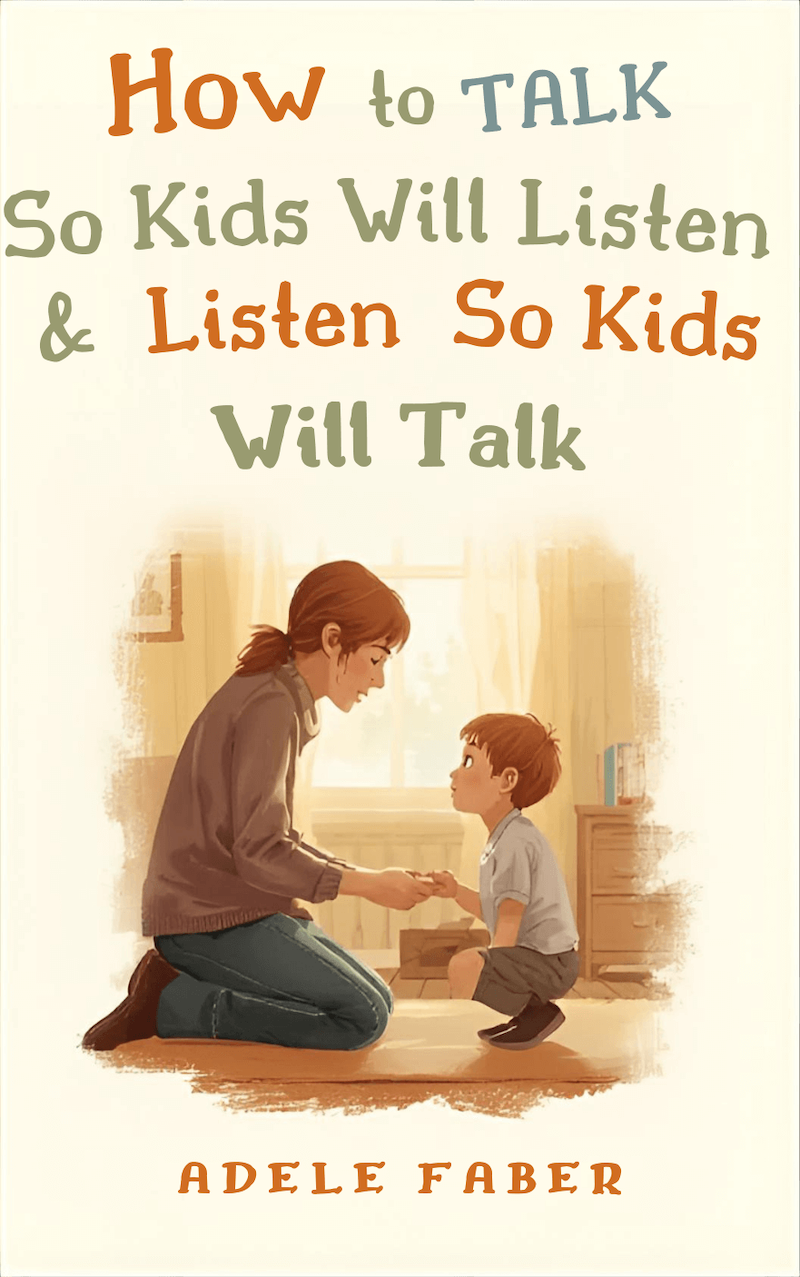
How to Talk So Kids Will Listen & Listen So Kids Will Talk Book Summary
This How to Talk So Kids Will Listen & Listen So Kids Will Talk Book Summary covers the key ideas, lessons, and takeaways in about 20 minutes.
Ultimately, the book is not just about getting kids to listen—it is about building relationships rooted in dignity and compassion. When children grow up hearing a voice of empathy instead of criticism, they internalize confidence and strength. The true measure of success is not compliance but character: raising children who know how to express feelings thoughtfully, solve problems creatively, and treat others with respect. These skills endure long beyond childhood and shape the adults they become.
Helps with these goals
Want the complete 20-minute summary?
- Full structured summary
- Video Summary
- Podcast Summary
- Audio summary
- Key takeaways
- Exercises
- Quiz
- Highlights and notes
- Ask the book with AI
What is in the How to Talk So Kids Will Listen & Listen So Kids Will Talk book summary?
Below is a preview of Sumizeit’s expert-written summary of How to Talk So Kids Will Listen & Listen So Kids Will Talk by Adele Faber. The full summary covers the book’s key ideas in text, audio, and video.
Adele Faber and Elaine Mazlish created a revolutionary parenting guide rooted in empathy, respect, and emotional intelligence. Their approach begins with a simple idea: children cooperate more willingly when they feel understood rather than controlled. Instead of relying on threats, punishment, and authority, parents can strengthen trust and create peaceful relationships by communicating thoughtfully. This perspective contrasts sharply with older disciplinary methods that depended heavily on obedience and command-based parenting, which often damaged relationships and left children feeling unseen.
The authors argue that a child’s behavior improves dramatically when the emotional climate around them is safe and empathetic. They teach parents how to listen to a child’s experience without shutting it down or rushing to correct it. When adults focus less on evaluation and more on connection, children become motivated from within and learn valuable skills like emotional regulation, cooperation, and independent problem solving.
At the core of Faber and Mazlish’s philosophy is the belief that how adults speak to children becomes the voice children internalize throughout life. Communication shapes identity. When a child hears messages like “You never listen,” they begin to believe that identity about themselves. When they hear, “You figured out a smart way to solve that problem,” they grow confident and capable. The authors strive to help parents use words that build strength rather than diminish potential.
Listening to and Validating Children’s Feelings
One of the foundational tools in the book is learning to acknowledge feelings instead of dismissing them. Many parents instinctively try to solve problems, reason with logic, or minimize uncomfortable emotions. A frustrated child crying about a friendship conflict might hear, “Don’t worry about it,” or “It’s not a big deal,” which only intensifies their distress because they feel unseen. Children want adults to understand the world from their vantage point before offering guidance.
Faber and Mazlish encourage parents to reflect back the emotion they observe: “You sound upset that you weren’t included.” “That must have felt embarrassing.” Acknowledging emotions helps children interpret their own internal world and feel safe enough to express it fully. Research cited in later psychological studies supports this: children whose parents validate emotions are better able to manage anger, anxiety, and frustration, and develop stronger overall mental health.
The authors stress avoiding comments that belittle, deny, or rationalize away a child’s pain. Phrases like “You’re being dramatic,” “You don’t really feel that way,” or “Stop crying,” teach children to mistrust their own emotional signals. When adults rush to fix, children learn that emotions must be shut down quickly rather than processed.
Sometimes empathy and imaginative play can help children cope with disappointment. If a child cries that they want ice cream before dinner, a parent could say, “I wish I had a magic button that gave us dessert whenever we wanted!” The playful response acknowledges longing without caving in, and it diffuses power struggles with humor rather than force.
Simply naming emotions is deeply comforting. The authors recommend phrases like: “You’re disappointed,” “You’re jealous,” “You’re nervous,” or “You’re…
Want the complete 20-minute summary?
- Full structured summary
- Video Summary
- Podcast Summary
- Audio summary
- Key takeaways
- Exercises
- Quiz
- Highlights and notes
- Ask the book with AI
Who should read How to Talk So Kids Will Listen & Listen So Kids Will Talk?
Parents, educators, and caregivers who want to move beyond power struggles and punishment. This book is ideal for anyone raising children from toddlers through adolescence who seeks practical communication strategies that build trust and cooperation. If you're frustrated by constant conflict or looking for a more respectful approach to discipline, this guide offers concrete tools you can use immediately.
Why does How to Talk So Kids Will Listen & Listen So Kids Will Talk matter?
In a world of increasing stress and disconnection, children need emotionally safe relationships more than ever. How to Talk So Kids Will Listen & Listen So Kids Will Talk by Adele Faber teaches parents that cooperation flows from understanding, not control, fundamentally shifting how families interact. The methods in this book transform homes from battlegrounds into places where children feel valued, heard, and capable of managing their own behavior. These skills don't just improve childhood—they shape the emotionally healthy adults children become.
What are the key themes in How to Talk So Kids Will Listen & Listen So Kids Will Talk?
- Emotional validation builds stronger relationships than dismissal or logic
- Children cooperate more willingly when they feel respected rather than controlled
- Communication shapes identity and self-belief throughout life
- Autonomy and choice are essential for developing confidence and resilience
- Collaborative problem-solving teaches responsibility better than punishment
- Labels and roles confine children to limiting identities
- Humor and imagination defuse conflict and create connection
- Parents modeling emotional awareness teaches children self-regulation
What are the key lessons from the How to Talk So Kids Will Listen & Listen So Kids Will Talk book summary?
Acknowledge Feelings Before Problem-Solving
Children need to feel heard and understood before they can listen to guidance. Reflecting back emotions like 'You sound frustrated' communicates that their inner world matters and helps them develop emotional vocabulary and self-awareness.
Describe Problems Instead of Accusing
Saying 'The toys are on the floor' invites the child to think and act, while 'You never clean up' triggers defensiveness and shame. Descriptive statements respect the child's intelligence and autonomy.
Offer Limited Choices to Build Autonomy
Presenting two reasonable options ('Now or after the book?') gives children a sense of control while maintaining parental boundaries. Autonomy reduces resistance and builds decision-making skills.
Use One-Word Reminders Instead of Lectures
Brief cues like 'Shoes' or 'Homework' are more effective than lengthy explanations because children's attention spans are limited. Short reminders allow children to fill in the reasoning themselves.
Avoid Labels That Shape Limiting Identity
Calling a child 'the messy one' or 'the shy one' creates a self-fulfilling prophecy. Children behave according to the identities assigned to them, so highlighting contradictory positive behaviors helps reshape how they see themselves.
Replace Punishment With Collaborative Problem-Solving
Involving children in creating solutions ('How can we fix this?') teaches responsibility and builds skills rather than breeding resentment. This method creates moral understanding instead of temporary compliance based on fear.
Model Emotional Honesty and Vulnerability
Expressing your own feelings without blame ('I feel frustrated when I'm interrupted') teaches children emotional maturity and assertiveness. Children internalize the communication patterns they witness in their parents.
Use Humor and Imagination to Interrupt Conflict Patterns
Playful approaches like racing the clock or pretending toys are lonely transform mundane tasks and defuse power struggles. Humor shifts both parent and child from adversarial to cooperative positions.
Express Belief in a Child's Capabilities
Statements like 'This is hard, and I believe you can do it' internalize strength and resilience. When parents communicate confidence in ability, children develop the courage to attempt challenges.
Allow Safe Struggle and Natural Consequences
Letting children experience the results of their choices (forgetting lunch, oversleeping) teaches more effectively than lectures. Failure becomes a learning tool rather than a source of shame when the emotional climate is supportive.
Give Information Instead of Criticism
Explaining 'Milk spoils if left on the counter' encourages internal reasoning, while criticizing creates defensiveness and shame. Educational messages help children develop wisdom for when adults aren't watching.
Acknowledge Longing Without Giving In
Fantasy statements like 'I wish I had a magic button for dessert anytime!' validate feelings while maintaining boundaries. This approach diffuses power struggles with empathy rather than force.
Write Notes Instead of Nagging
A lighthearted written reminder depersonalizes correction and reduces emotional tension. Notes make cooperation feel like teamwork rather than a battle of wills.
Validate Feelings Even When You Can't Change Circumstances
Saying 'That's disappointing' when you must deny a request acknowledges the child's experience without undermining your boundary. Validation and limits can coexist.
Let Children Seek Help Beyond Parents
Encouraging children to ask teachers, librarians, or friends for solutions expands their problem-solving resources. This builds independence and teaches that capable people exist in their wider world.
Share Observations When Children Overhear
Describing a child's positive behavior to another adult when they can listen ('She helped so patiently') strengthens self-esteem more effectively than direct praise. Overheard compliments feel more genuine and less conditional.
Separate the Child From the Behavior
Criticizing actions ('The book got torn') while respecting the child ('You care about your things') preserves dignity and connection. This distinction helps children learn without internalizing shame.
Follow Through on Limits With Kindness
Boundaries delivered with empathy ('I see you want to stay, and it's time to leave') teach respect for limits without evoking resistance. Firm and kind are not opposites.
Practice Self-Compassion When You Lose Patience
Apologizing and repairing after losing your temper ('I'm sorry I yelled; I was frustrated') models how to handle mistakes. Every interaction is an opportunity to improve, not a failure that defines your parenting.
Recognize That How You Speak Becomes Children's Inner Voice
Messages like 'You figured out a smart solution' become part of a child's self-talk. Words shape identity, so choosing language that builds strength rather than diminishes potential has lifelong impact.
Want the complete 20-minute summary?
- Full structured summary
- Video Summary
- Podcast Summary
- Audio summary
- Key takeaways
- Exercises
- Quiz
- Highlights and notes
- Ask the book with AI
How can you apply ideas from How to Talk So Kids Will Listen & Listen So Kids Will Talk?
- When a child is upset about a conflict, say 'You sound hurt that you weren't included' instead of 'Don't worry about it,' then wait for them to elaborate before offering solutions
- Replace morning commands with descriptive statements: instead of 'Get dressed!', point out 'It's 7:30 and we need to leave at 8' to invite independent problem-solving
- Use a simple written note on the refrigerator ('Please close me—Love, Your Fridge') to remind about chores without nagging or creating conflict
- During problem moments, ask 'How can we solve this?' and brainstorm ideas together without judgment before eliminating unrealistic options collaboratively
- When you feel frustrated, use 'I' statements: 'I feel tired and need quiet time' instead of blaming, modeling emotional honesty and vulnerability
- Offer limited choices in daily routines: 'Do you want to brush teeth before or after pajamas?' to build autonomy while maintaining structure
- Highlight moments that contradict negative labels: if a child is known for being forgetful, specifically acknowledge when they remember something important to reshape their self-image
- Use playful imagination during resistance: turn cleanup into a race against the clock or ask toys to 'go to their homes' instead of commanding with authority
What common mistakes do readers make with How to Talk So Kids Will Listen & Listen So Kids Will Talk?
- Dismissing or minimizing children's feelings with logic ('You shouldn't be sad, you have lots of friends') instead of validating emotions first, which prevents children from developing emotional awareness
- Relying on labels and roles that confine children to limiting identities, unintentionally creating self-fulfilling prophecies about who they believe they are
- Using punishment or consequences unrelated to the actual problem, which teaches fear rather than responsibility and damages the parent-child relationship
- Focusing exclusively on correcting behavior without understanding the feelings underneath, which leads to compliance through fear rather than genuine cooperation
- Rushing to solve children's problems instead of allowing them to struggle and problem-solve independently, which undermines their developing confidence and competence
Sumizeit Exercises Apply what you've learned
Turn ideas from How to Talk So Kids Will Listen & Listen So Kids Will Talk into action with a short guided reflection: identify the biggest takeaway, connect it to your life, and commit to one step you can take in the next 24 hours.
What is the expert analysis of How to Talk So Kids Will Listen & Listen So Kids Will Talk?
Overview
How to Talk So Kids Will Listen & Listen So Kids Will Talk is a seminal work in the field of parenting and communication authored by Adele Faber and Elaine Mazlish. Drawing on decades of educational experience and psychological insight, the book revolutionized traditional disciplinary approaches by emphasizing empathy, respect, and emotional intelligence in parent-child interactions. Its enduring influence stems from practical strategies that foster cooperation and emotional growth rather than obedience through control. Faber and Mazlish’s collaboration has left an indelible mark on modern parenting, counseling, and educational practices worldwide.
Core Thesis
The central argument of the book is that children respond most positively and develop healthiest emotional and social skills when they feel genuinely understood and respected rather than controlled or coerced. The authors assert that communication grounded in empathy and validation transforms the parent-child relationship from adversarial to collaborative. By listening attentively, acknowledging feelings, avoiding labels, and encouraging autonomy, adults nurture intrinsic motivation, emotional regulation, and problem-solving abilities in children. Ultimately, the way adults speak to children shapes their internal self-concept and lifelong capacity for healthy relationships.
Strengths
- Empathy-Centered Approach: The book excels in translating complex psychological principles into accessible, actionable techniques that parents can immediately apply.
- Practical Communication Tools: Strategies such as reflective listening, descriptive language, offering choices, and collaborative problem-solving are clearly illustrated and grounded in real-world scenarios.
- Focus on Emotional Validation: By prioritizing recognition of children’s feelings, the book aligns with contemporary developmental psychology emphasizing emotional intelligence as foundational to mental health.
- Promotion of Autonomy and Resilience: Encouraging children to struggle productively and make decisions fosters independence and self-confidence, which are essential for lifelong success.
- Balanced Tone: The authors’ use of humor, play, and creativity to defuse tension adds warmth and accessibility, making the guidance feel supportive rather than prescriptive.
Critiques & Counterarguments
- Potential Oversimplification: While the book provides valuable tools, some critics argue it underestimates the complexity of behavioral issues that may require more specialized interventions beyond communication techniques.
- Cultural and Socioeconomic Contexts: The strategies may not fully account for diverse cultural norms or socioeconomic realities where parental authority and discipline take different forms or where external stressors complicate ideal communication.
- Limited Discussion of Boundaries: The emphasis on empathy and autonomy might be seen by some as insufficiently addressing the need for clear limits and consequences in certain developmental stages or challenging behaviors.
- Competing Psychological Models: Approaches such as behaviorism or authoritative parenting models emphasize structure and consequences more explicitly, sometimes showing superior outcomes in certain contexts, challenging the universal applicability of Faber and Mazlish’s methods.
- Real-World Constraints: The ideal of patient, empathetic communication can be difficult to sustain consistently under parental fatigue, stress, or in families with multiple children, limiting the practicality for some caregivers.
Who Should Read This
This book is ideal for parents, caregivers, educators, and professionals invested in nurturing emotionally intelligent and cooperative children through respectful communication. It is particularly valuable for those seeking alternatives to authoritarian or punitive parenting styles and wishing to cultivate deeper, more trusting relationships with children. Additionally, counselors, social workers, and anyone involved in child development will find the insights and techniques beneficial for fostering empathy and autonomy in young people. Readers open to integrating psychological research with practical, compassionate guidance will appreciate this enduring classic.
Frequently asked questions about the How to Talk So Kids Will Listen & Listen So Kids Will Talk book summary
What is How to Talk So Kids Will Listen & Listen So Kids Will Talk about?
How to Talk So Kids Will Listen & Listen So Kids Will Talk by Adele Faber and Elaine Mazlish is a parenting guide that teaches communication strategies rooted in empathy, respect, and emotional intelligence. The book shows parents how to replace punishment and control with listening, validation, and collaborative problem-solving to build stronger relationships with their children. Rather than relying on threats or commands, the approach helps children cooperate willingly because they feel understood and respected.
Who should read How to Talk So Kids Will Listen & Listen So Kids Will Talk?
This book is ideal for parents, educators, and caregivers of children from toddlerhood through adolescence who want to move beyond power struggles and constant conflict. It's especially valuable for anyone frustrated with traditional punishment-based discipline or looking for practical, respectful communication strategies. Teachers, counselors, and anyone working with children will also benefit from the concrete tools and frameworks provided.
What are the main takeaways from How to Talk So Kids Will Listen & Listen So Kids Will Talk?
The main takeaways include: validate children's feelings before problem-solving, describe problems instead of accusing, offer limited choices to build autonomy, avoid limiting labels, replace punishment with collaborative solutions, and model emotional honesty. The core message is that children thrive when they feel understood and respected, and that cooperation flows from connection rather than control. How you speak to children becomes their inner voice, shaping their identity and self-belief throughout life.
How does validating feelings help with discipline?
Validating feelings teaches children emotional awareness and helps them feel safe enough to listen and cooperate. When you acknowledge a child's emotion before addressing behavior ('You're frustrated, and I need you to use words instead of hitting'), the child feels understood rather than attacked. This emotional safety allows them to access the part of their brain needed for learning and problem-solving, whereas dismissal or minimization triggers defensiveness and resistance.
What's the difference between punishment and problem-solving in this approach?
Punishment seeks to control behavior through fear or shame, often using unrelated consequences that don't teach understanding. Problem-solving invites children to participate in creating solutions, which teaches responsibility, builds negotiation skills, and preserves the relationship. Punishment stops behavior temporarily but damages connection; problem-solving develops internal discipline and moral reasoning that lasts.
How can parents avoid using limiting labels that harm children's self-image?
The book recommends acknowledging moments when children contradict negative labels: if a child is known as 'disorganized,' highlight when they successfully organized something. Avoid assigning roles based on birth order or perceived traits, and instead call attention to specific positive behaviors and choices. Describing what you observe without interpretation ('You remembered your backpack all week') helps children develop new, more capable self-perceptions.
Can these communication techniques work with teenagers?
Yes, the principles in How to Talk So Kids Will Listen & Listen So Kids Will Talk apply across ages, though implementation adjusts for developmental stages. Faber and Mazlish also co-authored How to Talk So Teens Will Listen & Listen So Teens Will Talk, which adapts these foundational strategies for adolescents. The core message—that respect, listening, and emotional validation are essential—remains powerful for teenagers navigating greater independence and identity formation.
What if I lose patience and yell at my child?
The book emphasizes self-compassion and the importance of repair. Apologizing genuinely when you lose patience ('I'm sorry I yelled; I was frustrated') models how to handle mistakes and shows children that relationships can recover from conflict. Every interaction is an opportunity to improve, not a defining moment of failure. Change takes practice, and progress over perfection is the goal.
About Sumizeit
Sumizeit is a profitable Scomy LLC company based in Miami, Florida. It has been helping readers learn from nonfiction books for 7 years with expert-written summaries in text, audio, podcast, and video.
Want the complete 20-minute summary?
- Full structured summary
- Video Summary
- Podcast Summary
- Audio summary
- Key takeaways
- Exercises
- Quiz
- Highlights and notes
- Ask the book with AI
Here's why readers love Sumizeit
Join thousands of learners getting smarter every day
"Great experience. Detailed summaries. Loved the gamification feature. Makes learning fun. Good customer service. I recommend Sumizeit to anyone. You'll learn a lot."
"I always felt busy but still wanting to keep up with the book discussion in my friend group. This was a great supplement to help me keep reading the books I find fun while keeping up with important books."
"I love this website. Instead of scrolling social media, I find myself learning a lot. I use it everyday. I recommend this app for anyone who is too busy and wants to get up to speed with their favorite books."
How to Talk So Kids Will Listen & Listen So Kids Will Talk Book Summary PDF
Looking for a How to Talk So Kids Will Listen & Listen So Kids Will Talk Book Summary PDF you can save and revisit offline? Our How to Talk So Kids Will Listen & Listen So Kids Will Talk Book Summary PDF captures the book’s core ideas in a clean, printable format — the key frameworks, takeaways, and structure without the fluff. Download the How to Talk So Kids Will Listen & Listen So Kids Will Talk Book Summary PDF when you want a reference you can annotate, share with your team, or review on the go. Get your How to Talk So Kids Will Listen & Listen So Kids Will Talk Book Summary PDF from the download page below.
Download How to Talk So Kids Will Listen & Listen So Kids Will Talk Book Summary PDFPeople also liked these summaries
Readers who explored How to Talk So Kids Will Listen & Listen So Kids Will Talk often enjoyed these titles next.





Want the complete 20-minute summary?
- Full structured summary
- Video Summary
- Podcast Summary
- Audio summary
- Key takeaways
- Exercises
- Quiz
- Highlights and notes
- Ask the book with AI
Featured Book Titles
Popular Book Summaries at sumizeit, leading book summary app
