


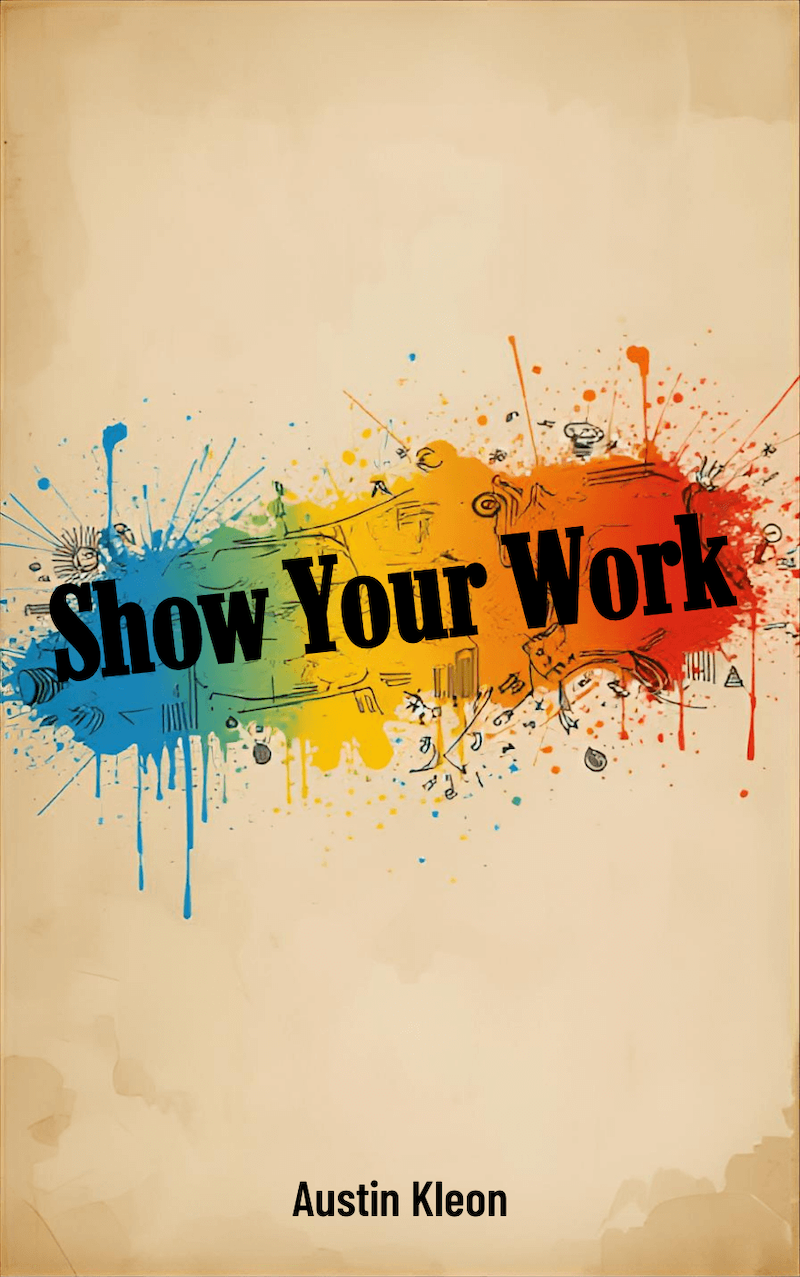
Show Your Work Book Summary
This Show Your Work Book Summary covers the key ideas, lessons, and takeaways in about 20 minutes.
Kleon believes that when creators share their process instead of hiding it, they open doors for collaboration, growth, and financial stability. Generosity becomes the most powerful form of promotion. When you help others, teach what you know, celebrate influences, and participate authentically, you become part of a creative network where everyone rises together. The message is simple: be open, be consistent, be generous, and keep going.
Helps with these goals
Want the complete 20-minute summary?
- Full structured summary
- Video Summary
- Podcast Summary
- Audio summary
- Key takeaways
- Exercises
- Quiz
- Highlights and notes
- Ask the book with AI
What is in the Show Your Work book summary?
Below is a preview of Sumizeit’s expert-written summary of Show Your Work by Austin Kleon. The full summary covers the book’s key ideas in text, audio, and video.
Austin Kleon’s Show Your Work! presents a transformative mindset shift for creative individuals who struggle with visibility, audience building, and self-promotion. Instead of hiding one’s creative efforts until something is polished and perfect, Kleon encourages sharing openly throughout the entire process—from the earliest experiments to the finished product. He argues that creativity is not a singular moment of brilliance but a continuous evolving journey that gains meaning when others can witness it unfold.
Many people feel uncomfortable promoting their work because they associate it with pushy sales behavior or self-centered bragging. Kleon reframes self-promotion not as showing off, but as showing generosity. By sharing what you learn, what you try, and what you struggle with, you give people value, which naturally attracts support. Audiences are more fascinated by the story behind work than by the polished outcome alone. A painting becomes more meaningful when viewers see the layers beneath the final strokes. A novel becomes more powerful when readers understand how many drafts and revisions were thrown away. The creative process is where connection happens, not the final reveal.
Learning in Public and Using Progress as a Strength
Kleon argues that people do not need to wait until they are experts to share their work. In fact, beginners often attract more enthusiasm because they are relatable and inspiring. People enjoy watching growth and cheering for improvement. When creators share their learning process publicly, they invite conversation, feedback, and emotional investment. This helps them improve faster while simultaneously building an audience.
Sharing work-in-progress also aids personal development through the practice of deliberate documentation. When you record your progress through notes, photos, videos, and written reflections, you create a trail that becomes a learning mirror. You can analyze what worked and what failed. You can track patterns and identify techniques that consistently lead to improvement. This habit is similar to the deliberate practice model described in performance psychology, where excellence is achieved through consistent evaluation, structured feedback, and intentional adjustment.
Perfectionism is one of the greatest enemies of creativity. Perfectionists wait until they feel “good enough,” which often means never starting at all. Kleon encourages replacing perfectionism with curiosity—focusing not on being better than others, but on discovering what is uniquely yours. Your voice, your background, and your interpretation make your work unlike anyone else’s. Even if a topic has been explored countless times, no one has explored it the way you would.
Building Genuine Relationships Through Sharing
Kleon emphasizes that creativity is an inherently social act rather than a solitary pursuit. Every piece of work reflects the influence of other artists, teachers, and thinkers. Instead of hiding inspirations, he recommends celebrating them openly. When you share the people, ideas, and sources that shape your creative thinking, you attract others who share similar interests. This becomes the basis for friendship, collaboration, mentorship, and opportunity.
Kleon introduces the idea of scenius —a collective genius that emerges from communities rather than from lone inventors.
Want the complete 20-minute summary?
- Full structured summary
- Video Summary
- Podcast Summary
- Audio summary
- Key takeaways
- Exercises
- Quiz
- Highlights and notes
- Ask the book with AI
Who should read Show Your Work?
Show Your Work is ideal for creative professionals, artists, writers, and entrepreneurs who struggle with self-promotion or feel their work isn't ready to share. If you're hiding your creative process until it's perfect, or you want to build an audience and attract opportunities through authentic engagement, this book offers a practical roadmap. It's equally valuable for beginners and established creators seeking to connect more deeply with their community.
Why does Show Your Work matter?
In an age of social media algorithms and constant digital noise, Show Your Work by Austin Kleon challenges the myth that success requires perfection and isolation. The book reveals how transparency, consistency, and generosity—not polished gatekeeping—are the real drivers of creative visibility and opportunity. As more people compete for attention online, understanding how to document your process and build genuine relationships has become essential for sustainable creative careers.
What are the key themes in Show Your Work?
- Sharing process over perfection
- Learning and growth in public
- Generosity as a form of marketing
- Community and scenius over isolated genius
- Documentation as a creative tool
- Consistency and momentum
- Authenticity and vulnerability
- Building personal platforms and independence
What are the key lessons from the Show Your Work book summary?
Perfectionism is creativity's biggest enemy
Waiting until your work is perfect often means never sharing at all. Kleon encourages replacing perfectionism with curiosity and progress, allowing your unique voice to emerge through continuous output rather than endless refinement.
The creative process is more valuable than the final product
People connect with the story behind your work—the struggles, experiments, and revisions—far more than the polished outcome alone. Showing the messy middle makes your work more human and relatable.
You don't need to be an expert to share
Beginners often attract more engagement than experts because growth and improvement are inherently inspiring. Your beginner's perspective and relatability can be your greatest asset.
Scenius beats the myth of the isolated genius
Groundbreaking work emerges from communities and networks, not solitary brilliance. By showing your work and celebrating influences, you position yourself within a creative ecosystem where everyone rises together.
Documentation creates deliberate learning
Recording your progress through photos, notes, and reflections acts as a mirror for self-improvement. This habit of deliberate documentation accelerates learning and helps you identify patterns in what works.
Sharing is an act of generosity, not bragging
Reframe self-promotion as giving value to others through your insights, experiments, and discoveries. When you teach and share what you learn, you attract support naturally rather than pushing it.
Consistency builds momentum faster than sporadic breakthroughs
Regular, rhythmic sharing—daily, weekly, or on a predictable schedule—trains both you and your audience while accumulating ideas into larger forms like books or exhibitions. Small daily progress compounds over time.
Your unique perspective is your competitive advantage
No one else can see the world through your lens or combine your influences the way you do. Your background, voice, and interpretation make your work inherently different, even if the topic has been explored before.
Quality connections matter more than follower count
A small, loyal audience that genuinely cares is far more valuable than thousands of passive observers. Build relationships based on shared enthusiasm rather than chasing vanity metrics.
Visibility opens doors that talent alone cannot
Opportunities arise because people have seen clear evidence of your passion and ability. A sketch posted online leads to commissions, a blog post attracts editors, and consistent sharing creates a living portfolio that others can trust.
Own your platform to protect your independence
While social media is useful for discovery, algorithms change and platforms collapse. Build a personal website and email list as permanent homes for your work where you control your identity and direct audience relationships.
Context transforms objects into meaningful experiences
People value things more deeply when they understand the story, origin, and thought behind them. Surrounding your work with context through storytelling creates emotional connection rather than mere observation.
Embrace your amateur status and curiosity
The word amateur comes from amator, meaning lover. Amateurs innovate because they're unafraid to look foolish and remain curious rather than protective. Staying curious prevents creative stagnation.
Criticism is inevitable; make it less powerful through volume
The best defense against negativity is consistent output. When you create and release work regularly, negative feedback loses its sting because you're always moving forward.
Authenticity requires protecting sensitive boundaries
While sharing your process, you can choose what to keep private. Healthy sharing involves separating your identity from your output so criticism doesn't become personal.
Generosity should remain foundational as you grow
Promote peers, share resources, highlight influences, and help younger creators. Generosity produces reciprocity and strengthens the creative ecosystem, though you must maintain boundaries to avoid burnout.
Perseverance trumps talent as the key to creative success
Most breakthroughs result from persistence rather than innate genius or luck. The ability to keep showing up and moving from one project to the next determines long-term success.
Embarrassment about past work signals growth
If your old work looks terrible, you've improved. This means you're not starting over each time—you're stepping upward with each new project and iteration.
Monetization supports rather than threatens creativity
Earning money through your creative work is ethical and necessary. Multiple paths exist—donations, products, memberships, teaching, commissions—and transparency matters more than the method you choose.
Authentic participation builds community faster than self-promotion
You earn attention by giving attention. Contribute meaningfully, support peers, and become a good citizen in your creative community—this reciprocal approach attracts genuine support.
Want the complete 20-minute summary?
- Full structured summary
- Video Summary
- Podcast Summary
- Audio summary
- Key takeaways
- Exercises
- Quiz
- Highlights and notes
- Ask the book with AI
How can you apply ideas from Show Your Work?
- Start a daily or weekly sharing practice on your chosen platform—document your process through photos, sketches, notes, or short written updates to build consistency and visibility
- Create a personal website or blog as your primary platform, using social media as a funnel to drive people to your owned space where you control your archive and messaging
- Document your learning by keeping a creative journal or digital log that records tools, methods, experiments, and what you discover—review it regularly to spot patterns and accelerate improvement
- Build and nurture an email list by offering something valuable in exchange for subscribers, creating direct access to your audience independent of algorithm changes
- Tell the story behind your work by writing process posts, behind-the-scenes content, or reflections on your challenges and breakthroughs to deepen emotional connection with your audience
- Celebrate influences and mentor relationships by publicly crediting and promoting the creators, teachers, and thinkers who shaped your work—this builds reciprocal relationships within your creative community
- Set a regular monetization strategy aligned with your values—whether through donations, products, teaching, commissions, or memberships—and communicate the value transparently
- Establish healthy boundaries by deciding what aspects of your life to keep private while maintaining authentic vulnerability in your creative sharing
What common mistakes do readers make with Show Your Work?
- Waiting for perfection before sharing, which often results in never releasing work at all and missing opportunities for feedback and connection
- Treating social media as your primary platform and ignoring the importance of owning your space through a personal website or email list
- Only promoting your own work without genuinely engaging with and supporting the creative community, which limits reciprocal relationships and makes self-promotion feel hollow
- Sharing inconsistently or sporadically instead of establishing a reliable rhythm, which fails to build momentum or train your audience to expect your work
Sumizeit Exercises Apply what you've learned
Turn ideas from Show Your Work into action with a short guided reflection: identify the biggest takeaway, connect it to your life, and commit to one step you can take in the next 24 hours.
What is the expert analysis of Show Your Work?
Overview
Show Your Work! by Austin Kleon is a seminal contribution to contemporary creativity literature, bridging the gap between artistic practice and audience engagement in the digital age. Kleon, an accomplished author and illustrator known for his insightful exploration of creativity’s social dimensions, offers a compelling manifesto for transparency and generosity in the creative process. Positioned as the second installment in his creativity trilogy, this work builds on his earlier ideas about influence and originality, expanding them into practical guidance for creators seeking visibility without compromising authenticity.
Core Thesis
Kleon’s central argument is that creative success is less about solitary genius or polished final products and more about the continuous act of sharing one’s evolving work openly and generously. He reframes self-promotion as an act of generosity, where revealing the messy, imperfect journey invites connection, feedback, and community. By “showing your work,” creators transform the creative process into a social, participatory experience that fosters growth, opportunity, and sustainable creative careers.
Strengths
- Reframing Self-Promotion: Kleon skillfully dismantles the stigma around self-promotion by positioning it as generosity rather than bragging, which is a psychologically and culturally resonant insight.
- Practical Framework: The book offers concrete, actionable advice such as documenting progress, sharing consistently, and building digital independence, making its philosophy accessible and implementable.
- Integration of Psychological Concepts: By connecting ideas like deliberate practice and the social nature of creativity (scenius), Kleon grounds his recommendations in established research and cultural history.
- Emphasis on Community and Reciprocity: The focus on authentic participation and mutual support counters the isolation myth of creativity and aligns with contemporary understandings of networked knowledge and collaboration.
- Encouragement of Amateur Spirit: Celebrating curiosity and imperfection democratizes creativity, empowering beginners and reducing barriers to entry.
Critiques & Counterarguments
- Overreliance on Digital Platforms: While Kleon advocates for owning one’s platform, much of the book’s examples and strategies hinge on social media dynamics, which can be volatile, algorithm-driven, and exclusionary, potentially disadvantaging creators without digital literacy or access.
- Romanticizing Transparency: The insistence on sharing all stages of work may not suit all creative fields or personalities; some creators require privacy or incubation periods to develop ideas fully before exposure, a nuance underexplored in the text.
- Limited Address of Structural Barriers: Kleon’s model presumes a level playing field where generosity and visibility naturally lead to opportunity, but systemic inequalities related to race, class, gender, and geography can impede access and recognition regardless of openness.
- Competing Research on Creativity and Privacy: Some psychological studies emphasize the importance of solitude and focused, uninterrupted work for deep creativity, challenging the notion that constant sharing is universally beneficial.
- Potential for Burnout and Overexposure: The encouragement of relentless sharing and engagement risks creative exhaustion and blurring of personal boundaries, issues that contemporary discourse on creator wellbeing increasingly highlights.
Who Should Read This
Show Your Work! is ideally suited for emerging and mid-career creators—artists, writers, designers, and entrepreneurs—who grapple with the challenge of gaining visibility without compromising authenticity. It is equally valuable for those interested in the intersection of creativity, digital culture, and personal branding. Readers seeking a psychologically informed, practical, and optimistic approach to building creative communities and sustainable careers will find Kleon’s work both inspiring and instructive. However, those who prefer a more private or traditional creative process, or who face significant structural barriers, should approach the book’s prescriptions with critical reflection.
Frequently asked questions about the Show Your Work book summary
What is Show Your Work about?
Show Your Work by Austin Kleon is a guide to building creative visibility and opportunity through transparency, consistency, and generosity. The book argues that sharing your creative process—not just finished products—attracts audience engagement, accelerates learning, and opens doors to collaboration and financial support. Rather than hiding work until it's perfect, Kleon encourages creators to document and share their journey, turning vulnerability into strength.
Who should read Show Your Work?
Show Your Work is essential reading for artists, writers, entrepreneurs, designers, and any creative professional who struggles with visibility or self-promotion. It's valuable for beginners who feel they're not ready to share, established creators seeking deeper audience connection, and anyone wanting to build a sustainable creative career. The book is accessible to anyone interested in understanding how authenticity and consistency drive creative success.
What are the main takeaways from Show Your Work?
The core takeaways include: share your process, not just finished products; consistency matters more than perfection; generosity and community-building are more effective than pushy self-promotion; document your work to accelerate learning; own your platform through personal websites and email lists; and build an audience through authentic engagement rather than chasing vanity metrics. The fundamental message is that creative success comes from showing up regularly, being vulnerable, and helping others.
How can I start sharing my work if I'm afraid of criticism?
Kleon suggests separating your identity from your output so criticism doesn't feel personal, and protecting sensitive areas of your life by choosing what to share. The best defense against criticism is volume—when you create and release work consistently, negative feedback loses power. Start by sharing small, low-stakes pieces to build confidence, remember that constructive feedback often contains useful truth, and simply ignore trolls and negativity rather than engaging with them.
Is it better to focus on growing a large audience or building quality relationships?
Quality relationships matter far more than follower count according to Show Your Work. A small, loyal audience that genuinely cares about your work is significantly more valuable than thousands of passive observers. Kleon emphasizes that meaningful opportunities and support arise from people who are emotionally invested in your journey, not from maximizing numbers.
Should I rely on social media or build my own platform?
While social media is useful for discovery, Show Your Work strongly recommends owning your platform through a personal website as your primary home. Algorithms change, platforms collapse, and visibility disappears without warning. Build a personal website and email list where you control your identity, archive, and direct relationships with your audience—use social media as a funnel to drive people to your owned space.
Can I make money from sharing my creative process?
Yes. Show Your Work encourages creators to monetize their work through multiple methods: donations, handmade products, digital assets, subscriptions, teaching, commissions, licensing, memberships, consulting, courses, or speaking. Kleon stresses that earning money supports creativity rather than threatens it, and transparency and fairness are essential. Charging for your work demonstrates belief in its value.
About Sumizeit
Sumizeit is a profitable Scomy LLC company based in Miami, Florida. It has been helping readers learn from nonfiction books for 7 years with expert-written summaries in text, audio, podcast, and video.
Want the complete 20-minute summary?
- Full structured summary
- Video Summary
- Podcast Summary
- Audio summary
- Key takeaways
- Exercises
- Quiz
- Highlights and notes
- Ask the book with AI
Here's why readers love Sumizeit
Join thousands of learners getting smarter every day
"Great experience. Detailed summaries. Loved the gamification feature. Makes learning fun. Good customer service. I recommend Sumizeit to anyone. You'll learn a lot."
"I always felt busy but still wanting to keep up with the book discussion in my friend group. This was a great supplement to help me keep reading the books I find fun while keeping up with important books."
"I love this website. Instead of scrolling social media, I find myself learning a lot. I use it everyday. I recommend this app for anyone who is too busy and wants to get up to speed with their favorite books."
Show Your Work Book Summary PDF
Looking for a Show Your Work Book Summary PDF you can save and revisit offline? Our Show Your Work Book Summary PDF captures the book’s core ideas in a clean, printable format — the key frameworks, takeaways, and structure without the fluff. Download the Show Your Work Book Summary PDF when you want a reference you can annotate, share with your team, or review on the go. Get your Show Your Work Book Summary PDF from the download page below.
Download Show Your Work Book Summary PDFPeople also liked these summaries
Readers who explored Show Your Work often enjoyed these titles next.


Want the complete 20-minute summary?
- Full structured summary
- Video Summary
- Podcast Summary
- Audio summary
- Key takeaways
- Exercises
- Quiz
- Highlights and notes
- Ask the book with AI
Featured Book Titles
Popular Book Summaries at sumizeit, leading book summary app
