


As an Amazon Associate, Sumizeit earns from qualifying purchases.
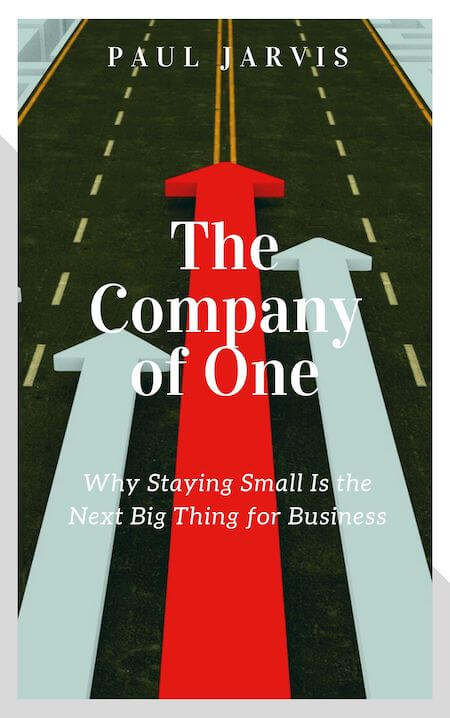
Company of One Book Summary
This Company of One Book Summary covers the key ideas, lessons, and takeaways in about 20 minutes.
A company of one prioritizes profit over growth. Starting small with a simple idea and launching it as quickly as possible to begin generating revenue is the first step. Products and services can always be expanded later.
Your approach is not to think of what “more” you can add whenever there’s an issue. Instead, you think of creative ways to solve problems. When you need to pivot, you do it without wasting time dealing with hierarchy. With everything your company of one does, you’re able to be nimble without the bureaucracy to deal with.
Of course, there are challenges. Only you can make yourself work, which is critical to your company of one succeeding. The regular company needs like accounting don’t go away just because that’s not your expertise. You have to find ways to meet all the business needs without drowning in additional expenses and more overhead.
But you’re poised to compete well. You have a lean operation. If you can resonate with customers, you’re on your way. Tell people your story and connect with them. Build their trust through great work and listening to their feedback. Then use networks to keep your business growing even if it stays a company of one.
Helps with these goals
Want the complete 20-minute summary?
- Full structured summary
- Video Summary
- Podcast Summary
- Audio summary
- Key takeaways
- Exercises
- Quiz
- Highlights and notes
- Ask the book with AI
What is in the Company of One book summary?
Below is a preview of Sumizeit’s expert-written summary of Company of One by Paul Jarvis. The full summary covers the book’s key ideas in text, audio, and video.
Most people who start a company are thinking about how they can make it bigger. Success is determined by having more of everything. You want more employees, more customers, more office space, and (of course) more profit.
Company of One challenges the push to have more, cautioning against the higher costs and lower control that come with growth. If you keep your business small, you are more agile. You also have more autonomy over your day inside and outside of work.
If you’re interested in being a company of one, you have to distinguish it from a freelance career. While both have the freedom to decide how much to work, a freelancer doesn’t get paid unless they work. A company will be able to make money even when you’re not working.
More isn’t always better.
The focus of a company of one is not growth. Many organizations have their sights set on becoming large operations. That means hiring more staff to cover marketing, accounting, legal, human resources, and more. These organizations will put more money into real estate for offices and technology to have cutting-edge tools and systems.
A company of one takes a different approach. You purposefully start small and scale very carefully. When there are issues, you don’t believe that putting “more” into the problem is necessarily the solution. Instead, you use the autonomy that comes with being a lean operation to your advantage.
A company of one doesn’t just have to be one person.
It may feel like a misnomer, but the principles of a company of one aren’t limited to a single-person business. It is about the mindset more than the actual organizational structure. This means that you can be a company of one even if you work at a large organization.
Questioning whether or not growth is the solution is the key to being a “company of one.” As a company that just has you or a small number of employees, you keep the organization from growing unnecessarily even if that means not taking on additional clients. If you’re a company of one within a large organization, you also question growth and keep your part of the operation lean.
Done well, a company of one is efficient and offers simplicity and autonomy.
When there’s just you at the company, you have to be good at what you do. There’s no safety net or a team of people to pick up the slack. If you’re going to set out to be a company of one, it is helpful if you have experience in traditional companies building your skills.
For example, a digital strategist works for five years with an agency before hanging out her shingle. She is an expert in what she does, but she has also discovered how she works best. This includes the time of day that is best for her to do the actual work and when she can do other things like taking meetings.
Understanding how you work best and operating around…
Want the complete 20-minute summary?
- Full structured summary
- Video Summary
- Podcast Summary
- Audio summary
- Key takeaways
- Exercises
- Quiz
- Highlights and notes
- Ask the book with AI
Who should read Company of One?
Company of One is ideal for entrepreneurs, freelancers, and small business owners who want to build profitable ventures without the pressure to constantly expand. It's also valuable for employees within large organizations who want to adopt a lean, autonomous mindset in their roles. If you're skeptical about the traditional growth-at-all-costs model or seeking better work-life balance, this book offers a refreshing alternative.
Why does Company of One matter?
In today's economy, the myth that bigger is always better is being challenged by successful solo entrepreneurs and small teams. Company of One by Paul Jarvis provides a blueprint for profitability and sustainability without the bloat of traditional corporate structures. As remote work and freelancing become mainstream, understanding how to thrive as a lean operation has become essential knowledge for modern business builders.
What are the key themes in Company of One?
- Profitability over growth
- Autonomy and control in business
- Lean operations and efficiency
- Self-motivation and accountability
- Personal touch and customer relationships
- Strategic saying no
- Agility without bureaucracy
- Creative problem-solving
What are the key lessons from the Company of One book summary?
More isn't the answer to every problem
Instead of automatically throwing more resources, people, or technology at challenges, a company of one questions whether growth actually solves the issue. Lean operations force creative, efficient solutions.
The company of one is a mindset, not just a structure
You can operate with company-of-one principles even within a large organization by questioning unnecessary growth and keeping operations lean. It's about how you think, not solely about headcount.
Define your minimum viable profit before launch
Instead of betting on future profitability after growth, identify the specific revenue threshold you need to become profitable and structure your costs to reach that mark quickly.
Launch quickly with a simple solution
You don't need a groundbreaking idea to succeed—solve a real problem people have or improve something that already exists. Speed to market matters more than perfection.
Your size is a competitive advantage
Direct customer interaction, personal touches, and the ability to make decisions without approval chains are benefits only small operations can offer. Exploit these strengths.
Self-motivation is non-negotiable
Without a boss or team structure to keep you accountable, your internal drive is what determines success. You must be capable of managing your own productivity and discipline.
Optimize your personal productivity
Conduct regular audits of how you spend your time, eliminate low-value tasks, automate what you can, and design your work environment to minimize distractions and maximize focus.
Learning to say no keeps you sane and profitable
Set a financial target range and only accept work that keeps you within that band. Being selective about projects preserves your autonomy and prevents burnout.
Networks are your marketing and funding engine
Word-of-mouth and referrals from your existing network are more effective and cheaper than traditional marketing. Crowdfunding preserves ownership better than venture capital if you need funding.
Being self-employed carries less risk than working for a large company
While any business has risk, large companies face constant pressures from ownership changes, layoffs, and high overhead. A lean operation is often more stable than it appears.
You need systems for the parts you're not skilled at
Accounting, marketing, and sales still matter even if they're not your core strength. Plan to outsource or systematize these functions to avoid them becoming financial drains.
Agility is built into small operations
Without bureaucracy or complicated approval chains, you can pivot quickly when customers need something different. This responsiveness is a core strength of companies of one.
Your story and personality are marketing assets
Share your authentic purpose and the compelling narrative of how you built your company. Customers connect with real people and their values more than faceless corporations.
Listen to customers to improve and attract more
Understanding why customers chose you over competitors provides actionable insights. This feedback loop drives both product improvement and referral generation.
Build trust through genuine connection
About 83% of new business comes from word-of-mouth referrals. People support businesses they trust, so authenticity and genuine care for customer success are critical investments.
Work smarter by understanding how you operate best
Identify your peak productivity hours, best working conditions, and ideal task sequencing. Structure your company around how you naturally work best for maximum efficiency.
Profitability compounds when you stay lean
Lower overhead costs mean you reach profitability faster and can reinvest profits more effectively. This creates sustainable growth without constant external funding.
Crowdfunding may be better than venture capital depending on your demographics
Venture capital requires giving up autonomy and control, while crowdfunding lets you retain ownership. Women on Kickstarter perform better than men, making it a strategic choice for some founders.
Focus on delivering quality work to become more competitive
When there's no team to rely on, excellence in your core service becomes your primary differentiator and reputation builder.
Want the complete 20-minute summary?
- Full structured summary
- Video Summary
- Podcast Summary
- Audio summary
- Key takeaways
- Exercises
- Quiz
- Highlights and notes
- Ask the book with AI
How can you apply ideas from Company of One?
- Calculate your minimum viable profit and work backward to set expenses that get you there quickly
- Conduct a quarterly productivity audit to identify time-wasting tasks and opportunities to automate or eliminate
- Create a personal brand story that explains your purpose and values, then share it consistently across your marketing
- Build a waiting list or advance booking system to say no to projects outside your target profit range
- Set up a simple feedback system to learn why customers chose you and share those insights in marketing
- Design your workspace and work schedule around when you're most productive, not around traditional office hours
- Leverage your existing network first for business development before investing in paid marketing
- Document and systematize non-core tasks like accounting and legal to reduce their burden on your time and budget
What common mistakes do readers make with Company of One?
- Assuming that growth is always the solution to business challenges instead of seeking creative efficiency
- Launching with a perfect product instead of getting a simple solution to market quickly to start generating revenue
- Overcommitting to clients and projects without setting and enforcing a profit target range
- Neglecting the business fundamentals like accounting and marketing because they're not your passion, letting them drain resources
- Failing to build genuine relationships with customers and instead treating them transactionally
- Underestimating the self-discipline required to stay productive without external accountability structures
Sumizeit Exercises Apply what you've learned
Turn ideas from Company of One into action with a short guided reflection: identify the biggest takeaway, connect it to your life, and commit to one step you can take in the next 24 hours.
What is the expert analysis of Company of One?
Overview
Company of One by Paul Jarvis emerges as a significant contribution to contemporary business literature by challenging the conventional paradigm that equates success with relentless growth. Jarvis, a seasoned writer and designer with extensive experience consulting for major corporations and high-profile clients, distills his insights into a manifesto for sustainable, autonomous entrepreneurship. His own embodiment of the "company of one" ethos lends authenticity and practical grounding to the work, making it a compelling read for those disillusioned with traditional corporate trajectories.
Core Thesis
At its core, Company of One posits that smaller, intentionally lean businesses can outperform larger, growth-obsessed companies by prioritizing autonomy, agility, and profitability over expansion. Jarvis argues that growth often introduces complexity, higher costs, and diminished control, which can undermine a company's core mission and the entrepreneur’s quality of life. Instead, by maintaining a small scale, entrepreneurs can foster efficiency, direct client relationships, and creative problem-solving, ultimately achieving a sustainable and fulfilling business model.
Strengths
- Innovative Reframing of Success: Jarvis compellingly reframes success away from traditional metrics of size and scale toward autonomy and profitability, resonating with a growing audience seeking alternative business models.
- Practical Guidance: The book offers actionable strategies such as defining minimum viable profit, conducting productivity audits, and leveraging networks for growth without sacrificing independence.
- Authentic Voice: Jarvis’s personal experience as a solo entrepreneur enriches the narrative, providing credibility and relatable insights that ground theoretical concepts in real-world practice.
- Holistic Perspective: The work integrates psychological and operational considerations, emphasizing self-motivation, discipline, and work-life balance alongside business tactics.
- Challenging Conventional Wisdom: By questioning the assumption that "more is better," the book invites readers to critically evaluate growth as an unqualified good, a valuable intellectual provocation.
Critiques & Counterarguments
- Oversimplification of Growth Dynamics: While Jarvis rightly critiques indiscriminate growth, the book sometimes underestimates the strategic benefits of scaling, such as economies of scale, market influence, and resilience through diversification.
- Limited Scope of Applicability: The model predominantly suits knowledge-based, digital, or creative industries. Capital-intensive or highly regulated sectors may find the "company of one" approach less feasible or sustainable.
- Potential Underestimation of Risk: The narrative downplays the challenges of solo entrepreneurship, particularly the burden of managing all business functions, which can lead to burnout or operational blind spots without adequate support.
- Competing Research on Team Dynamics: Organizational psychology and management studies often highlight the innovation and problem-solving advantages of diverse teams, which a company of one might lack.
- Real-World Evidence of Growth Benefits: Many successful startups leverage growth to attract investment, talent, and market share, enabling them to outcompete smaller rivals; this dynamic is somewhat marginalized in Jarvis’s thesis.
Who Should Read This
Company of One is ideally suited for independent entrepreneurs, freelancers contemplating formalizing their operations, and professionals disenchanted with corporate hierarchies seeking autonomy without sacrificing profitability. It also appeals to readers interested in sustainable business practices and those exploring alternative economic models that prioritize quality of work and life over sheer expansion. Additionally, intrapreneurs within larger organizations who wish to cultivate lean, agile teams may find valuable insights here.
Frequently asked questions about the Company of One book summary
What is Company of One about?
Company of One by Paul Jarvis is about building profitable, sustainable businesses that prioritize efficiency and autonomy over growth. The book challenges the traditional assumption that bigger is always better, showing how staying small allows entrepreneurs to be more agile, maintain control, and reach profitability faster while enjoying better work-life balance.
Who should read Company of One?
Entrepreneurs and freelancers considering launching their own ventures should read this book, as well as anyone working in a large organization who wants to adopt lean, autonomous thinking. It's valuable for people skeptical of the growth-at-all-costs mentality and those seeking to build sustainable, profitable businesses without traditional corporate structures.
What are the main takeaways from Company of One?
The key takeaways include prioritizing profitability over growth, launching quickly with simple solutions, leveraging your size as a competitive advantage through personal connection with customers, and learning to say no to maintain balance. Paul Jarvis emphasizes that success doesn't require a large team—it requires self-motivation, efficiency, and the ability to solve problems creatively without bureaucracy.
Can a company of one make good money?
Yes, according to the US Census Bureau data cited in the book, the number of self-employed people without employees who generate at least $1 million annually is growing. By focusing on profitability from the start, minimizing overhead, and leveraging networks and word-of-mouth referrals, companies of one can build highly profitable ventures.
Is it risky to start a company of one?
While starting your own business carries risk, the book argues that working for large corporations also carries significant risk through layoffs, ownership changes, and instability. A lean company of one often faces fewer financial pressure points than bloated organizations and can be more stable if you manage costs carefully and build a sustainable customer base.
How do you grow a company of one if you want to?
Company of One doesn't prohibit growth—it questions whether growth is always necessary. If you choose to expand, the book suggests doing so intentionally and carefully rather than automatically. You can grow through building strong customer relationships, generating word-of-mouth referrals, and reinvesting profits into areas that serve your existing clients better.
What is minimum viable profit and why does it matter?
Minimum viable profit is the specific revenue threshold at which your business becomes profitable. It's central to company-of-one thinking because it forces you to set expenses strategically and launch quickly rather than waiting for growth to justify costs. Knowing this number helps you say no to unprofitable work and make decisions aligned with sustainability.
Can you operate as a company of one within a large organization?
Yes, Company of One emphasizes that it's a mindset more than a structure. Even within a large company, you can question whether growth is the answer to problems, operate with lean thinking, and maintain autonomy in your department or role by resisting unnecessary expansion.
About Sumizeit
Sumizeit is a profitable Scomy LLC company based in Miami, Florida. It has been helping readers learn from nonfiction books for 7 years with expert-written summaries in text, audio, podcast, and video.
Want the complete 20-minute summary?
- Full structured summary
- Video Summary
- Podcast Summary
- Audio summary
- Key takeaways
- Exercises
- Quiz
- Highlights and notes
- Ask the book with AI
Here's why readers love Sumizeit
Join thousands of learners getting smarter every day
"Great experience. Detailed summaries. Loved the gamification feature. Makes learning fun. Good customer service. I recommend Sumizeit to anyone. You'll learn a lot."
"I always felt busy but still wanting to keep up with the book discussion in my friend group. This was a great supplement to help me keep reading the books I find fun while keeping up with important books."
"I love this website. Instead of scrolling social media, I find myself learning a lot. I use it everyday. I recommend this app for anyone who is too busy and wants to get up to speed with their favorite books."
Company of One Book Summary PDF
Looking for a Company of One Book Summary PDF you can save and revisit offline? Our Company of One Book Summary PDF captures the book’s core ideas in a clean, printable format — the key frameworks, takeaways, and structure without the fluff. Download the Company of One Book Summary PDF when you want a reference you can annotate, share with your team, or review on the go. Get your Company of One Book Summary PDF from the download page below.
Download Company of One Book Summary PDFPeople also liked these summaries
Readers who explored Company of One often enjoyed these titles next.





Want the complete 20-minute summary?
- Full structured summary
- Video Summary
- Podcast Summary
- Audio summary
- Key takeaways
- Exercises
- Quiz
- Highlights and notes
- Ask the book with AI
Featured Book Titles
Popular Book Summaries at sumizeit, leading book summary app