


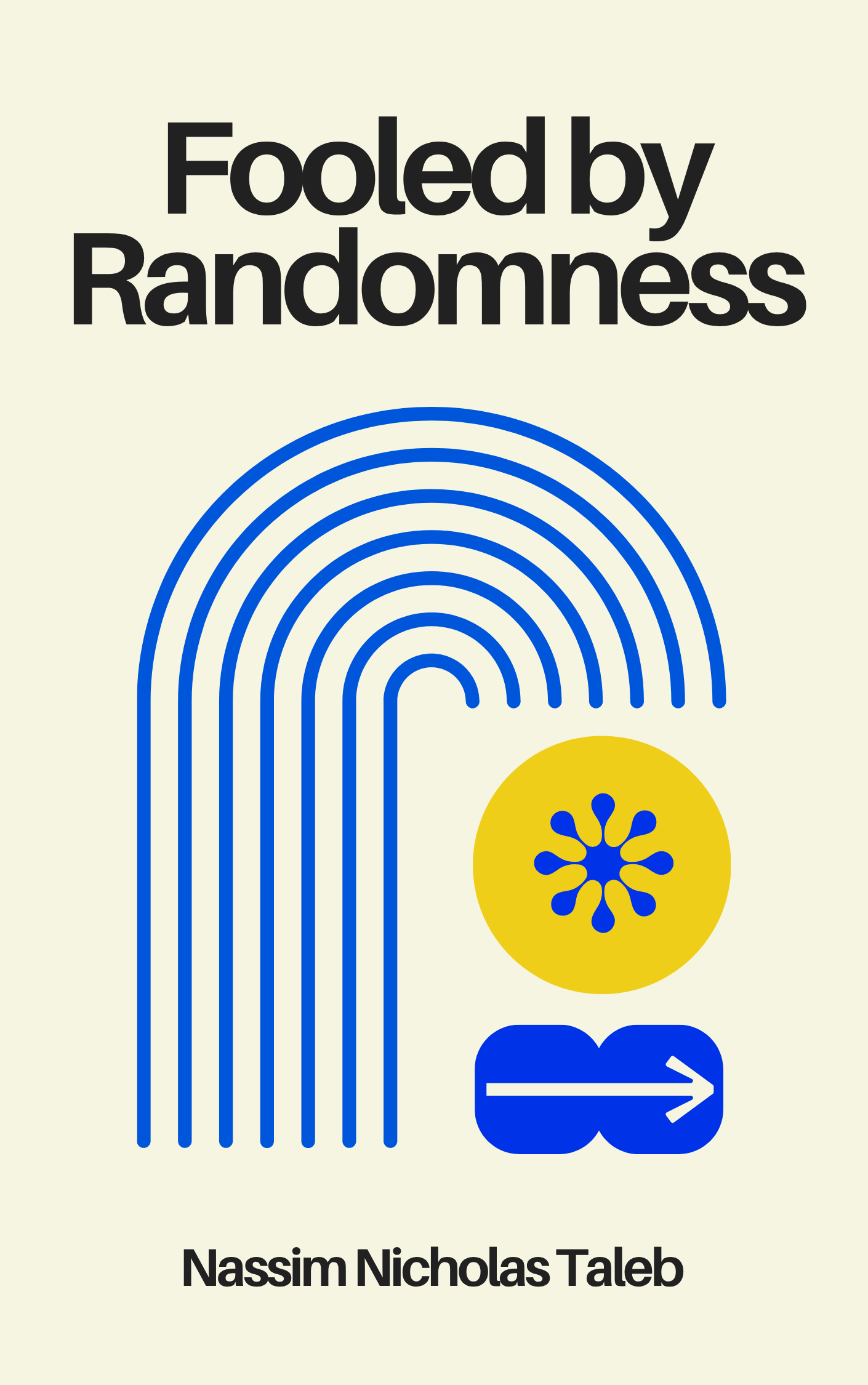
Fooled by Randomness Book Summary
This Fooled by Randomness Book Summary covers the key ideas, lessons, and takeaways in about 20 minutes.
Helps with these goals
Want the complete 20-minute summary?
- Full structured summary
- Video Summary
- Podcast Summary
- Audio summary
- Key takeaways
- Exercises
- Quiz
- Highlights and notes
- Ask the book with AI
What is in the Fooled by Randomness book summary?
Below is a preview of Sumizeit’s expert-written summary of Fooled by Randomness by Nassim Nicholas Taleb. The full summary covers the book’s key ideas in text, audio, and video.
In Fooled by Randomness, Nassim Nicholas Taleb confronts the widely held belief that success is primarily the product of talent, intelligence, and deliberate strategy. He argues that many outcomes we attribute to skill are instead the result of randomness, luck, and unpredictable forces far beyond human control. Using examples from financial markets, history, science, and everyday life, Taleb shows how deeply flawed human reasoning becomes when we try to explain events driven by uncertainty using simple causal stories. The book exposes the fundamental gap between the chaotic reality of the world and the tidy narratives we create to make sense of it.
Why We Misinterpret Success
Taleb explains that society overestimates the significance of skill and underestimates luck. In fields driven by chance—like investing, entrepreneurship, and politics—even mediocre decision-makers can appear brilliant if randomness works in their favor. Conversely, skilled individuals can look incompetent if they are struck by bad luck. Taleb compares a professional pianist to a hedge fund trader: the pianist’s success reflects years of consistent skill and repeatable performance, while a trader can earn a fortune simply by being lucky during favorable market periods.
He highlights examples from the dot-com era, where traders and venture capitalists generated enormous profits during the technology bubble. Business media called them geniuses, investors treated them as prophetic, and their methods were taught as formulas for success. Yet when the bubble burst in 2000, many of these same individuals lost everything, proving their apparent talent was simply exposure to good luck.
Survivorship Bias and the Silent Graveyard of Failures
Taleb uses survivorship bias to explain why our perception of success is distorted. Survivorship bias occurs when we analyze only the visible winners and ignore the much larger number of failures that disappear quietly. For example:
For every bestselling author, millions of manuscripts never get published.
For every startup that becomes a unicorn, thousands collapse unnoticed.
For every hedge fund that beats the market, hundreds shut down due to losses.
Taleb notes that analysts study the strategies of successful companies like Apple, Google, and Netflix, producing books such as Good to Great, but do not examine companies that followed the same principles and still failed. Without seeing the failures, we mistake rare outcomes for reproducible formulas.
He compares this to looking at only soldiers who survived a war and concluding that wearing metal helmets protects lives—when in reality, the helmets may have saved only those hit in nonfatal areas.
Rare Events Drive Disproportionate Outcomes
Taleb argues that rare, extreme events—rather than predictable, incremental ones—determine most major outcomes in finance and history. For instance:
The 9/11 attacks transformed global politics in a single morning.
The sudden collapse of Lehman Brothers in 2008 triggered a worldwide financial crisis.
A small miscommunication at Chernobyl caused a nuclear disaster with global consequences.
COVID-19 reshaped economies and daily life nearly overnight.
In markets, a trader might earn small consistent gains for years and then be wiped out by one catastrophic downturn.
Want the complete 20-minute summary?
- Full structured summary
- Video Summary
- Podcast Summary
- Audio summary
- Key takeaways
- Exercises
- Quiz
- Highlights and notes
- Ask the book with AI
Who should read Fooled by Randomness?
Fooled by Randomness is essential for investors, entrepreneurs, and professionals who want to understand why success often has more to do with luck than skill. It's also valuable for anyone who makes decisions under uncertainty—managers, analysts, strategists, and even casual observers of markets and history who want to avoid being manipulated by compelling but false narratives.
Why does Fooled by Randomness matter?
In an age of constant information and confident experts, this book cuts through overconfidence and faulty reasoning that costs people and organizations billions. Nassim Nicholas Taleb exposes how we systematically misattribute random outcomes to skill, making poor decisions based on misleading track records and hindsight bias. Understanding these biases is critical for anyone seeking to make smarter choices in finance, business, and life.
What are the key themes in Fooled by Randomness?
- The distinction between skill and luck in determining outcomes
- Survivorship bias and the invisibility of failures
- How rare, unpredictable events drive disproportionate results
- Narrative fallacy and our need to create causal stories
- The dangers of overconfidence and false expertise
- Building robustness and antifragility in uncertain environments
What are the key lessons from the Fooled by Randomness book summary?
Success Often Reflects Luck, Not Skill
Many outcomes we attribute to talent and strategy are actually products of randomness and favorable timing. A trader's exceptional returns may reflect good luck during a favorable market period, not superior decision-making ability.
Survivorship Bias Distorts Our Perception of Success
We study winners and ignore the far larger population of failures, leading us to mistake rare outcomes for reproducible formulas. For every bestselling author or successful startup, thousands with similar approaches fail silently.
In High-Randomness Fields, Track Records Can Deceive
A large enough population of random decision-makers will produce individuals who appear consistently successful purely by chance. These 'lucky survivors' are often mistaken for geniuses and given influence far beyond what their actual skill warrants.
Rare Events Drive More Outcomes Than Incremental Changes
Black Swan events—unpredictable, high-impact occurrences like financial crashes or technological disruptions—shape history and markets more than steady, predictable developments. Single catastrophic events can erase years of gains.
Our Brains Are Wired to Misunderstand Probability
Humans evolved to understand simple cause-and-effect in small groups, not complex probability in large systems. This mismatch makes us susceptible to cognitive biases like seeing patterns in randomness and trusting confident experts.
We Judge Decisions by Outcome Rather Than Quality of Reasoning
A poor decision that happened to work out looks brilliant, while a sound decision derailed by bad luck appears foolish. This outcome bias prevents learning from actual decision-making processes.
The Narrative Fallacy Makes Unpredictable Events Seem Obvious Afterward
Historians and analysts create neat explanations after events occur, making surprises appear inevitable with hindsight. This illusion of understanding breeds overconfidence and prevents genuine preparation.
Information and Noise Are Often Confused
Constant stock tickers, breaking news, and economic commentary are mostly noise that triggers emotional reactions without adding real insight. Frequent monitoring typically worsens decision-making and increases anxiety.
Humility Is Essential in the Face of Uncertainty
Acknowledging the limits of human knowledge and the role of luck in outcomes leads to better decisions than false confidence. Wisdom involves respecting randomness rather than trying to eliminate it.
Antifragility Is Superior to Resilience in Chaotic Environments
Rather than merely surviving shocks, strategic positioning allows you to benefit from volatility and rare events. Designs that gain from disorder outperform those that simply endure it.
Diversification and Optionality Reduce Catastrophic Risk
Spreading exposure across uncorrelated outcomes and maintaining flexibility to exploit unexpected opportunities provides protection without sacrificing upside. This approach handles the unpredictable better than concentrated bets.
Confusing Correlation with Causation Leads to False Conclusions
Our pattern-recognition instincts make us see causal relationships in random coincidences and spurious correlations. Rigorous thinking requires distinguishing meaningful relationships from statistical artifacts.
Expert Predictions Are Unreliable in High-Uncertainty Fields
Even Nobel Prize-winning economists and seasoned professionals cannot forecast rare events or complex system behavior reliably. Confidence in prediction ability often inversely correlates with actual predictive accuracy.
Never Risk Catastrophic Loss for Incremental Gain
Strategies that produce small consistent profits while risking total ruin during rare events are fundamentally flawed. Real safety requires avoiding exposure to scenarios where a single bad outcome ends the game.
Hindsight Bias Prevents Learning from Experience
Our tendency to rewrite history as inevitable obscures the actual contingencies and luck involved in outcomes. Overcoming this bias requires deliberately examining multiple possible scenarios that didn't occur.
Emotional Reactions to Volatility Often Destroy Wealth
Fear and overconfidence triggered by price movements push investors to buy highs and sell lows, locking in losses. Detachment from short-term noise improves long-term results.
The Illusion of Control Leads to Dangerous Overconfidence
Humans systematically overestimate their influence on outcomes and underestimate external forces. Accepting what cannot be controlled is the first step toward rational decision-making.
Luck and Skill Cannot Be Separated by Looking at Results Alone
Exceptional outcomes could result from exceptional skill, exceptional luck, or some combination. Only examination of process, methodology, and decision quality can reveal the true driver.
Society Rewards Confident Stories More Than Uncertain Truths
Compelling narratives and self-assured experts command attention and resources even when they lack predictive power. Skepticism toward confident claims is a valuable intellectual defense.
Building Antifragile Systems Requires Accepting Small, Frequent Losses
Strategies designed to benefit from volatility often experience regular small setbacks while waiting for rare large gains. This requires psychological fortitude to endure visible losses for invisible future benefits.
Want the complete 20-minute summary?
- Full structured summary
- Video Summary
- Podcast Summary
- Audio summary
- Key takeaways
- Exercises
- Quiz
- Highlights and notes
- Ask the book with AI
How can you apply ideas from Fooled by Randomness?
- Review your investment decisions based on reasoning quality and process rather than recent returns; use this lens to identify luck-based gains you shouldn't extrapolate
- Build financial buffers and diversified income streams to reduce exposure to single catastrophic events in your career or investments
- Limit how frequently you check stock prices, account balances, or performance metrics to reduce noise-driven emotional decisions and anxiety
- Seek investment and business opportunities with asymmetric payoffs where potential gains far exceed potential losses, even if they experience frequent small setbacks
- When evaluating expert advice or track records, investigate the silent failures and survivorship bias in the sample rather than focusing only on publicized successes
- Design your career and finances to benefit from volatility through optionality—maintaining flexibility to exploit unexpected opportunities when they arise
- Practice intellectual humility by explicitly acknowledging the role of luck in your successes and failures rather than attributing all outcomes to personal capability
What common mistakes do readers make with Fooled by Randomness?
- Believing that a successful investor's or entrepreneur's recent track record proves superior skill when it may reflect lucky timing or favorable conditions unlikely to repeat
- Studying what successful companies did and replicating those strategies without accounting for the thousands of companies that failed while following identical approaches
- Trusting confident experts and charismatic leaders without scrutinizing whether their predictions have actually proven accurate or whether they carry personal responsibility for failures
- Making frequent portfolio adjustments or business pivots based on short-term noise and daily market movements rather than long-term positioning and strategic conviction
Sumizeit Exercises Apply what you've learned
Turn ideas from Fooled by Randomness into action with a short guided reflection: identify the biggest takeaway, connect it to your life, and commit to one step you can take in the next 24 hours.
What is the expert analysis of Fooled by Randomness?
Overview
Fooled by Randomness, authored by Nassim Nicholas Taleb, stands as a seminal work that challenges conventional wisdom about success, skill, and luck. Taleb, a former derivatives trader and philosopher, leverages his extensive experience in financial markets and complex systems to expose the pervasive human misinterpretation of randomness. This book inaugurates his influential Incerto series, which has reshaped discourse across economics, psychology, and risk management by emphasizing the limits of prediction and the profound impact of rare, unpredictable events.
Core Thesis
Taleb’s central argument is that much of what society attributes to skill and intelligence is in fact the product of randomness and luck. He contends that humans are psychologically predisposed to create coherent narratives that mask the underlying chaos and unpredictability of real-world events. This narrative fallacy, combined with survivorship bias and an overreliance on flawed statistical reasoning, leads to systematic errors in how success and failure are understood, particularly in domains like finance, entrepreneurship, and politics. Taleb advocates for embracing uncertainty, adopting probabilistic thinking, and building robustness against rare but consequential “Black Swan” events rather than attempting futile precise predictions.
Strengths
- Interdisciplinary Insight: Taleb’s synthesis of finance, psychology, history, and philosophy provides a rich, multifaceted perspective on randomness and human cognition.
- Compelling Use of Examples: The book’s vivid illustrations—from hedge fund collapses to historical catastrophes—effectively ground abstract concepts in tangible reality.
- Psychological Depth: Taleb’s exploration of cognitive biases such as survivorship bias, hindsight bias, and pattern recognition errors offers profound insights into why humans misinterpret chance.
- Practical Wisdom: The emphasis on building antifragility and resilience presents actionable strategies for navigating uncertainty in personal and professional contexts.
- Challenging Established Narratives: By questioning celebrated success stories and expert predictions, Taleb provokes critical reflection on widely accepted beliefs.
Critiques & Counterarguments
- Overemphasis on Luck: Critics argue that Taleb sometimes underplays the role of genuine skill and expertise, especially in domains where repeated practice and knowledge demonstrably improve outcomes, such as classical music or certain scientific disciplines.
- Complexity of Causality: While randomness is undeniably influential, some scholars caution against reducing all success to luck, noting that complex causal webs often intertwine skill, environment, and chance in ways that resist simple categorization.
- Empirical Challenges: Taleb’s critique of predictive models and expert forecasts, though compelling, may overlook advances in fields like behavioral economics and machine learning that have improved probabilistic forecasting under uncertainty.
- Philosophical Counterpoints: Opposing schools of thought, such as rational choice theory and Bayesian epistemology, emphasize the value of updating beliefs and making decisions under uncertainty, suggesting that Taleb’s skepticism might be too radical or dismissive of systematic learning.
- Practical Limitations: While advocating for robustness and antifragility is valuable, some readers may find Taleb’s prescriptions abstract or difficult to operationalize, especially in complex organizational or societal systems.
Who Should Read This
Fooled by Randomness is essential reading for professionals and intellectuals engaged in fields characterized by uncertainty and risk, including finance, entrepreneurship, economics, and policy-making. It also appeals to scholars of psychology and philosophy interested in cognitive biases and epistemology. Beyond specialists, the book is invaluable for any thoughtful reader seeking a deeper understanding of how chance shapes life’s outcomes and how to cultivate intellectual humility and resilience in a complex, unpredictable world.
Frequently asked questions about the Fooled by Randomness book summary
What is Fooled by Randomness about?
Fooled by Randomness by Nassim Nicholas Taleb argues that much of what we attribute to skill, talent, and strategic ability is actually the product of luck and unpredictable randomness. The book exposes how human reasoning systematically misinterprets chaotic outcomes by creating simple causal narratives, leading us to overestimate the predictability of events and the reliability of expert predictions.
Who should read Fooled by Randomness?
This book is essential for investors, traders, entrepreneurs, and business leaders who make decisions under uncertainty. It's also valuable for managers, analysts, policymakers, and anyone who consumes expert opinions or tracks performance metrics. Anyone seeking to understand why confident predictions often fail and how to build more robust strategies will benefit from this work.
What are the main takeaways from Fooled by Randomness?
The core takeaways are: most success results from luck rather than skill, survivorship bias distorts our perception of what works, rare extreme events drive disproportionate outcomes, track records can reflect randomness instead of ability, and our brains systematically misunderstand probability. Taleb urges adopting probabilistic thinking, designing antifragile systems that benefit from volatility, avoiding catastrophic risk exposure, and cultivating humility about what we can predict.
What is survivorship bias and why does it matter?
Survivorship bias occurs when we analyze only visible winners while ignoring the far larger population of failures that disappear from view. This creates false patterns—we might conclude that successful companies followed a certain formula when in reality thousands of companies followed the same approach and failed. This bias leads us to mistake rare lucky outcomes for reproducible strategies.
What are Black Swans according to Taleb?
Black Swans are rare, unpredictable, high-impact events that cannot be reliably forecasted but dramatically shape outcomes in finance and history. Examples include 9/11, the 2008 financial crisis, and COVID-19. Taleb argues that these events, not incremental predictable changes, determine most major outcomes, making traditional forecasting unreliable.
How does narrative fallacy prevent learning?
Narrative fallacy is our tendency to create neat, causal explanations for events after they occur, making unpredictable outcomes appear inevitable with hindsight. This illusion of understanding breeds overconfidence and prevents genuine learning because we convince ourselves we understand what actually happened, rather than acknowledging the role of contingency and luck.
What is antifragility and how does it differ from resilience?
Resilience means surviving shocks and returning to normal; antifragility means benefiting from disorder and volatility. An antifragile strategy gains from rare events while tolerating frequent small losses, whereas a resilient strategy merely endures disruption. Taleb advocates for antifragile positioning that profits from unpredictable changes rather than merely surviving them.
Can expert track records be trusted according to Fooled by Randomness?
No. Taleb demonstrates that in any large population of traders or decision-makers, some will appear consistently successful purely by chance. These lucky survivors are celebrated as geniuses and given influence, when their performance reflects randomness rather than skill. Even Nobel Prize-winning economists can fail spectacularly when confronted with rare events outside their models.
About Sumizeit
Sumizeit is a profitable Scomy LLC company based in Miami, Florida. It has been helping readers learn from nonfiction books for 7 years with expert-written summaries in text, audio, podcast, and video.
Want the complete 20-minute summary?
- Full structured summary
- Video Summary
- Podcast Summary
- Audio summary
- Key takeaways
- Exercises
- Quiz
- Highlights and notes
- Ask the book with AI
Here's why readers love Sumizeit
Join thousands of learners getting smarter every day
"Great experience. Detailed summaries. Loved the gamification feature. Makes learning fun. Good customer service. I recommend Sumizeit to anyone. You'll learn a lot."
"I always felt busy but still wanting to keep up with the book discussion in my friend group. This was a great supplement to help me keep reading the books I find fun while keeping up with important books."
"I love this website. Instead of scrolling social media, I find myself learning a lot. I use it everyday. I recommend this app for anyone who is too busy and wants to get up to speed with their favorite books."
Fooled by Randomness Book Summary PDF
Looking for a Fooled by Randomness Book Summary PDF you can save and revisit offline? Our Fooled by Randomness Book Summary PDF captures the book’s core ideas in a clean, printable format — the key frameworks, takeaways, and structure without the fluff. Download the Fooled by Randomness Book Summary PDF when you want a reference you can annotate, share with your team, or review on the go. Get your Fooled by Randomness Book Summary PDF from the download page below.
Download Fooled by Randomness Book Summary PDFPeople also liked these summaries
Readers who explored Fooled by Randomness often enjoyed these titles next.

Want the complete 20-minute summary?
- Full structured summary
- Video Summary
- Podcast Summary
- Audio summary
- Key takeaways
- Exercises
- Quiz
- Highlights and notes
- Ask the book with AI
Featured Book Titles
Popular Book Summaries at sumizeit, leading book summary app
