


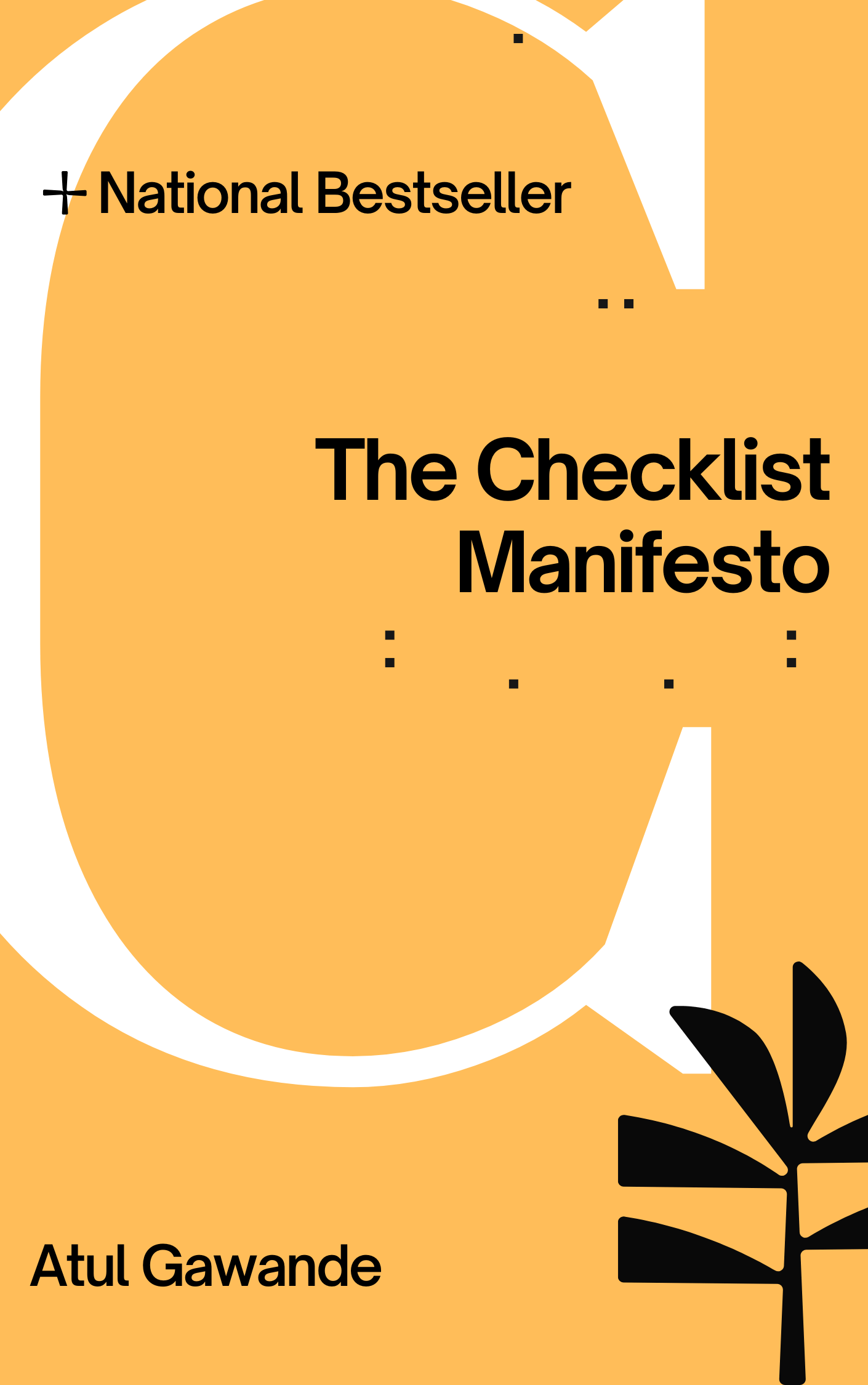
The Checklist Manifesto Book Summary
This The Checklist Manifesto Book Summary covers the key ideas, lessons, and takeaways in about 20 minutes.
The book’s ultimate lesson is philosophical as much as practical: progress depends not just on intelligence but on discipline. Great achievements no longer come from solitary geniuses but from well-coordinated teams working within smart systems. Checklists remind us that excellence is not about knowing everything—it’s about never forgetting what matters most.
Helps with these goals
Want the complete 20-minute summary?
- Full structured summary
- Video Summary
- Podcast Summary
- Audio summary
- Key takeaways
- Exercises
- Quiz
- Highlights and notes
- Ask the book with AI
What is in the The Checklist Manifesto book summary?
Below is a preview of Sumizeit’s expert-written summary of The Checklist Manifesto by Atul Gawande. The full summary covers the book’s key ideas in text, audio, and video.
Atul Gawande opens The Checklist Manifesto with an uncomfortable truth: despite our advanced capabilities—performing complex surgeries, building skyscrapers, landing robots on Mars—highly trained experts still make basic, preventable mistakes. A surgeon can forget to wash hands before an operation, a pilot can overlook a crucial lever, and an investor can miss a glaring red flag. These errors aren’t due to laziness or ignorance, but to cognitive overload. Humans, he explains, are wired to forget under pressure.
Gawande reflects on his own mistakes in the operating room. After years of training at Harvard and thousands of successful procedures, he still saw operations go wrong for trivial reasons—a missing sponge, an unsterilized instrument, or a wrong dose of medication. He realized that medicine’s traditional approach—more training, more expertise, longer hours—wasn’t enough to prevent failure. The challenge wasn’t a lack of knowledge but a failure to manage complexity.
We live in what Gawande calls “the century of complexity.” No single person, no matter how brilliant, can master every variable in a modern system. The volume of medical information doubles every few years; in aviation, aircraft systems evolve faster than pilots can memorize them. Checklists, Gawande discovered, bridge this gap between knowledge and execution. They act as guardrails for the human mind, ensuring that the fundamentals are never forgotten even in high-stakes situations.
Complexity and the Need for Simplicity
Gawande provides vivid examples of how complexity can overwhelm even the most skilled professionals. In an ICU, a single patient may require 178 daily tasks, from adjusting ventilators to managing nutrition, all of which must be completed flawlessly. A momentary lapse—forgetting to check a catheter, missing an antibiotic dose—can have deadly consequences.
He contrasts this with construction management, another field where checklists reign supreme. The construction of a skyscraper like the Burj Khalifa or One World Trade Center involves thousands of workers, engineers, and contractors, each handling a small piece of an immense puzzle. A missed inspection or miscommunication could endanger hundreds of lives. Yet construction projects succeed consistently not because of perfect people, but because of systems that enforce accountability and verification.
Checklists, Gawande argues, distill complex processes into manageable sequences. They do not oversimplify the work but make the essential visible. They externalize memory, allowing professionals to focus on judgment rather than recollection. This simple tool—an idea as old as a grocery list—has become indispensable in a world drowning in complexity.
Lessons from the Skies: The Aviation Model
The aviation industry offers the clearest evidence that checklists save lives. Gawande recounts the 1935 crash of Boeing’s Model 299, the prototype of what would become the B-17 bomber. During a test flight, the pilot—a decorated Air Corps veteran—forgot to disengage a small control lock. The plane stalled and crashed, killing him. Investigators concluded that the aircraft was “too complex for one man to fly.”
Boeing’s engineers responded not by redesigning the plane but by creating a simple, step-by-step checklist for pilots.
Want the complete 20-minute summary?
- Full structured summary
- Video Summary
- Podcast Summary
- Audio summary
- Key takeaways
- Exercises
- Quiz
- Highlights and notes
- Ask the book with AI
Who should read The Checklist Manifesto?
The Checklist Manifesto is essential for professionals in high-stakes fields—surgeons, pilots, engineers, investors, and managers—who want to reduce preventable errors and improve outcomes. It's also valuable for anyone managing complex systems or leading teams, as it reveals how simple tools can transform reliability across any industry. Even readers seeking personal productivity gains will find practical wisdom on organizing and executing complicated tasks.
Why does The Checklist Manifesto matter?
In our era of unprecedented complexity, even the most brilliant and experienced professionals make costly mistakes simply by forgetting critical steps under pressure. Atul Gawande demonstrates that checklists—a deceptively simple tool—can cut surgical deaths by nearly half, prevent aircraft disasters, and transform how teams collaborate. As systems grow more complex, the gap between what we know and what we actually execute widens; this book shows how to bridge that gap and build reliability into any process.
What are the key themes in The Checklist Manifesto?
- Cognitive overload and the limits of human memory under pressure
- Bridging the gap between knowledge and execution through systems
- Simplicity and discipline as foundations of excellence
- Teamwork and communication as safety mechanisms
- Humility and ego in professional practice
- Redefining heroism from individual brilliance to collective reliability
What are the key lessons from the The Checklist Manifesto book summary?
Expertise Without Systems Fails Under Complexity
Even highly trained professionals make preventable mistakes when cognitive demands exceed human capacity, proving that training alone cannot solve the problem of complexity.
Checklists Are Guardrails for the Mind
By externalizing memory into a structured tool, checklists free professionals to focus on judgment and problem-solving rather than recollection.
Aviation's Safety Model Works Across All Fields
The discipline that made commercial aviation the safest form of transportation—systematic checklists at critical pause points—can be adapted to surgery, construction, finance, and any complex domain.
A Good Checklist Must Be Brief and Focused
Effective checklists contain only five to nine essential items addressing the most dangerous-to-miss steps, avoiding both oversimplification and overwhelming complexity.
Timing and Pause Points Are Critical
Checklists work only when integrated at logical moments in a process—such as before incision in surgery or before takeoff in aviation—where they interrupt workflow just enough to catch errors.
The Sully Sullenberger Example Shows Real Heroism
When faced with both engines failing, Captain Sullenberger didn't rely on spontaneous genius but followed his checklist, demonstrating that structured discipline under crisis saves lives.
The WHO Safe Surgery Checklist Proved Universal Effectiveness
A 19-step surgical checklist reduced major complications by 36% and deaths by 47% across eight hospitals worldwide—from Harvard to rural Tanzania—proving that consistency matters more than wealth or infrastructure.
Checklists Transform Workplace Hierarchies and Communication
By requiring teams to introduce themselves and review plans together, checklists empower junior staff to speak up, catch errors, and feel ownership over outcomes regardless of traditional hierarchy.
Resistance Comes From Professional Ego
Elite professionals often view checklists as insulting to their competence, but overcoming this resistance through leader modeling and peer involvement reveals that discipline and expertise are partners, not competitors.
Checklists Are Both Memory Aids and Communication Tools
A well-designed checklist serves dual purposes: it prevents forgetting critical steps and creates shared understanding across a team, improving coordination and accountability.
Do-Confirm vs. Read-Do Format Matters
Different processes require different checklist types—some where you complete tasks then verify, others where you perform steps as you read them—and choosing the wrong format reduces effectiveness.
Language Must Be Precise and Familiar
Ambiguous wording in checklists causes hesitation and misinterpretation; clear, everyday language ensures users understand and execute each step confidently.
Checklists Must Be Tested and Refined in Real Scenarios
No checklist is perfect on first draft; effective implementation requires piloting in actual working conditions and incorporating feedback from the people who will use them.
Construction Demonstrates Checklist Success at Scale
Building skyscrapers like the Burj Khalifa with thousands of workers and tasks succeeds not through perfect people but through systems that enforce accountability and verification at every stage.
Finance and Investment Checklists Combat Emotional Decision-Making
Investors like Charlie Munger use checklists to verify fundamentals before buying stocks, creating a mechanical discipline that prevents the emotional biases that lead to poor financial decisions.
Checklists Address the 'Century of Complexity' Challenge
As medical information doubles every few years and systems evolve faster than humans can memorize them, checklists become indispensable for managing exponential growth in knowledge and variables.
The Nurse Who Caught the Antibiotic Omission Shows Empowerment
When checklists create psychological safety for junior team members to question decisions, hidden errors surface and lives are saved—proving checklists are social technologies as much as procedural ones.
Progress Now Depends on Discipline, Not Just Intelligence
Gawande argues that modern achievement comes from well-coordinated teams working within smart systems rather than solitary geniuses, fundamentally redefining what excellence means.
Emergency Response and Disaster Relief Rely on Checklists
During crises like the Haiti earthquake, logistics and supply-chain checklists prevented duplication and confusion, demonstrating that systematic coordination saves lives when chaos threatens.
Excellence Is About Never Forgetting What Matters Most
The ultimate lesson of the checklist manifesto is philosophical: greatness through consistency means acknowledging that even the brightest minds need external systems to reliably execute when stakes are highest.
Want the complete 20-minute summary?
- Full structured summary
- Video Summary
- Podcast Summary
- Audio summary
- Key takeaways
- Exercises
- Quiz
- Highlights and notes
- Ask the book with AI
How can you apply ideas from The Checklist Manifesto?
- Create a pre-surgery or pre-meeting checklist for your team with 5-9 essential items, testing it in real scenarios before full rollout
- Implement pause-point checklists at critical junctures in your workflow—before major decisions, at project handoffs, or before launching products
- Use a Do-Confirm checklist for complex tasks where you complete actions first, then verify each one (common in finance and quality control)
- Design an investment or hiring checklist that forces systematic verification of fundamentals before making emotional or rushed decisions
- Build a team communication ritual into your checklist by requiring people to introduce roles and review the plan aloud together before starting
- Adapt the WHO Safe Surgery Checklist framework to your industry by identifying the three to four highest-risk phases and creating verification points for each
- Train leaders to model checklist use publicly so employees see discipline as a strength rather than an insult to expertise
What common mistakes do readers make with The Checklist Manifesto?
- Making checklists too long or detailed, which overwhelms users and defeats the purpose of simplification
- Placing checklist items at the wrong moment in a workflow, so they interrupt unnecessarily or arrive too late to prevent errors
- Using ambiguous or jargon-filled language that causes confusion rather than clarity during execution
- Implementing checklists without buy-in from respected peers or leaders, leading to resistance and abandonment
- Treating checklists as rigid rules that micromanage experts rather than as safety guardrails that free them to focus on judgment
Sumizeit Exercises Apply what you've learned
Turn ideas from The Checklist Manifesto into action with a short guided reflection: identify the biggest takeaway, connect it to your life, and commit to one step you can take in the next 24 hours.
What is the expert analysis of The Checklist Manifesto?
Overview
The Checklist Manifesto is a seminal work by Atul Gawande, a distinguished surgeon, public health expert, and prolific writer. The book addresses a paradox at the heart of modern expertise: despite unprecedented knowledge and technological advancement, human error remains a persistent threat in complex professional environments. Gawande’s unique vantage point as a practicing surgeon and Harvard professor lends the narrative both credibility and immediacy. His collaboration with global institutions like the World Health Organization further amplifies the book’s significance, positioning it as a transformative text that transcends medicine to influence aviation, construction, finance, and beyond.
Core Thesis
Gawande’s central argument is elegantly simple yet profound: in an era defined by complexity, human cognitive capacity is insufficient to manage all variables flawlessly. The solution lies not in more training or intelligence alone, but in the disciplined use of checklists—concise, well-designed tools that externalize memory and enforce critical procedural steps. Checklists serve as cognitive guardrails, reducing preventable errors, enhancing communication, and fostering teamwork. They represent a paradigm shift from relying on individual heroics to embracing systematic reliability, humility, and collaborative discipline as the new hallmarks of professional excellence.
Strengths
- Interdisciplinary Insight: Gawande masterfully connects disparate fields—medicine, aviation, construction, finance—demonstrating the universal applicability of checklists and reinforcing the argument with compelling, real-world examples.
- Empirical Rigor: The book is grounded in robust data, notably the WHO Safe Surgery Checklist trials, which show dramatic reductions in surgical complications and mortality across diverse healthcare settings.
- Human-Centered Narrative: Gawande’s personal reflections and storytelling humanize the abstract concept of error prevention, making the argument accessible without sacrificing intellectual depth.
- Practical Framework: By outlining principles for effective checklist design and implementation, the book offers actionable guidance rather than mere theory.
- Philosophical Depth: The work challenges traditional notions of expertise and heroism, advocating for a cultural transformation that values humility and collective responsibility.
Critiques & Counterarguments
- Potential Oversimplification: While checklists are powerful, the book may understate the complexity of human factors such as motivation, organizational culture, and resistance to change, which can impede checklist adoption and efficacy.
- Evidence Scope: The most compelling data come from controlled environments like hospitals and aviation; extrapolating checklist effectiveness to less structured or more creative domains (e.g., entrepreneurship or artistic fields) may be less straightforward.
- Competing Views on Expertise: Some schools of thought emphasize adaptive expertise and improvisation over rigid protocols, arguing that excessive reliance on checklists might stifle innovation or critical thinking in dynamic situations.
- Cultural and Contextual Variability: The book primarily reflects Western institutional contexts; its prescriptions might encounter greater challenges in cultures with different hierarchical norms or resource constraints, where checklist compliance may be less feasible.
- Technological Evolution: Advances in AI and automation could potentially reduce the need for human-managed checklists, raising questions about the long-term relevance of the manual checklist paradigm.
Who Should Read This
The Checklist Manifesto is essential reading for professionals operating in high-stakes, complex environments—surgeons, pilots, engineers, project managers, and executives—who seek to enhance reliability and safety in their work. It also benefits organizational leaders and policymakers interested in systemic improvement and cultural change. Beyond practitioners, the book appeals to scholars and thoughtful readers intrigued by the intersection of human psychology, systems design, and organizational behavior. Ultimately, anyone grappling with complexity and human fallibility will find Gawande’s insights both illuminating and practically valuable.
Frequently asked questions about the The Checklist Manifesto book summary
What is The Checklist Manifesto about?
The Checklist Manifesto by Atul Gawande is about how simple, well-designed checklists can dramatically reduce preventable errors and improve outcomes in complex, high-stakes fields like medicine, aviation, and construction. Gawande argues that as systems grow more complex, even brilliant experts make costly mistakes from cognitive overload, and checklists serve as guardrails for the human mind, ensuring critical steps are never forgotten. The book combines real-world stories—from emergency landings to surgical safety—with practical principles for designing and implementing effective checklists.
Who should read The Checklist Manifesto?
Anyone managing complex processes, leading teams, or working in high-stakes environments should read this book, including surgeons, pilots, engineers, project managers, investors, and organizational leaders. It's equally valuable for individual professionals seeking better personal systems and for anyone curious about how simple tools can have outsized impact on safety and reliability. Gawande's accessible writing makes it relevant beyond just experts—general readers will find universal lessons about discipline, humility, and teamwork.
What are the main takeaways from The Checklist Manifesto?
The central takeaways are: expertise alone cannot prevent errors under complexity; well-designed checklists (five to nine items at critical pause points) cut mistakes dramatically; checklists improve team communication and empower junior staff to speak up; effective checklists require clear language, proper timing, and real-world testing; and modern heroism lies in discipline and reliable systems rather than individual brilliance. Ultimately, Gawande shows that greatness comes from consistency—never forgetting what matters most—not from genius.
How did the WHO Safe Surgery Checklist change healthcare?
The 19-step checklist Gawande designed with the WHO reduced surgical complications by 36%, death by 47%, and postoperative infections by nearly half across eight hospitals worldwide. By 2009, over 20 countries had adopted it, affecting an estimated 2 million surgeries annually. The checklist's success—equal in wealthy hospitals and rural clinics—proved that consistency and communication matter more than resources, fundamentally reshaping global surgical practice.
What can the aviation industry teach about checklists?
Aviation demonstrates the power of checklists through decades of safety: after Boeing created a simple pre-flight checklist following a 1935 crash, test pilots flew 1.8 million miles without incident. Modern cockpit discipline—where even experienced pilots verify fundamentals on every flight—created the safest form of transportation. The story of Captain Sully's emergency landing shows that checklists don't replace expertise; they enable clear thinking under extreme pressure.
Why do experts resist checklists?
Many professionals, especially in elite fields like surgery or finance, view checklists as insulting to their competence and autonomy. Gawande argues this resistance stems from ego—experts conflate discipline with mediocrity. However, he shows that expertise and humility are partners, not opposites. Overcoming resistance requires cultural transformation: leaders must model checklist use, celebrate successes with data, and involve respected peers in design so teams see checklists as tools for reliability, not insults to skill.
What makes a checklist effective?
An effective checklist is brief (five to nine items), focused only on killer items most dangerous to miss, written in clear familiar language, properly timed at logical pause points in a process, and piloted in real scenarios before full rollout. Gawande explains two types: Do-Confirm (complete tasks then verify) and Read-Do (perform as you read). The format must match the workflow, and checklists work best when integrated into team rituals that improve communication and shared understanding.
About Sumizeit
Sumizeit is a profitable Scomy LLC company based in Miami, Florida. It has been helping readers learn from nonfiction books for 7 years with expert-written summaries in text, audio, podcast, and video.
Want the complete 20-minute summary?
- Full structured summary
- Video Summary
- Podcast Summary
- Audio summary
- Key takeaways
- Exercises
- Quiz
- Highlights and notes
- Ask the book with AI
Here's why readers love Sumizeit
Join thousands of learners getting smarter every day
"Great experience. Detailed summaries. Loved the gamification feature. Makes learning fun. Good customer service. I recommend Sumizeit to anyone. You'll learn a lot."
"I always felt busy but still wanting to keep up with the book discussion in my friend group. This was a great supplement to help me keep reading the books I find fun while keeping up with important books."
"I love this website. Instead of scrolling social media, I find myself learning a lot. I use it everyday. I recommend this app for anyone who is too busy and wants to get up to speed with their favorite books."
The Checklist Manifesto Book Summary PDF
Looking for a The Checklist Manifesto Book Summary PDF you can save and revisit offline? Our The Checklist Manifesto Book Summary PDF captures the book’s core ideas in a clean, printable format — the key frameworks, takeaways, and structure without the fluff. Download the The Checklist Manifesto Book Summary PDF when you want a reference you can annotate, share with your team, or review on the go. Get your The Checklist Manifesto Book Summary PDF from the download page below.
Download The Checklist Manifesto Book Summary PDFPeople also liked these summaries
Readers who explored The Checklist Manifesto often enjoyed these titles next.

Want the complete 20-minute summary?
- Full structured summary
- Video Summary
- Podcast Summary
- Audio summary
- Key takeaways
- Exercises
- Quiz
- Highlights and notes
- Ask the book with AI
Featured Book Titles
Popular Book Summaries at sumizeit, leading book summary app
