


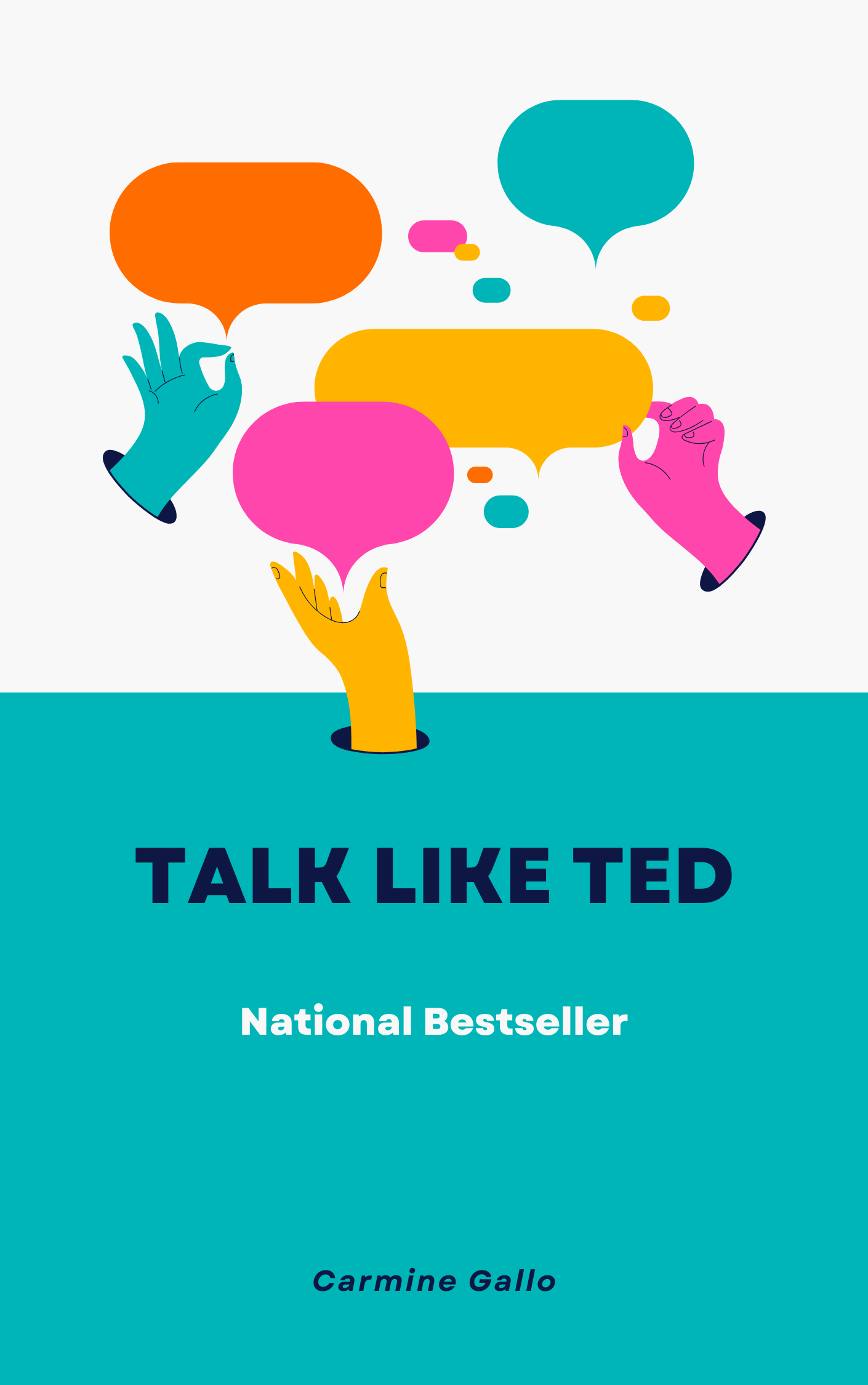
Talk Like Ted Book Summary
This Talk Like Ted Book Summary covers the key ideas, lessons, and takeaways in about 20 minutes.
The book’s message is clear: You don’t have to be famous or naturally charismatic to move people—you just have to speak with heart, clarity, and purpose. By combining passion with structure, and data with emotion, anyone can become a powerful storyteller capable of shaping ideas that spread globally.
Great speaking isn’t about performing—it’s about connecting deeply enough to be remembered.
Helps with these goals
Want the complete 20-minute summary?
- Full structured summary
- Video Summary
- Podcast Summary
- Audio summary
- Key takeaways
- Exercises
- Quiz
- Highlights and notes
- Ask the book with AI
What is in the Talk Like Ted book summary?
Below is a preview of Sumizeit’s expert-written summary of Talk Like Ted by Carmine Gallo. The full summary covers the book’s key ideas in text, audio, and video.
In Talk Like TED: The 9 Public-Speaking Secrets of the World’s Top Minds, communication expert Carmine Gallo explores how the world’s best communicators inspire, educate, and captivate audiences. Gallo spent years analyzing over 500 TED Talks and interviewing top TED presenters, neuroscientists, and communication researchers. His conclusion: what makes TED Talks so magnetic isn’t just the ideas themselves, but how those ideas are delivered—with emotion, clarity, and storytelling.
TED Talks, which began as a small conference in 1984, have evolved into a global phenomenon viewed by billions. They embody the modern ideal of communication: short, story-driven, emotionally resonant, and intellectually stimulating. Gallo distills this magic into nine principles anyone can learn, whether you’re an entrepreneur pitching investors, a teacher inspiring students, or a leader rallying a team.
At its core, Talk Like TED argues that great speakers transform information into inspiration. They don’t lecture—they connect. They don’t recite facts—they tell stories that awaken curiosity and emotion.
Speak About What You Love
Passion is the cornerstone of memorable communication. According to Gallo, audiences can instantly detect whether a speaker truly cares about their topic. Neuroscience supports this: genuine enthusiasm triggers mirror neurons in listeners, allowing them to feel what the speaker feels. Passion isn’t just contagious—it’s persuasive.
Sir Ken Robinson’s TED Talk, Do Schools Kill Creativity?, illustrates this perfectly. Robinson’s lifelong mission to reform education radiates through his humor, warmth, and conviction. His talk became the most viewed TED Talk ever—not because of fancy visuals, but because his passion was palpable. Similarly, Elon Musk’s enthusiasm for space travel and sustainable energy electrifies audiences; his excitement makes people believe the impossible is achievable.
Even if you’re assigned a dull topic, Gallo suggests finding a passionate angle. A financial analyst, for instance, could focus on how their work drives innovation or helps small businesses thrive. Passion transforms obligation into opportunity—it’s the emotional engine of influence.
Tell Stories That Move Hearts and Minds
Humans have communicated through stories for over 100,000 years. Storytelling activates the same brain regions involved in experience and emotion, helping audiences empathize and remember. “Stories,” Gallo writes, “are data with a soul.”
He categorizes TED stories into three main types:
Personal stories – Personal experiences build authenticity and trust. In My Stroke of Insight, Dr. Jill Bolte Taylor described witnessing her own stroke from a neuroscientist’s perspective. Her detailed account—how her perception dissolved and how she felt peace amid paralysis—transformed scientific data into a spiritual journey.
Stories about others – Real-life examples inspire empathy and action. Bryan Stevenson, in his talk We Need to Talk About an Injustice, began with a story about his grandmother and clients on death row. These personal narratives grounded his moral message in humanity.
Brand or idea stories – Steve Jobs was a master at this. When unveiling the iPhone, he didn’t list technical specs; he told a story about combining a phone, an iPod, and an internet communicator into “one revolutionary device.”
Every great story…
Want the complete 20-minute summary?
- Full structured summary
- Video Summary
- Podcast Summary
- Audio summary
- Key takeaways
- Exercises
- Quiz
- Highlights and notes
- Ask the book with AI
Who should read Talk Like Ted?
Talk Like TED is for anyone who needs to present ideas persuasively—entrepreneurs pitching investors, teachers inspiring students, leaders rallying teams, or professionals who want to communicate with greater impact. Whether you're naturally charismatic or struggle with public speaking, this book offers practical principles that anyone can master with deliberate practice and authenticity.
Why does Talk Like Ted matter?
In an age of information overload, the ability to deliver memorable, emotionally resonant communication is a superpower. Carmine Gallo's Talk Like TED distills the science behind why certain ideas spread globally while others fade, giving you a roadmap to inspire action and influence beyond your immediate audience. Mastering these principles can transform your career, your message, and your impact on the world.
What are the key themes in Talk Like Ted?
- Passion is contagious and persuasive
- Stories are data with a soul
- Novelty triggers the brain's attention and curiosity
- Emotion and intellect must intersect for ideas to stick
- Authenticity builds trust more than polish
- Practice until mastery feels effortless
- Brevity forces clarity and amplifies power
What are the key lessons from the Talk Like Ted book summary?
Speak About What You Love
Genuine passion is instantly detectable by audiences and triggers mirror neurons that allow listeners to feel what you feel. When you care deeply about your topic, that enthusiasm becomes your most persuasive tool.
Stories Beat Statistics
Stories activate the same brain regions involved in experience and emotion, making them far more memorable than data alone. Personal narratives, stories about others, and brand stories all deepen connection and drive action.
Use the Five Emotional Ingredients
Every powerful story contains detail, mystery, unexpectedness, adversity, and resolution. These elements reflect universal human experience and make audiences root for your message.
Teach Something New
The human brain releases dopamine when presented with novel information, increasing attention and retention. Novelty doesn't mean completely new—it can be a fresh lens on existing knowledge.
Create Jaw-Dropping Moments
Surprising or emotionally powerful peaks sear ideas into long-term memory by triggering the amygdala. These moments can be startling visuals, live demonstrations, shocking statistics, or powerful confessions.
Humor Lowers Defenses and Aids Retention
People retain information 30% better when it's presented humorously, and laughter builds rapport. Authentic humor—through anecdotes, analogies, and observational wit—should serve your message, not your ego.
Engage Multiple Senses
When audiences see and hear information together, recall improves by up to 600% compared to hearing alone. Multisensory experiences involving sight, sound, imagery, and touch anchor memory more powerfully.
The 18-Minute Rule Reflects Brain Biology
After roughly 18 minutes, glucose depletion causes cognitive fatigue and retention drops. This brevity constraint forces clarity and allows only the strongest ideas to survive.
Apply the Rule of Three
Structure your talk around three key ideas—the human brain loves this balanced triad structure, finding it memorable and elegant. This principle appears across culture and communication.
Practice 50-200 Times for Effortless Delivery
Top TED speakers rehearse extensively not to memorize, but to internalize so they can focus on connection. Mastery through practice frees you from anxiety and allows authentic presence.
Speak at Conversational Speed
Aim for about 190 words per minute to sound natural and maintain audience engagement. This pacing mirrors natural conversation and prevents both rushing and dragging.
Synchronize Hand Gestures with Speech
Research shows that coordinated hand gestures boost audience comprehension and trust. Natural, open body language—standing tall, maintaining eye contact, gesturing purposefully—amplifies your message.
Authenticity Trumps Perfection
Audiences connect with honesty over polish. Your quirks, emotions, and even your accent are your signature—suppressing them distances you from viewers, while embracing them builds emotional resonance.
Emotional Transparency Builds Trust
People don't want a polished robot; they want a relatable human being. When you're emotionally transparent about your struggles, values, and beliefs, you create deeper connection than any perfect delivery ever could.
Use Props and Visuals Strategically
Physical props, vivid imagery, and visual demonstrations transform abstract concepts into tangible experiences. When props aren't possible, detailed sensory description and guided imagination activate the same neural pathways.
Find a Passionate Angle on Any Topic
Even if assigned a seemingly dull subject, you can uncover a passionate perspective—focusing on impact, purpose, or human connection. Passion transforms obligation into opportunity.
Novelty Activates Curiosity
Fresh frameworks, unexpected data visualizations, or reframed contexts all satisfy the brain's hunger for discovery. Curiosity fuels engagement more powerfully than information alone.
Add Soft Breaks Every 10 Minutes
When talks exceed the ideal 18-minute window, insert stories, videos, or interactive moments every 10 minutes to reset audience attention and prevent cognitive fatigue.
Clarity Requires Deep Understanding
If you can't explain your idea simply, you don't understand it well enough. Simplicity and brevity force you to distill complex concepts into their essence.
Connect Emotion and Intellect for Lasting Impact
Ideas stick when they satisfy both the rational and emotional brain. Data without emotion is forgettable; emotion without substance is manipulative. The intersection is transformative.
Want the complete 20-minute summary?
- Full structured summary
- Video Summary
- Podcast Summary
- Audio summary
- Key takeaways
- Exercises
- Quiz
- Highlights and notes
- Ask the book with AI
How can you apply ideas from Talk Like Ted?
- Rehearse your next presentation 50+ times to transform anxiety into muscle memory and free yourself to focus on authentic connection with your audience
- Structure your talk around three core ideas using the Rule of Three to create a memorable, balanced framework
- Open with a personal story that illustrates your passion for the topic, establishing trust and emotional engagement before diving into content
- Insert a jaw-dropping moment—a startling visual, live demonstration, shocking statistic, or powerful confession—to anchor your key idea in audience memory
- Replace text-heavy slides with images, videos, or props that engage multiple senses and boost retention by up to 600%
- Weave humor naturally through anecdotes, analogies, and observational wit rather than forced jokes to lower defenses and increase information retention by 30%
- Identify and emphasize the novel angle or fresh lens in your message to activate the brain's dopamine response and fuel curiosity
What common mistakes do readers make with Talk Like Ted?
- Hiding your personality or quirks behind a polished facade instead of embracing authenticity, which distances audiences and diminishes trust
- Cramming too much information into your talk instead of ruthlessly editing to three core ideas, overwhelming the audience's working memory
- Relying on statistics and data alone without stories, missing the emotional connection that makes information memorable and actionable
- Under-rehearsing and winging it, which forces you to focus on recall rather than connection and signals anxiety to the audience
- Using sarcasm, forced jokes, or humor that serves your ego rather than your message, which breaks rapport and distracts from your purpose
Sumizeit Exercises Apply what you've learned
Turn ideas from Talk Like Ted into action with a short guided reflection: identify the biggest takeaway, connect it to your life, and commit to one step you can take in the next 24 hours.
What is the expert analysis of Talk Like Ted?
Overview
Talk Like TED: The 9 Public-Speaking Secrets of the World’s Top Minds is authored by Carmine Gallo, a seasoned communication coach and former journalist with deep experience training leaders at some of the world’s most influential companies. This book stands out in the crowded field of public speaking guides by grounding its insights in a comprehensive analysis of over 500 TED Talks, combined with interviews from top presenters and neuroscientists. Gallo’s work synthesizes communication theory, psychology, and storytelling into a practical framework designed to elevate anyone’s speaking abilities. Its significance lies in translating the elusive qualities of TED’s most captivating speakers into accessible, actionable principles for a broad audience.
Core Thesis
At its core, Talk Like TED advances the argument that exceptional public speaking transcends mere information delivery; it is the art of transforming facts into inspiration through emotional connection, storytelling, and authenticity. Gallo contends that the magic of TED Talks derives less from the novelty of ideas and more from how those ideas are conveyed—imbued with passion, clarity, sensory engagement, and memorable moments. The book’s nine principles collectively serve as a blueprint for speakers to engage hearts and minds, thereby ensuring their messages resonate and endure.
Strengths
- Empirical Foundation: Gallo’s extensive analysis of TED Talks and incorporation of neuroscience research lends the book a credible and evidence-based foundation, distinguishing it from anecdotal or purely prescriptive public speaking manuals.
- Holistic Approach: The integration of emotional, cognitive, and sensory elements—passion, storytelling, humor, novelty, and authenticity—reflects a sophisticated understanding of how humans process and retain information.
- Practical Framework: The nine principles are clearly delineated and illustrated with compelling examples from renowned speakers, making the guidance tangible and relatable for readers across professions.
- Focus on Authenticity: Emphasizing genuine connection over polished performance challenges conventional notions of public speaking and aligns with contemporary values around vulnerability and transparency.
- Cross-Disciplinary Insights: Drawing from psychology, neuroscience, and leadership studies enriches the narrative and broadens the appeal beyond communication specialists to educators, entrepreneurs, and leaders.
Critiques & Counterarguments
- Overreliance on TED as a Model: While TED Talks are influential, they represent a specific format and audience; the book’s heavy focus on TED may limit applicability to other speaking contexts such as academic lecturing or informal conversations.
- Potential Oversimplification: The distillation into nine principles risks glossing over the complexity and nuance inherent in effective communication, potentially encouraging formulaic approaches rather than adaptive artistry.
- Evidence Scope: Although Gallo references neuroscience and behavioral research, the book occasionally lacks depth in discussing contradictory findings or the limitations of applying lab-based insights to live speaking scenarios.
- Competing Schools of Thought: Some communication theorists emphasize dialogic and interactive models of speaking that prioritize audience participation and co-creation of meaning, which are less foregrounded in Gallo’s largely presenter-centric framework.
- Real-World Constraints: The ideal of rehearsing 50 to 200 times or creating jaw-dropping moments may be impractical for many professionals constrained by time, resources, or organizational culture, raising questions about the book’s accessibility for all readers.
Who Should Read This
Talk Like TED is ideally suited for professionals, educators, entrepreneurs, and leaders who seek to elevate their public speaking from routine information delivery to inspiring communication. It benefits those who value evidence-based strategies and aspire to connect emotionally with diverse audiences. Additionally, individuals preparing for high-stakes presentations or looking to harness storytelling and authenticity in their communication will find Gallo’s principles especially valuable. However, readers seeking a comprehensive exploration of all public speaking contexts or interactive communication models might need to supplement this book with other resources.
Frequently asked questions about the Talk Like Ted book summary
What is Talk Like TED about?
Talk Like TED by Carmine Gallo is a guide to mastering the communication principles behind the world's most viral TED Talks. After analyzing over 500 TED presentations and interviewing top speakers, Gallo distills nine core principles—including passion, storytelling, novelty, humor, and authenticity—that transform information into inspiration and help any speaker move audiences to action.
Who should read Talk Like TED?
Anyone who needs to deliver a persuasive presentation should read this book—entrepreneurs pitching to investors, teachers inspiring students, leaders rallying teams, and professionals seeking greater speaking impact. Whether you're naturally charismatic or struggle with public speaking, Talk Like TED provides practical, science-backed principles that anyone can master with practice and intention.
What are the main takeaways from Talk Like TED?
The main takeaways include: speak about topics you're genuinely passionate about, structure your talk around three core ideas, use stories to make data memorable, create one jaw-dropping moment to anchor your message, engage multiple senses, keep presentations brief (ideally under 18 minutes), practice extensively until delivery feels effortless, and above all, be authentically yourself. These nine principles work together to create communication that inspires action and spreads ideas globally.
How does the 18-minute rule improve presentations?
TED's 18-minute limit reflects the brain's natural attention span—after this point, glucose depletion causes cognitive fatigue and retention drops. This constraint forces speakers to identify and focus on only the strongest ideas, eliminating filler and increasing clarity. Brevity amplifies impact because only essential content survives the editing process.
Why is storytelling more effective than statistics?
Stories activate the same brain regions involved in actual experience and emotion, while statistics alone activate only language processing areas. This is why stories are far more memorable and persuasive—they create emotional connection and help audiences empathize. Gallo calls stories 'data with a soul' because they transform abstract information into human meaning.
How much should speakers practice their presentation?
Top TED speakers typically rehearse between 50 and 200 times. The goal isn't to memorize scripts but to internalize the material so thoroughly that delivery feels effortless and natural. Extensive practice transforms anxiety into muscle memory, freeing you to focus on genuine connection with your audience rather than recalling your lines.
How does authenticity affect audience connection?
Audiences connect more deeply with speakers who are emotionally transparent and authentic than those who present a polished, perfect facade. Your quirks, accent, and personal vulnerabilities are your signature—when you embrace rather than suppress them, you create emotional resonance that outlasts the presentation. People trust relatable humans far more than perfected robots.
About Sumizeit
Sumizeit is a profitable Scomy LLC company based in Miami, Florida. It has been helping readers learn from nonfiction books for 7 years with expert-written summaries in text, audio, podcast, and video.
Want the complete 20-minute summary?
- Full structured summary
- Video Summary
- Podcast Summary
- Audio summary
- Key takeaways
- Exercises
- Quiz
- Highlights and notes
- Ask the book with AI
Here's why readers love Sumizeit
Join thousands of learners getting smarter every day
"Great experience. Detailed summaries. Loved the gamification feature. Makes learning fun. Good customer service. I recommend Sumizeit to anyone. You'll learn a lot."
"I always felt busy but still wanting to keep up with the book discussion in my friend group. This was a great supplement to help me keep reading the books I find fun while keeping up with important books."
"I love this website. Instead of scrolling social media, I find myself learning a lot. I use it everyday. I recommend this app for anyone who is too busy and wants to get up to speed with their favorite books."
Talk Like Ted Book Summary PDF
Looking for a Talk Like Ted Book Summary PDF you can save and revisit offline? Our Talk Like Ted Book Summary PDF captures the book’s core ideas in a clean, printable format — the key frameworks, takeaways, and structure without the fluff. Download the Talk Like Ted Book Summary PDF when you want a reference you can annotate, share with your team, or review on the go. Get your Talk Like Ted Book Summary PDF from the download page below.
Download Talk Like Ted Book Summary PDFPeople also liked these summaries
Readers who explored Talk Like Ted often enjoyed these titles next.



Want the complete 20-minute summary?
- Full structured summary
- Video Summary
- Podcast Summary
- Audio summary
- Key takeaways
- Exercises
- Quiz
- Highlights and notes
- Ask the book with AI
Featured Book Titles
Popular Book Summaries at sumizeit, leading book summary app
