


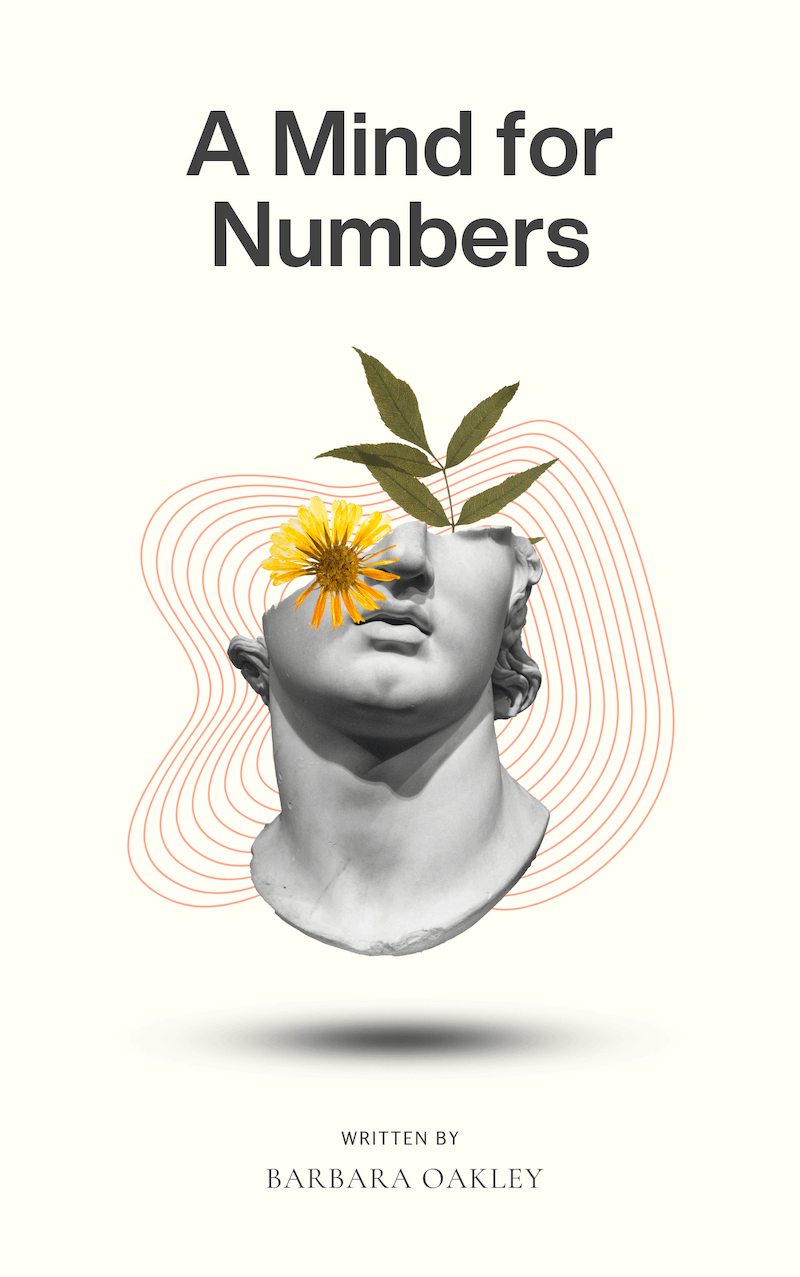
Prefer the print book? Buy on Amazon
As an Amazon Associate, Sumizeit earns from qualifying purchases.
A Mind for Numbers Book Summary
This A Mind for Numbers Book Summary covers the key ideas, lessons, and takeaways in about 20 minutes.
Helps with these goals
Want the complete 20-minute summary?
- Full structured summary
- Video Summary
- Podcast Summary
- Audio summary
- Key takeaways
- Exercises
- Quiz
- Highlights and notes
- Ask the book with AI
Not ready to upgrade?
Get this summary + 2 more picks sent to your inbox, free.
What is in the A Mind for Numbers book summary?
Below is a preview of Sumizeit’s expert-written summary of A Mind for Numbers by Barbara Oakley. The full summary covers the book’s key ideas in text, audio, and video.
In A Mind for Numbers, Barbara Oakley draws from neuroscience, psychology, and her own experience of transforming from a self-described “hopeless math student” to an engineering professor to show how anyone can learn difficult subjects like math and science. She argues that learning isn’t a matter of talent—it’s about understanding how your brain works.
Oakley explains that the brain has two primary modes of thinking: the focused mode and the diffuse mode. The focused mode is active when you’re concentrating intensely on solving a problem—like writing a computer algorithm, balancing a chemical equation, or studying a complex formula. This mode relies on deliberate, logical, and sequential thought, similar to how a flashlight beam illuminates one narrow spot.
The diffuse mode, by contrast, is what happens when you relax your mind—during a walk, a shower, or even while washing dishes. In this mode, the brain connects ideas broadly, linking seemingly unrelated concepts. Oakley compares it to a lantern’s soft, wide light that illuminates the whole room. She points out that many breakthroughs occur in this diffuse mode. For example, mathematician Henri Poincaré solved some of his toughest problems while stepping onto a bus, not sitting at his desk. Similarly, Einstein credited his habit of daydreaming and violin playing with sparking his creative physics insights.
Oakley emphasizes that true learning requires a balance between both modes. If you stay too long in focused mode, your brain becomes mentally rigid, making it harder to see creative solutions. But if you never enter focused mode, your learning remains shallow. She recommends alternating between the two deliberately using techniques like the Pomodoro Technique—25 minutes of intense focus followed by a 5-minute break. This rhythm allows the brain to rest and form new neural connections during the breaks, which is when much of the actual learning happens.
Building Knowledge Through Chunking
A key idea in Oakley’s framework is chunking, the process of grouping bits of information into larger, more meaningful “chunks” that your brain can recall and use efficiently. She explains that this process mirrors how experts think. A beginner chess player, for example, sees individual pieces on a board, but a grandmaster instantly recognizes patterns of play—these are cognitive chunks.
Oakley provides several examples of chunking in practice:
A musician no longer reads each note individually but sees phrases and patterns of rhythm.
A programmer doesn’t memorize each line of code but recognizes entire structures such as loops and conditionals.
A math student learns to identify types of equations and recall the appropriate solution method without starting from scratch each time.
To build strong chunks, Oakley outlines a four-step process:
Focus on the concept completely. Distraction prevents chunk formation. For example, when learning the quadratic formula, give it your full attention—don’t multitask or half-listen.
Understand the idea. It’s not enough to memorize; you must grasp why it works. Ask yourself, “What problem does this formula solve?”
Practice and recall. Work through problems until the process becomes intuitive.
Want the complete 20-minute summary?
- Full structured summary
- Video Summary
- Podcast Summary
- Audio summary
- Key takeaways
- Exercises
- Quiz
- Highlights and notes
- Ask the book with AI
Who should read A Mind for Numbers?
A Mind for Numbers is ideal for students struggling with math, science, or technical subjects, as well as professionals seeking to master complex skills in any field. It's also perfect for educators and parents who want to understand how the brain learns and can help others learn more effectively. Whether you've labeled yourself "bad at math" or simply want to optimize your learning strategy, this book provides practical tools for anyone willing to challenge that limiting belief.
Why does A Mind for Numbers matter?
In an era where continuous learning is essential for career success and personal growth, understanding how your brain actually works transforms your ability to master difficult subjects. Barbara Oakley's neuroscience-backed strategies demolish the myth that intelligence is fixed, offering hope and actionable methods to anyone who's struggled academically. Her insights about focus, memory, and productive struggle are increasingly relevant as people navigate rapid technological change and the need for lifelong skill development.
What are the key themes in A Mind for Numbers?
- Intelligence and ability are developable, not fixed traits
- The balance between focused and diffuse thinking modes enables real breakthroughs
- Chunking information into meaningful patterns mirrors how experts think
- Struggle and discomfort are signs of learning, not failure
- Sleep, exercise, and rest are active learning processes, not distractions from it
- Deliberate practice and active recall outperform passive review
- Procrastination stems from brain avoidance of discomfort, not laziness
Want the complete 20-minute summary?
- Full structured summary
- Video Summary
- Podcast Summary
- Audio summary
- Key takeaways
- Exercises
- Quiz
- Highlights and notes
- Ask the book with AI
How can you apply ideas from A Mind for Numbers?
- Use the Pomodoro Technique to structure your study sessions, working in 25-minute focused intervals with 5-minute breaks to activate your diffuse thinking mode
- Create a study plan that reviews material at gradually increasing intervals (one day, three days, one week) to move knowledge into long-term memory through spaced repetition
- Close your notes and test yourself frequently on material rather than rereading, triggering active recall to strengthen neural pathways
- Mix different types of problems during study sessions instead of drilling identical ones, preparing your brain for real-world problem-solving where you must choose the right approach
- Review challenging material before bed and prioritize quality sleep to allow your brain to consolidate learning overnight and wake with fresh insights
- Change your study environment if procrastination patterns emerge, breaking the habit loop by removing environmental cues that trigger avoidance
- Deliberately seek out difficult problems and focus your practice on your weaknesses rather than repeating easy material you already understand
- Incorporate a 20-minute walk or brief exercise into your study routine to boost oxygen flow, focus, and cognitive performance
What common mistakes do readers make with A Mind for Numbers?
- Assuming intelligence is fixed and believing you simply 'don't have a math brain,' which becomes a self-fulfilling prophecy that prevents effort and growth
- Relying on passive review like rereading notes or watching tutorials, which creates an illusion of understanding without triggering the active recall necessary for real learning
- Cramming material the night before a test, depriving your brain of sleep consolidation and spaced repetition that moves knowledge into long-term memory
- Staying in focused mode for hours without breaks, causing mental rigidity and preventing your diffuse mode from making creative connections and consolidating learning
- Treating procrastination as a character flaw rather than a neurological response to discomfort, which prevents you from addressing the actual cause through environmental and behavioral changes
- Drilling identical practice problems repeatedly, which creates false confidence but doesn't prepare you to recognize when to apply different methods in varied situations
Sumizeit Exercises Apply what you've learned
Turn ideas from A Mind for Numbers into action with a short guided reflection: identify the biggest takeaway, connect it to your life, and commit to one step you can take in the next 24 hours.
What is the expert analysis of A Mind for Numbers?
Overview
A Mind for Numbers by Barbara Oakley is a seminal work that bridges neuroscience, psychology, and practical pedagogy to demystify the process of learning challenging subjects such as mathematics and science. Oakley’s unique perspective stems from her personal transformation—from struggling student to accomplished engineering professor—lending the book both academic rigor and relatable authenticity. This blend of empirical insight and lived experience makes the book a significant contribution to educational literature, particularly in an era where effective learning strategies are in high demand.
Core Thesis
At its core, Oakley’s thesis posits that mastery in technical disciplines is not a product of innate talent but the result of understanding and leveraging how the brain functions. Central to this is the dual-mode theory of cognition: the focused mode for concentrated, logical problem-solving, and the diffuse mode for relaxed, associative thinking that fosters creativity and insight. Mastery arises from intentionally cycling between these modes, complemented by cognitive chunking, deliberate practice, and strategic management of procrastination. The overarching insight is empowering—intelligence and skill acquisition are malleable and can be cultivated through effortful, informed strategies.
Strengths
- Integration of Neuroscience and Practical Advice: Oakley skillfully translates complex brain science into actionable learning techniques, making cognitive theory accessible without oversimplification.
- Personal Narrative as a Motivational Framework: Her autobiographical elements humanize the learning journey, offering hope and a roadmap for those who feel intellectually inadequate.
- Comprehensive Toolkit of Strategies: The book covers a broad spectrum of evidence-based methods—chunking, spaced repetition, active recall, and the Pomodoro Technique—grounded in cognitive psychology and educational research.
- Emphasis on Growth Mindset and Emotional Factors: By addressing procrastination, anxiety, and motivation, Oakley acknowledges the psychological barriers to learning, providing holistic guidance beyond mere technique.
- Use of Metaphors and Analogies: These pedagogical devices facilitate deeper understanding by linking abstract concepts to familiar experiences, enhancing retention and reducing fear of complex subjects.
Critiques & Counterarguments
- Potential Oversimplification of Cognitive Modes: The dichotomy of focused versus diffuse modes, while pedagogically useful, risks oversimplifying the nuanced and dynamic nature of brain activity. Contemporary neuroscience suggests a more integrated and overlapping interplay of neural networks during learning.
- Limited Engagement with Individual Differences: Oakley’s framework assumes a degree of universality that may not account sufficiently for neurodiversity or varied learning styles, which could limit applicability for some readers.
- Evidence Base and Empirical Rigor: While many techniques are supported by research, some examples rely heavily on anecdotal evidence or classical case studies (e.g., Poincaré, Einstein) that may romanticize the diffuse mode’s role without rigorous experimental validation.
- Competing Educational Theories: Constructivist and socio-cultural theories emphasize learning as a socially mediated process, which Oakley’s largely individualistic and cognitive approach may underemphasize.
- Real-World Constraints: The recommended strategies, such as deliberate practice and spaced repetition, require substantial self-discipline and time investment that may not be feasible for all learners, particularly those in under-resourced or high-pressure educational environments.
Who Should Read This
A Mind for Numbers is ideally suited for learners and educators seeking a scientifically grounded yet practical guide to mastering challenging technical subjects. It appeals to:
- Students struggling with math, science, or engineering who need motivation and effective study strategies.
- Adult learners and professionals aiming to acquire new technical skills or re-skill in a rapidly evolving job market.
- Educators and tutors interested in incorporating cognitive science principles into their teaching methodologies.
- Readers fascinated by the neuroscience of learning who appreciate a balance of theory and application.
- Individuals interested in self-improvement frameworks that emphasize growth mindset and overcoming psychological barriers like procrastination.
Frequently asked questions about the A Mind for Numbers book summary
What is A Mind for Numbers about?
A Mind for Numbers by Barbara Oakley reveals how your brain actually learns, drawing on neuroscience and her personal journey from math failure to engineering professor. The book teaches practical strategies—from understanding focused and diffuse thinking modes to chunking information and deliberate practice—that enable anyone to master difficult subjects like math and science, proving that intelligence is built through effort and smart learning strategies, not innate talent.
Who should read A Mind for Numbers?
Anyone struggling with math, science, or technical subjects will benefit from this book, as will students seeking to optimize their learning approach and educators wanting to understand how brains learn. Professionals in any field who need to master complex skills, parents wanting to help their children study effectively, and anyone who's internalized the belief that they 'aren't good at math' will find hope and practical tools in Oakley's framework.
What are the main takeaways from A Mind for Numbers?
The core takeaways are: (1) Balance focused thinking for problem-solving with diffuse thinking for creative breakthroughs using techniques like the Pomodoro method; (2) Build expertise by chunking information into meaningful patterns and connecting them; (3) Use active recall and spaced repetition instead of passive review; (4) Treat procrastination as a brain avoidance response you can manage through environmental changes; (5) Embrace struggle as learning, prioritize sleep and exercise, and adopt a growth mindset that views intelligence as developable.
How does the Pomodoro Technique help learning according to Barbara Oakley?
The Pomodoro Technique—working in 25-minute focused sessions followed by 5-minute breaks—aligns with how your brain naturally learns. The focused intervals engage your concentrated problem-solving mode, while the breaks activate your diffuse mode, which is when your brain actually consolidates knowledge and makes creative connections. This rhythm prevents mental rigidity and maximizes learning efficiency.
What is chunking and why does it matter for learning?
Chunking is grouping bits of related information into larger, meaningful patterns your brain can recall instantly—similar to how a chess grandmaster recognizes board patterns or a musician sees phrase structures rather than individual notes. Oakley explains that expertise is built on chunks; by deliberately grouping concepts and practicing recall, you transform scattered knowledge into intuitive understanding that transfers to new problems.
How does sleep affect learning according to A Mind for Numbers?
Sleep is an active learning process, not wasted time away from studying. During deep sleep, your brain transfers knowledge from short-term to long-term storage and clears toxins accumulated during the day. Reviewing material before bed leverages this process, which is why people often wake up with fresh insights. Students who sleep well outperform those who cram, because sleep consolidation is where knowledge actually sticks.
What does Barbara Oakley say about procrastination?
Oakley reframes procrastination not as laziness but as your brain's neurological response to discomfort—when you face a difficult task, your brain's insular cortex registers pain, triggering avoidance of easier, rewarding activities. Understanding this cause helps you address it through techniques like the Pomodoro method to lower initial resistance, changing your study environment, and deliberately setting new cues and rewards rather than relying on willpower alone.
How can understanding focused and diffuse thinking modes improve my learning?
The focused mode is your concentrated, logical thinking used for problem-solving and absorbing initial concepts, while the diffuse mode is your relaxed, broad pattern-recognition activated during breaks, walks, or sleep—when many breakthroughs occur. Oakley shows that real learning requires balancing both: intense focus to build chunks of knowledge, then diffuse time for your brain to consolidate and make creative connections. The Pomodoro Technique and regular breaks deliberately activate this balance.
About Sumizeit
Sumizeit is a profitable Scomy LLC company based in Miami, Florida. It has been helping readers learn from nonfiction books for 7 years with expert-written summaries in text, audio, podcast, and video.
Want the complete 20-minute summary?
- Full structured summary
- Video Summary
- Podcast Summary
- Audio summary
- Key takeaways
- Exercises
- Quiz
- Highlights and notes
- Ask the book with AI
Here's why readers love Sumizeit
Join thousands of learners getting smarter every day
"Great experience. Detailed summaries. Loved the gamification feature. Makes learning fun. Good customer service. I recommend Sumizeit to anyone. You'll learn a lot."
"I always felt busy but still wanting to keep up with the book discussion in my friend group. This was a great supplement to help me keep reading the books I find fun while keeping up with important books."
"I love this website. Instead of scrolling social media, I find myself learning a lot. I use it everyday. I recommend this app for anyone who is too busy and wants to get up to speed with their favorite books."
A Mind for Numbers Book Summary PDF
Looking for a A Mind for Numbers Book Summary PDF you can save and revisit offline? Our A Mind for Numbers Book Summary PDF captures the book’s core ideas in a clean, printable format — the key frameworks, takeaways, and structure without the fluff. Download the A Mind for Numbers Book Summary PDF when you want a reference you can annotate, share with your team, or review on the go. Get your A Mind for Numbers Book Summary PDF from the download page below.
Download A Mind for Numbers Book Summary PDFPeople also liked these summaries
Readers who explored A Mind for Numbers often enjoyed these titles next.




Want the complete 20-minute summary?
- Full structured summary
- Video Summary
- Podcast Summary
- Audio summary
- Key takeaways
- Exercises
- Quiz
- Highlights and notes
- Ask the book with AI
Featured Book Titles
Popular Book Summaries at sumizeit, leading book summary app