


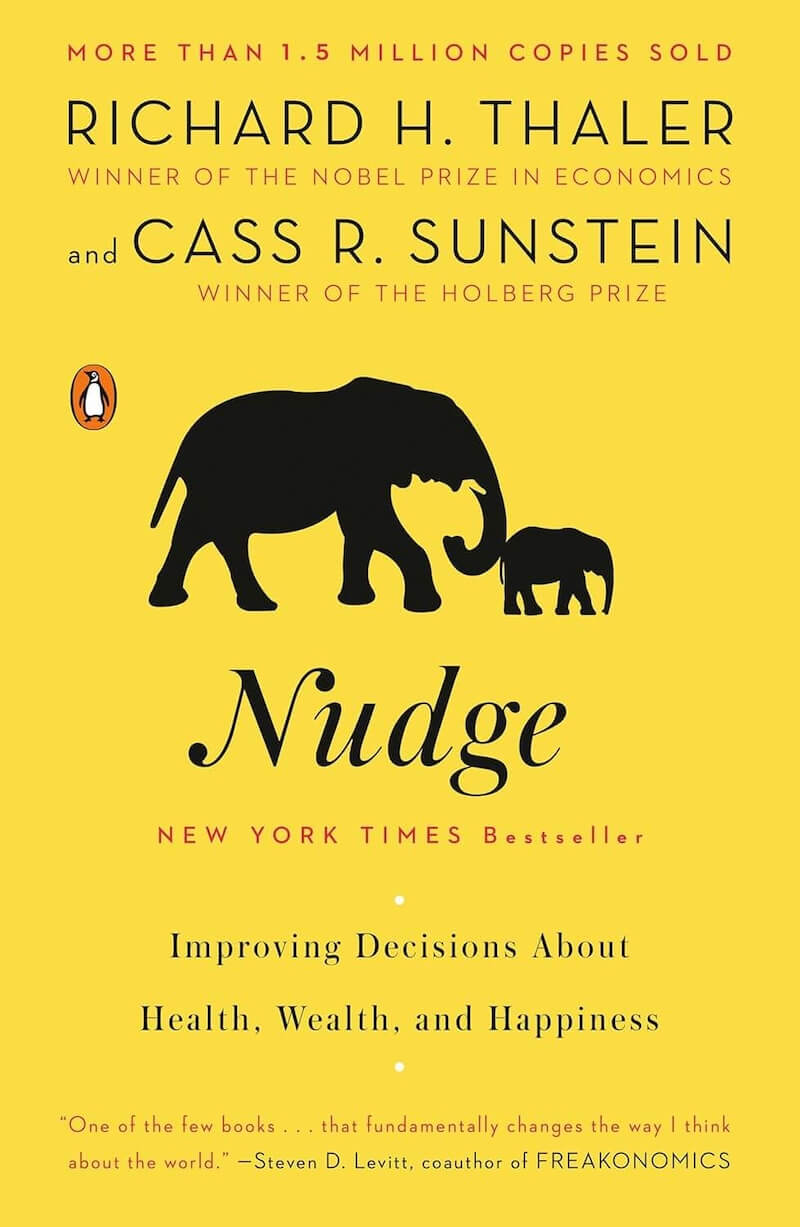
Prefer the print book? Buy on Amazon
As an Amazon Associate, Sumizeit earns from qualifying purchases.
Nudge Book Summary
This Nudge Book Summary covers the key ideas, lessons, and takeaways in about 20 minutes.
Helps with these goals
Want the complete 20-minute summary?
- Full structured summary
- Video Summary
- Podcast Summary
- Audio summary
- Key takeaways
- Exercises
- Quiz
- Highlights and notes
- Ask the book with AI
Not ready to upgrade?
Get this summary + 2 more picks sent to your inbox, free.
What is in the Nudge book summary?
Below is a preview of Sumizeit’s expert-written summary of Nudge by Cass R. Sunstein, Richard H. Thaler. The full summary covers the book’s key ideas in text, audio, and video.
In Nudge: Improving Decisions About Health, Wealth, and Happiness, Richard H. Thaler and Cass R. Sunstein revolutionize our understanding of how humans make decisions. They argue that people are not purely rational calculators who carefully weigh every cost and benefit. Instead, we are deeply influenced by emotions, cognitive shortcuts, and the environment around us. The authors introduce the concept of choice architecture, the idea that every environment in which we make decisions—whether a cafeteria, an online store, or a government form—has a structure that influences outcomes.
The book’s central thesis is that because no decision environment is ever neutral, choice architects—those who design how options are presented—should use this power to promote choices that improve people’s lives. For example, when a cafeteria places fruit at eye level and desserts on a lower shelf, more people will choose the fruit, even though both remain available. The same logic applies to personal finance, healthcare, and environmental policy.
This principle leads to libertarian paternalism, a philosophy that blends freedom and guidance. People retain complete autonomy (“libertarian”), but choice architects gently steer them toward decisions that enhance welfare (“paternalism”). It’s about giving a nudge, not a shove.
Understanding Why People Make Mistakes
Thaler and Sunstein build their argument on decades of behavioral research showing that people are predictably irrational. They make systematic mistakes due to cognitive biases—mental shortcuts that help us make quick decisions but often lead us astray.
Here are the most common biases explored in Nudge:
Anchoring Bias: Our judgments are unduly influenced by the first number or piece of information we see. For example, if a car’s price tag says “$50,000” but is discounted to $35,000, we perceive it as a bargain, even if $35,000 is still overpriced. Real estate agents also exploit this bias by showing an expensive home first to make subsequent homes seem more affordable.
Availability Bias: We overestimate the likelihood of events that are more memorable or vivid. After watching news about shark attacks or plane crashes, people fear flying or swimming more than they statistically should, even though the risks are minimal.
Representativeness Bias: We stereotype situations or people based on superficial similarities. For instance, investors might assume a rising stock must continue to rise because it “fits” the pattern of success, even when data suggests otherwise.
Status Quo Bias: We prefer things to stay as they are. Employees often fail to enroll in 401(k) retirement plans simply because enrollment requires extra steps.
Loss Aversion: People experience losses about twice as intensely as they experience gains of the same size. A person may refuse to sell a losing stock because realizing a loss feels worse than keeping a poor investment.
Overconfidence: Most of us believe we’re better-than-average drivers, decision-makers, or investors. This bias fuels risky behavior, from overtrading in financial markets to underestimating health risks.
These biases reveal that even intelligent people make suboptimal choices when faced with uncertainty, complexity, or temptation.
Want the complete 20-minute summary?
- Full structured summary
- Video Summary
- Podcast Summary
- Audio summary
- Key takeaways
- Exercises
- Quiz
- Highlights and notes
- Ask the book with AI
Who should read Nudge?
Nudge is essential for anyone involved in designing systems, policies, or products that affect people's choices—from government officials and business leaders to educators and healthcare administrators. It's also valuable for individuals who want to understand why they make the decisions they do and how to design their own environments for better outcomes. Whether you're interested in behavioral economics, public policy, or simply making smarter life choices, this book provides actionable insights backed by decades of research.
Why does Nudge matter?
In an increasingly complex world where small design choices have enormous consequences, understanding how humans actually make decisions has never been more important. Nudge reveals that people don't behave as perfectly rational actors, and that recognizing this fact allows us to design smarter systems that improve health, financial security, and societal welfare without restricting freedom. From retirement savings to organ donation to energy conservation, the principles in this book are actively reshaping policy and business globally, making it essential reading for anyone seeking to create meaningful positive change.
What are the key themes in Nudge?
- Cognitive biases and how predictable irrationality influences decisions
- Choice architecture and the power of environment design
- Libertarian paternalism: balancing freedom with gentle guidance
- The role of defaults and inertia in shaping behavior
- Social proof and the influence of peer behavior
- Smart disclosure and transparent information design
- Reducing sludge and friction to enable better choices
- Ethical nudging and preserving human autonomy
Want the complete 20-minute summary?
- Full structured summary
- Video Summary
- Podcast Summary
- Audio summary
- Key takeaways
- Exercises
- Quiz
- Highlights and notes
- Ask the book with AI
How can you apply ideas from Nudge?
- Redesign retirement savings plans with automatic enrollment to increase participation from 60% to over 90%
- Simplify government benefit applications and reduce sludge so eligible people actually receive support they're entitled to
- Set beneficial defaults (green energy, healthier lunch options, organ donation) while making alternatives easily available
- Use comparative peer messaging and social proof to encourage energy conservation, tax compliance, or health behaviors
- Create smart disclosure systems with standardized, transparent information (nutrition labels, mortgage calculators, energy ratings) to enable informed decisions
- Reduce decision complexity through better organization, clearer categories, and plain-language communication
- Add friction to harmful choices (confirmation steps before risky investments) and reduce friction for beneficial ones (one-click healthy options)
- Provide visible feedback on consequences of choices (real-time energy use, savings growth, health metrics) to help course-correct
What common mistakes do readers make with Nudge?
- Assuming people are rational calculators who carefully weigh costs and benefits rather than recognizing they rely on mental shortcuts and are influenced by context
- Framing messages around what people don't do (e.g., 'most people don't recycle') which normalizes bad behavior rather than encouraging good behavior
- Creating choices that require active enrollment for beneficial programs, losing the power of defaults and inertia
- Designing systems that add unnecessary friction and sludge, making it harder for people to act in their own best interest
- Ignoring how presentation and framing of identical information produce dramatically different behavioral responses
- Viewing nudges as manipulation rather than recognizing that all choice environments already influence behavior—ethical nudging just makes that influence intentional and beneficial
Sumizeit Exercises Apply what you've learned
Turn ideas from Nudge into action with a short guided reflection: identify the biggest takeaway, connect it to your life, and commit to one step you can take in the next 24 hours.
What is the expert analysis of Nudge?
Overview
Nudge: Improving Decisions About Health, Wealth, and Happiness is a seminal work co-authored by Richard H. Thaler, a Nobel Prize-winning economist and pioneer of behavioral economics, and Cass R. Sunstein, a distinguished legal scholar and former government regulator. Published in 2008, the book has profoundly influenced public policy, business strategy, and psychological understandings of decision-making by introducing the concept of “choice architecture.” Its significance lies in bridging economics, psychology, and law to demonstrate how subtle environmental cues can steer human behavior toward better outcomes without restricting freedom.
Core Thesis
Thaler and Sunstein argue that humans are predictably irrational, often making decisions influenced by cognitive biases and heuristics rather than pure rationality. Because no decision environment is neutral, those who design choice contexts—“choice architects”—have both the power and responsibility to nudge individuals toward choices that improve their welfare. This approach, termed libertarian paternalism, preserves freedom of choice while gently guiding decisions through thoughtfully designed defaults, simplifications, and social norms. The central insight is that small, well-crafted interventions in the decision environment can yield outsized benefits in health, finance, and societal well-being.
Strengths
- Interdisciplinary Synthesis: The book masterfully integrates insights from behavioral economics, psychology, and law, providing a robust framework for understanding and improving decision-making.
- Practical Applicability: By offering concrete examples—such as automatic enrollment in retirement plans and organ donation opt-out policies—the authors demonstrate how theory translates into effective real-world interventions.
- Ethical Nuance: The concept of libertarian paternalism balances autonomy with guidance, addressing concerns about manipulation while advocating for responsible choice design.
- Clarity and Accessibility: Despite the complexity of its subject, the book communicates ideas with clarity and engaging prose, making it accessible to policymakers, business leaders, and general readers alike.
- Empirical Foundation: The reliance on decades of behavioral research and real-world experiments lends credibility and weight to the authors’ claims.
Critiques & Counterarguments
- Potential for Ethical Slippery Slope: Critics warn that even transparent nudges risk paternalism sliding into coercion or manipulation, especially when wielded by governments or corporations with conflicting interests.
- Limited Scope for Systemic Change: While nudges can improve individual choices, they may be insufficient to address deep structural issues such as poverty, inequality, or climate change, which require broader regulatory or economic reforms.
- Overreliance on Defaults and Simplifications: Some argue that defaults may encourage passivity rather than informed decision-making, potentially undermining critical thinking and long-term engagement.
- Competing Theories of Decision-Making: Alternative models, such as those emphasizing deliberative rationality or social constructivism, challenge the primacy of cognitive biases and suggest that context and culture play more complex roles than nudging accounts allow.
- Empirical Ambiguities: Some studies show mixed results regarding the durability and generalizability of nudges, raising questions about their effectiveness across diverse populations and settings.
Who Should Read This
Nudge is essential reading for policymakers, behavioral scientists, economists, and business strategists seeking to harness behavioral insights to improve decision environments ethically and effectively. It also benefits psychologists and legal scholars interested in the intersection of human behavior and institutional design. Finally, thoughtful general readers who wish to understand the subtle forces shaping their daily choices will find the book illuminating and empowering, as it offers tools to recognize and potentially counteract cognitive biases in their own lives.
Frequently asked questions about the Nudge book summary
What is Nudge about?
Nudge by Richard H. Thaler and Cass R. Sunstein explores how people make decisions and how subtle environmental design—called 'nudges'—can improve those decisions without restricting freedom. The book demonstrates that because no choice environment is ever neutral, architects of those environments should intentionally design them to help people make better decisions about health, wealth, and happiness.
Who should read Nudge?
Nudge is essential for policymakers, business leaders, product designers, and anyone responsible for how choices are presented to others. It's also valuable for individuals wanting to understand their own decision-making patterns and improve their lives. Whether you're interested in behavioral economics, public policy, personal finance, or simply making smarter choices, this book provides actionable, research-backed insights.
What are the main takeaways from Nudge?
Nudge's core message is that human behavior is predictable and manageable through smart design. The main takeaways include: defaults are extraordinarily powerful, social proof influences behavior, cognitive biases lead us astray predictably, small environmental changes produce enormous results, and we can improve outcomes by designing systems around how people actually behave rather than how we wish they behaved—all while preserving freedom of choice.
What is choice architecture?
Choice architecture refers to the structure and design of the environment in which people make decisions. Every choice environment—from a cafeteria layout to a website design to a government form—has a structure that influences what people choose. Since no choice context is neutral, choice architects should design these environments intentionally to improve outcomes.
How do defaults change behavior in Nudge?
Defaults are one of the most powerful nudges because people tend to accept whatever option requires the least effort. The book shows that automatic enrollment in retirement plans increases participation from 60% to over 90%, and organ donation rates exceed 90% in opt-out countries versus under 25% in opt-in countries—demonstrating that defaults shape behavior even when alternatives are easily available.
What is libertarian paternalism?
Libertarian paternalism is the philosophy underlying Nudge—it combines freedom with gentle guidance. People retain complete autonomy and can always choose differently ('libertarian'), but choice architects help steer them toward decisions that improve their lives ('paternalism'). It's about giving a nudge, not a shove.
What are cognitive biases and why do they matter?
Cognitive biases are mental shortcuts that help us make quick decisions but often lead us astray. Nudge explores six key biases: anchoring (judgment influenced by first information), availability (overestimating memorable events), representativeness (stereotyping based on patterns), status quo bias (preferring things unchanged), loss aversion (feeling losses twice as intensely as gains), and overconfidence. Understanding these biases helps explain why people make predictable mistakes.
How does Nudge apply to real-world policy and business?
Nudge principles are actively used in public health (vaccination reminders), education (homework deadline texts), environmental policy (visible recycling bins, green energy defaults), finance (automatic savings escalation), and consumer behavior (frictionless purchasing). The UK Behavioural Insights Team and similar government nudge units worldwide use these insights to increase tax compliance, improve health outcomes, and reduce missed public services without expensive mandates.
About Sumizeit
Sumizeit is a profitable Scomy LLC company based in Miami, Florida. It has been helping readers learn from nonfiction books for 7 years with expert-written summaries in text, audio, podcast, and video.
Want the complete 20-minute summary?
- Full structured summary
- Video Summary
- Podcast Summary
- Audio summary
- Key takeaways
- Exercises
- Quiz
- Highlights and notes
- Ask the book with AI
Here's why readers love Sumizeit
Join thousands of learners getting smarter every day
"Great experience. Detailed summaries. Loved the gamification feature. Makes learning fun. Good customer service. I recommend Sumizeit to anyone. You'll learn a lot."
"I always felt busy but still wanting to keep up with the book discussion in my friend group. This was a great supplement to help me keep reading the books I find fun while keeping up with important books."
"I love this website. Instead of scrolling social media, I find myself learning a lot. I use it everyday. I recommend this app for anyone who is too busy and wants to get up to speed with their favorite books."
Nudge Book Summary PDF
Looking for a Nudge Book Summary PDF you can save and revisit offline? Our Nudge Book Summary PDF captures the book’s core ideas in a clean, printable format — the key frameworks, takeaways, and structure without the fluff. Download the Nudge Book Summary PDF when you want a reference you can annotate, share with your team, or review on the go. Get your Nudge Book Summary PDF from the download page below.
Download Nudge Book Summary PDFPeople also liked these summaries
Readers who explored Nudge often enjoyed these titles next.

Want the complete 20-minute summary?
- Full structured summary
- Video Summary
- Podcast Summary
- Audio summary
- Key takeaways
- Exercises
- Quiz
- Highlights and notes
- Ask the book with AI
Featured Book Titles
Popular Book Summaries at sumizeit, leading book summary app