


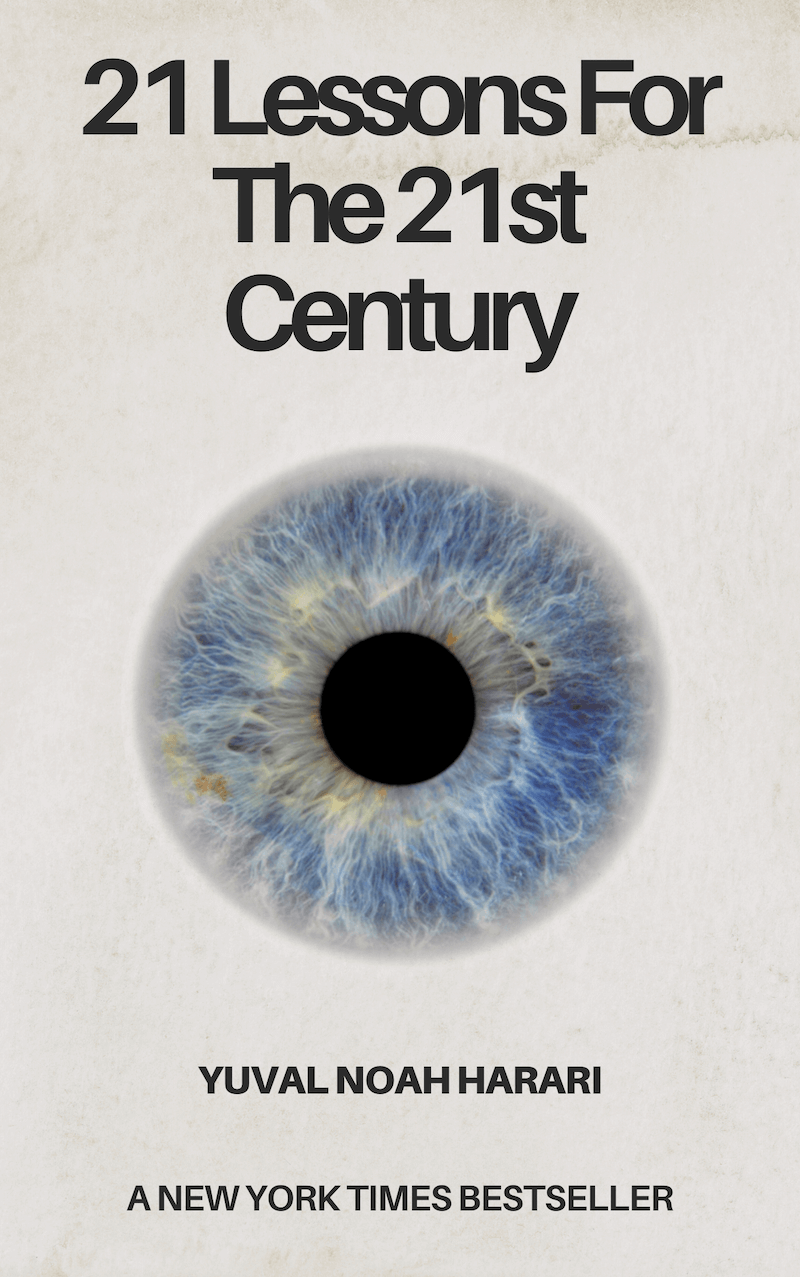
21 Lessons For The 21st Century Book Summary
This 21 Lessons For The 21st Century Book Summary covers the key ideas, lessons, and takeaways in about 20 minutes.
Harari harps on the importance of critical thinking and analysis, as well as embracing our limits of understanding as the world grows more and more complex. This includes approaching tense social issues with logic and debate, rather than with fear and tenacity.
Being able to distinguish truth from misinformation is one of the most important skills a person can adopt during a time when we are flooded with information from various media and platforms daily.
Although many of us fear issues such as terrorism and technological advancement affecting our individual economic stability, we must rely on our ability to stay engaged, flexible, and informed.
Helps with these goals
Want the complete 20-minute summary?
- Full structured summary
- Video Summary
- Podcast Summary
- Audio summary
- Key takeaways
- Exercises
- Quiz
- Highlights and notes
- Ask the book with AI
What is in the 21 Lessons For The 21st Century book summary?
Below is a preview of Sumizeit’s expert-written summary of 21 Lessons For The 21st Century by Yuval Noah Harari. The full summary covers the book’s key ideas in text, audio, and video.
Key Insights
In “21 Lessons for the 21st Century” by Yuval Noah Harari, the author dives into how our 21st-century world, full of rapidly evolving technological advancements, affects both politics and social transformation. He asks the important question of what it means to live, learn, and make decisions in our world today.
Author Harari examines complex issues such as the spread of misinformation, the psychology of terrorism, and the future of education with developments such as artificial intelligence on the rise.
Harari breaks down complicated ideas into accessible and insightful lessons that challenge readers to think critically about their roles as citizens, parents, and individuals in a rapidly changing world.
Whether you're trying to understand how to raise children in an uncertain future or simply make sense of the world around you, “21 Lessons for the 21st Century” serves as a blueprint for navigating the challenges of modern-day life with clarity, awareness, and purpose.
Technology’s Effect On Financial, Economic, & Political Systems
During the 20th century, three political structures competed for global control; they were communism, fascism, and liberalism. When the late 20th century came around, liberalism was the frontrunner as it honored democracy and freedom. But, how well is liberalism holding up now?
It seems as if liberalism is declining, and this could be due to the rapid advancement in information technology.
It’s no secret that since the 1990s, computers have become a staple in our daily lives and have redesigned the way we live. And although technology plays a hand in everything we do, it’s becoming more and more clear that politicians are not able to control it.
For example, let’s look at the world of finance. Technology has recreated our financial system, which has made it almost impossible for the Average Joe to understand it. If we keep going down this road of technological advancements, there may come a time when no human will be able to make sense of financial data.
Think about the enormity of that circumstance! If we, as humans, can’t understand financial data, governments will be waiting on computers to permit their budgets and tax reform plans. Shouldn’t humans have control over technology? Seems pretty backwards!
Most politicians don’t see the harm in technological disruption. They may not even think of it as a disruption at all. If we look at the 2016 United States presidential election, neither Donald Trump nor Hillary Clinton touched on the fact of job losses due to technology. In reality, the only time technological disruption was discussed was when it concerned the Hillary emails.
With the lack of discussion around technology, voters are beginning to lose faith in our government authorities. Average people living in democracies are seeing the direct impact on their jobs as artificial intelligence becomes a reliable colleague at work. With AI being able to do just about everything a human can do, workers are beginning to feel irrelevant and unheard.
Want the complete 20-minute summary?
- Full structured summary
- Video Summary
- Podcast Summary
- Audio summary
- Key takeaways
- Exercises
- Quiz
- Highlights and notes
- Ask the book with AI
Who should read 21 Lessons For The 21st Century?
21 Lessons For The 21st Century is essential reading for anyone seeking to understand how technology, politics, and rapid change are reshaping our world. Whether you're a parent worried about your children's future, a professional concerned about automation in your field, or simply a citizen trying to make sense of contemporary issues like misinformation and political polarization, this book offers clarity. It's particularly valuable for educators, policymakers, and thoughtful individuals who want to engage critically with the major challenges defining our era.
Why does 21 Lessons For The 21st Century matter?
As artificial intelligence, automation, and digital transformation accelerate, we need frameworks for understanding their consequences—and Harari provides them. The book cuts through the noise of modern life to examine what's really at stake: our economic security, our ability to distinguish truth from misinformation, our political institutions, and how we prepare the next generation. In an age of information overload and rapid technological disruption, gaining clarity on these 21st-century challenges isn't optional—it's fundamental to navigating an uncertain future with awareness and purpose.
What are the key themes in 21 Lessons For The 21st Century?
- The limits of human understanding in a complex world
- Technology's disruptive impact on jobs, politics, and democracy
- The psychology and strategy behind terrorism and fear
- Information overload and the need for critical thinking
- Immigration, cultural identity, and national borders
- The decline of liberal democracy and political instability
- Education reform for an uncertain future
What are the key lessons from the 21 Lessons For The 21st Century book summary?
Technology Outpaces Political Control
Modern politicians lack the understanding and authority to govern rapidly advancing technology, particularly in finance and AI. This disconnect fuels public anxiety and erodes faith in democratic institutions.
AI Threatens Both Physical and Cognitive Work
Unlike the Industrial Revolution, which displaced only physical labor, AI can now replicate cognitive tasks like analysis, communication, and decision-making. This makes virtually no job safe from automation.
Human Intuition Is Pattern Recognition
Neuroscience reveals that what we call intuition and free will are actually the brain's rapid pattern-matching processes. This understanding raises troubling questions about whether AI will soon match or exceed human decision-making in law, finance, and medicine.
Terrorists Win Through Strategic Overreaction
Terrorist groups lack military power but exploit psychological manipulation—using small attacks to provoke disproportionate government responses. The goal is political disruption, not military victory.
Fear Is More Powerful Than Statistics
Terrorism kills far fewer people than traffic accidents, yet generates vastly greater fear and political reaction. This disconnect between actual risk and perceived threat shapes policy and public behavior.
Knowledge Illusion Fuels Overconfidence
Modern humans mistake familiarity for understanding—we think we know how a zipper works simply because we see it daily. This illusion causes people to confidently offer solutions on topics they barely understand.
Ignorance Is More Widespread Than We Admit
The average adult knows far less about how the modern world actually functions than they believe. This gap between perceived and actual knowledge creates dangerous vulnerabilities in democratic decision-making.
Traditional Education Is Obsolete
Schools built to fill students with memorized facts no longer serve a world where information is instantly accessible everywhere. The new priority must be teaching critical thinking and information literacy.
Critical Thinking Distinguishes Truth From Misinformation
In an era of information abundance and AI-generated content, the ability to analyze sources and separate fact from fiction is the most valuable skill a person can develop.
Democracy Is Vulnerable to Technological Disruption
Liberalism and democratic systems assumed an informed electorate and stable economic conditions. Rapid automation and wealth concentration undermine both assumptions, destabilizing political legitimacy.
Worker Anxiety Drives Political Radicalism
As technology threatens employment, citizens lose faith in traditional political parties and turn to populist movements. Events like Brexit and Trump's election partly reflected worker fears about automation and relevance.
Immigration Debates Involve Legitimate Trade-Offs
Immigration forces genuine tensions between cultural diversity and social cohesion, national identity and human opportunity. These cannot be solved by simply labeling one side right and the other wrong.
Assimilation Demands Must Be Questioned
Expecting immigrants to entirely abandon their cultural identity, religion, and traditions to 'fit in' is both unrealistic and unfair—especially when native citizens don't fully embrace their own stated values.
Modern Humans Lack Self-Sufficiency
Unlike our ancestors, contemporary humans depend entirely on complex systems they don't understand and cannot operate independently. This creates both vulnerability and false confidence.
Information Abundance Requires New Skills
The 20th-century problem was information scarcity; the 21st-century problem is abundance, misinformation, and algorithmic filtering. Education must shift from knowledge acquisition to discernment.
Flexibility and Engagement Matter More Than Fixed Knowledge
In a rapidly changing world, the ability to learn, adapt, and stay engaged is more valuable than accumulated facts. Lifelong learning and intellectual humility become essential survival skills.
Political Systems Must Adapt to Technological Reality
Liberal democracy was designed for a different era. Modern political institutions must evolve to address automation, wealth concentration, and information warfare, or lose legitimacy.
Emotional Reactions Drive Bad Policy
Fear, anger, and tribal instinct often override rational analysis in public decision-making, leading to counterproductive responses to genuine threats like terrorism and climate change.
Understanding Complexity Requires Humility
The 21st-century world is too complex for any single expert or ideology to solve. Progress requires acknowledging what we don't know and embracing intellectual humility.
Youth Need Preparation for Uncertainty, Not a Fixed Path
Traditional education prepares students for stable careers in a stable world. Modern education must teach adaptability, resilience, and the mental tools to navigate unpredictable change.
Want the complete 20-minute summary?
- Full structured summary
- Video Summary
- Podcast Summary
- Audio summary
- Key takeaways
- Exercises
- Quiz
- Highlights and notes
- Ask the book with AI
How can you apply ideas from 21 Lessons For The 21st Century?
- Redesign your personal learning approach: focus on developing critical thinking and information literacy rather than memorizing facts you can instantly look up
- Before accepting claims about complex topics like climate change or AI, ask advocates to explain their understanding in detail—this reveals whether they're experts or victims of the knowledge illusion
- Teach children media literacy and skepticism as essential life skills, not optional extras, to help them navigate misinformation
- When evaluating political proposals or fear-based policy arguments, separate actual statistical risk from psychological impact to make better decisions
- Stay intellectually flexible and embrace ongoing learning rather than assuming your current knowledge is sufficient for navigating future change
- Approach polarized social issues like immigration with curiosity about opposing viewpoints, recognizing that complex problems often involve legitimate trade-offs rather than simple right answers
- Advocate for education reform in your community that emphasizes analysis, debate, and problem-solving over rote memorization
What common mistakes do readers make with 21 Lessons For The 21st Century?
- Assuming that because you use technology daily, you understand how it fundamentally works—falling victim to the knowledge illusion
- Overestimating how much you actually know about topics you're unfamiliar with, then confidently offering solutions or opinions
- Letting fear and emotion override statistical reality when evaluating risks like terrorism, leading to disproportionate reactions
- Treating immigration as a purely moral/immoral issue rather than engaging with genuine tensions between cultural preservation and human opportunity
Sumizeit Exercises Apply what you've learned
Turn ideas from 21 Lessons For The 21st Century into action with a short guided reflection: identify the biggest takeaway, connect it to your life, and commit to one step you can take in the next 24 hours.
What is the expert analysis of 21 Lessons For The 21st Century?
Overview
21 Lessons for the 21st Century is authored by Yuval Noah Harari, a historian of global renown whose previous works, Sapiens and Homo Deus, have reshaped popular understanding of humanity’s past and potential futures. This book stands out as a timely and ambitious attempt to grapple with the immediate challenges facing contemporary society—technological disruption, political instability, and social transformation—through a multidisciplinary lens. Harari’s stature as a public intellectual lends significant weight to his exploration of how individuals and societies might navigate the complexities of the present century.
Core Thesis
At its core, 21 Lessons for the 21st Century argues that humanity is entering an unprecedented era defined by rapid technological advancement, particularly in artificial intelligence and biotechnology, which challenges traditional political, economic, and social structures. Harari posits that the key to thriving in this new landscape lies in cultivating critical thinking, embracing intellectual humility regarding our knowledge limits, and fostering adaptive, informed citizenship. He underscores the urgency of rethinking education, political discourse, and identity in order to address issues such as misinformation, automation-driven job displacement, immigration tensions, and the psychological impact of terrorism.
Strengths
- Interdisciplinary Insight: Harari synthesizes history, neuroscience, technology, and political theory to present a holistic view of contemporary challenges, making complex ideas accessible without oversimplifying.
- Clarity and Engagement: The book’s structure into discrete “lessons” allows readers to engage with a wide range of topics in digestible segments, each prompting reflection on personal and societal roles.
- Timeliness and Relevance: Harari addresses pressing issues such as AI’s impact on employment, the fragility of liberal democracies, and the cultural tensions around immigration with immediacy and nuance.
- Emphasis on Critical Thinking: The call to develop analytical skills in the face of information overload is particularly compelling and practically oriented toward educational reform.
- Balanced Social Commentary: The nuanced discussion of immigration debates and terrorism avoids simplistic binaries, encouraging readers to appreciate complexity and multiple perspectives.
Critiques & Counterarguments
- Speculative Projections: While Harari’s foresight is provocative, some predictions about AI’s ability to fully supplant human cognitive roles may underestimate the resilience of human creativity and social intelligence, which remain difficult to automate.
- Technological Determinism: The book occasionally leans toward a deterministic view that technology inevitably disrupts political and economic systems, potentially downplaying human agency, policy interventions, and cultural adaptation that can mediate these effects.
- Oversimplification of Political Dynamics: The framing of liberalism’s decline and populist backlashes such as Brexit and Trump’s election might not fully account for deeper socioeconomic factors, including inequality and globalization, which complicate the narrative of technological disruption alone.
- Limited Engagement with Alternative Perspectives: Competing schools of thought, such as those emphasizing the potential for universal basic income or new forms of democratic participation enabled by technology, receive less attention, leaving the discourse somewhat one-sided.
- Empirical Ambiguity: Some assertions, like the neural basis of “free will” or the precise impact of terrorism relative to other risks, rely on selective evidence that could be challenged by ongoing neuroscientific debates or sociological research emphasizing the role of structural violence and systemic risks.
Who Should Read This
21 Lessons for the 21st Century is essential reading for intellectually curious individuals seeking a broad yet incisive overview of the challenges shaping our contemporary world. It is particularly suited for:
- Policy makers and political theorists interested in the intersection of technology and governance.
- Educators and curriculum developers aiming to rethink pedagogy in an age of information abundance.
- Professionals in technology, economics, and social sciences who want to contextualize their work within larger societal transformations.
- General readers who appreciate thoughtful, accessible discourse on complex global issues and who desire to cultivate a more nuanced understanding of the forces shaping the 21st century.
Frequently asked questions about the 21 Lessons For The 21st Century book summary
What is 21 Lessons For The 21st Century about?
21 Lessons For The 21st Century by Yuval Noah Harari examines how rapid technological advancement, political instability, and information overload are reshaping modern life. The book addresses urgent challenges including AI's impact on employment, the psychology of terrorism, misinformation, immigration, and the future of education—offering frameworks for understanding and navigating these critical issues with clarity and critical thinking.
Who should read 21 Lessons For The 21st Century?
The book is essential for parents, educators, policymakers, professionals worried about automation, and any citizen seeking to understand contemporary challenges. It appeals to thoughtful people who want to think critically about technology's impact, political polarization, and how to prepare younger generations for an uncertain future—anyone trying to make sense of rapid change.
What are the main takeaways from 21 Lessons For The 21st Century?
The core lessons include: politicians cannot control technology; AI threatens all types of jobs; humans suffer from the knowledge illusion and overestimate their understanding; critical thinking is now essential; terrorism wins through strategic overreaction; and education must shift from memorization to analysis. Harari emphasizes that intellectual humility, flexibility, and the ability to distinguish truth from misinformation are the most valuable skills for navigating an uncertain future.
How does Harari explain the impact of AI on employment?
Harari argues that unlike the Industrial Revolution—which only displaced physical labor—modern AI can replicate cognitive work like analysis, decision-making, and communication. This makes virtually no job entirely safe, since computers can now perform both physical and intellectual tasks faster and more accurately than humans, creating unprecedented economic disruption.
Why does Harari think modern education needs to change?
Traditional education focused on filling students' heads with facts, which made sense when information was scarce. Today, facts are instantly accessible via the internet, making memorization obsolete. Instead, schools should teach critical thinking, information literacy, and the ability to analyze competing sources—skills essential for distinguishing truth from misinformation in the 21st century.
What is the knowledge illusion and why does it matter?
The knowledge illusion is the false belief that we understand something simply because it's familiar and we see it regularly. For example, most people think they understand how a zipper works but cannot explain it. This illusion is dangerous because it leads people to confidently offer solutions on topics they barely understand, affecting everything from elections to climate policy.
How does Harari explain terrorism's psychological impact?
Harari uses the metaphor of a fly in a china shop: terrorists lack military power but exploit psychology to provoke disproportionate government responses. A small attack generates enormous fear and political upheaval—the goal is disruption, not military victory. Governments that overreact emotionally play directly into terrorists' strategic hands.
About Sumizeit
Sumizeit is a profitable Scomy LLC company based in Miami, Florida. It has been helping readers learn from nonfiction books for 7 years with expert-written summaries in text, audio, podcast, and video.
Want the complete 20-minute summary?
- Full structured summary
- Video Summary
- Podcast Summary
- Audio summary
- Key takeaways
- Exercises
- Quiz
- Highlights and notes
- Ask the book with AI
Here's why readers love Sumizeit
Join thousands of learners getting smarter every day
"Great experience. Detailed summaries. Loved the gamification feature. Makes learning fun. Good customer service. I recommend Sumizeit to anyone. You'll learn a lot."
"I always felt busy but still wanting to keep up with the book discussion in my friend group. This was a great supplement to help me keep reading the books I find fun while keeping up with important books."
"I love this website. Instead of scrolling social media, I find myself learning a lot. I use it everyday. I recommend this app for anyone who is too busy and wants to get up to speed with their favorite books."
21 Lessons For The 21st Century Book Summary PDF
Looking for a 21 Lessons For The 21st Century Book Summary PDF you can save and revisit offline? Our 21 Lessons For The 21st Century Book Summary PDF captures the book’s core ideas in a clean, printable format — the key frameworks, takeaways, and structure without the fluff. Download the 21 Lessons For The 21st Century Book Summary PDF when you want a reference you can annotate, share with your team, or review on the go. Get your 21 Lessons For The 21st Century Book Summary PDF from the download page below.
Download 21 Lessons For The 21st Century Book Summary PDFPeople also liked these summaries
Readers who explored 21 Lessons For The 21st Century often enjoyed these titles next.


Want the complete 20-minute summary?
- Full structured summary
- Video Summary
- Podcast Summary
- Audio summary
- Key takeaways
- Exercises
- Quiz
- Highlights and notes
- Ask the book with AI
Featured Book Titles
Popular Book Summaries at sumizeit, leading book summary app
