
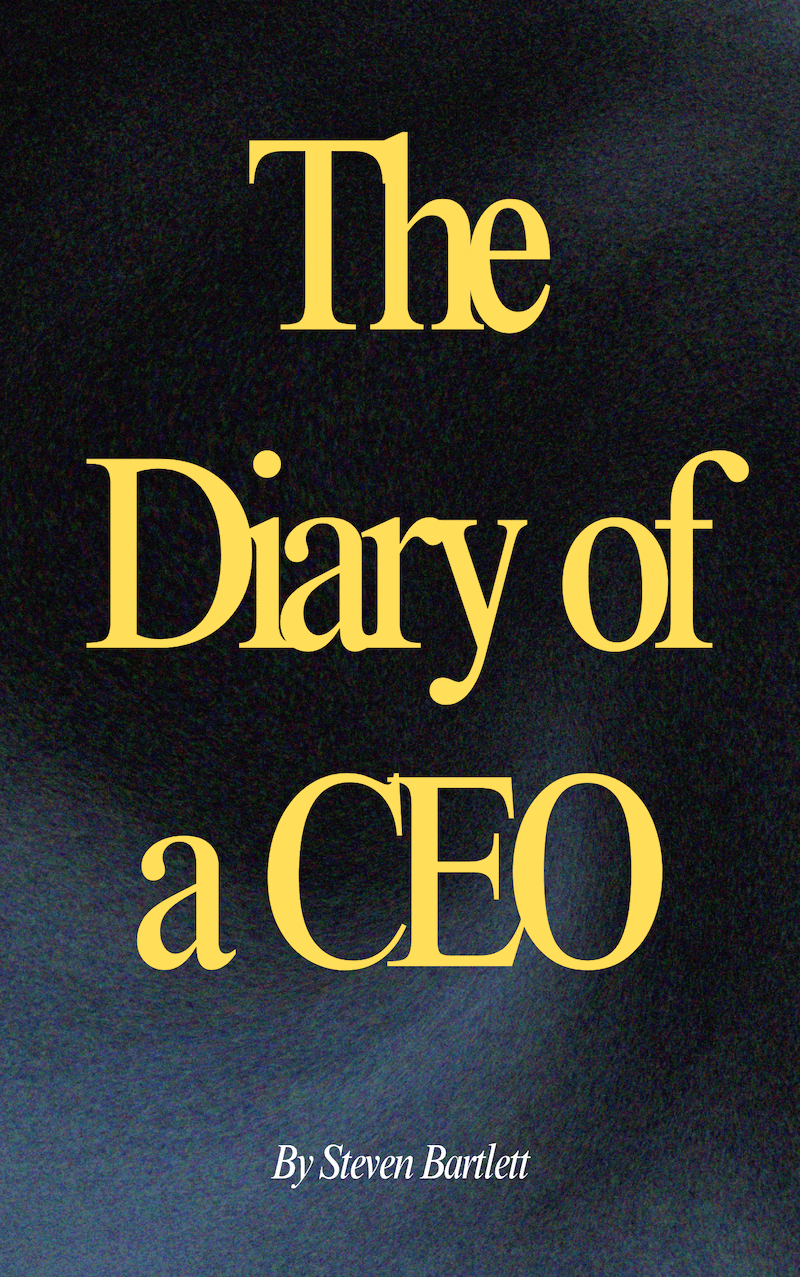
The Diary of a CEO Book Summary
This The Diary of a CEO Book Summary covers the key ideas, lessons, and takeaways in about 20 minutes.
The story is a testament to the power of perseverance and the ability to learn from both successes and failures. Maintaining a clear vision while being adaptable to change is crucial. The narrative serves as a guide for aspiring entrepreneurs, offering practical advice and inspiring insights. The path to success is not linear but filled with challenges that can be overcome with the right mindset and support system.
Want the complete 20-minute summary?
- Full structured summary
- Video Summary
- Podcast Summary
- Audio summary
- Key takeaways
- Exercises
- Quiz
- Highlights and notes
- Ask the book with AI
What is in the The Diary of a CEO book summary?
Below is a preview of Sumizeit’s expert-written summary of The Diary of a CEO by Steven Bartlett. The full summary covers the book’s key ideas in text, audio, and video.
What Will You Learn
Who Is This For
Overview/Background
The Diary of a CEO provides an insightful exploration into the life and lessons of one of the youngest entrepreneurs to make a significant mark in the business world. Born in Botswana in 1992 and raised in the UK, Steven Bartlett rose to fame as the founder of Social Chain, a leading social media marketing agency. His journey from a dropout at Manchester Metropolitan University to becoming the youngest-ever investor on BBC's Dragons' Den is chronicled in this book. The narrative is a collection of thoughts, experiences, and the hard-won wisdom gained while building his empire.
The book, published in 2021, delves into the entrepreneurial journey, offering a candid look at the highs and lows of a career. It captures the essence of the modern business world through a personal lens, filled with reflections on leadership, failure, innovation, and personal growth. Struggles with mental health, self-doubt, and the intense pressure of running a successful business are discussed openly. The book is structured like a diary, with each chapter focusing on a specific aspect of the journey, making it both personal and deeply relatable for aspiring entrepreneurs.
The Power of Vision and Binary Questions
Having a clear and compelling vision is the cornerstone of any successful enterprise. The vision for Social Chain was not just to build a marketing agency but to create a company that would redefine how brands interact with audiences on social media. This vision guided every decision, from the type of clients to the innovative campaigns developed.
A well-articulated vision attracts a talented team and clients who share enthusiasm for the mission. Vision is not static but evolves with time and circumstances, and this evolution is key to adapting to rapid changes in the digital world and staying ahead of the competition.
On the other hand, binary questions or questions that demand a simple yes or no response are particularly effective, especially when they start with 'will' instead of 'can' or 'would.' Using 'will' fosters a sense of ownership, making the question-behavior effect more potent. While 'can' implies capability, 'will' suggests a personal commitment.
In sales, converting a statement into a question grants the prospect a sense of control. Instead of dictating what they should believe or asserting the superiority of your product, you invite them to realize the untapped potential your offer presents.
For example, rather than stating, "This technology will boost your sales," you could ask, "Will you aim for increased revenue growth this quarter?" It's unlikely they would respond negatively, as it subtly steers the conversation towards a positive outcome.
A straightforward yes or no question forces the prospect to decide without room for evasion. They are either interested in improvement or they are not. This approach gently challenges them, guiding them toward meaningful change and encouraging a commitment to enhancing their own performance.
So why are questions so effective? When faced with a question, your brain engages in mental gymnastics, picturing yourself performing the…
Want the complete 20-minute summary?
- Full structured summary
- Video Summary
- Podcast Summary
- Audio summary
- Key takeaways
- Exercises
- Quiz
- Highlights and notes
- Ask the book with AI
Who should read The Diary of a CEO?
The Diary of a CEO is ideal for aspiring entrepreneurs and business leaders seeking practical wisdom from someone who built a multimillion-dollar company from scratch. It's also valuable for professionals navigating digital transformation, anyone struggling with the mental health challenges of ambition, and individuals hungry for candid insights into modern entrepreneurship beyond sanitized business advice.
Why does The Diary of a CEO matter?
In an era of rapid digital disruption and entrepreneurial saturation, Steven Bartlett's unfiltered account reveals what actually drives success—not just tactics, but mindset, resilience, and self-awareness. This book matters because it addresses the real cost of ambition: burnout, self-doubt, and mental health challenges that most business books ignore, offering a more holistic framework for sustainable success.
What are the key themes in The Diary of a CEO?
- Vision as a compass for decision-making
- Learning from failure and embracing setbacks
- Building a cohesive team aligned on values
- Innovation and adaptability in competitive markets
- Mental health and personal well-being in entrepreneurship
- Curiosity and leaning into the unfamiliar
- The power of discipline through environmental design
- Effective communication and leadership
What are the key lessons from the The Diary of a CEO book summary?
A clear, evolving vision guides all decisions
Having a compelling vision attracts talented teams and clients while providing direction. The vision should evolve with market conditions rather than remain rigid, enabling you to stay ahead of competition.
Binary questions create commitment through cognitive dissonance
Yes-or-no questions force clear decisions and leverage the psychological discomfort of misalignment between actions and self-image. Starting with 'will' rather than 'can' suggests personal ownership and commitment.
You have five seconds to capture attention
In a world of shrinking attention spans, your opening moments are critical. Lead with emotionally engaging storytelling rather than data to break through the noise and keep audiences engaged.
Hire for values alignment early, skills later
Early-stage hires define company culture, so prioritize cultural fit alongside expertise. A single misaligned employee can poison an entire team, making values-based hiring crucial when the organization is small.
Culture becomes harder to fix as you scale
The earlier you establish strong cultural foundations, the easier it is to maintain them as the company grows. Once dysfunction takes root in a large organization, systemic change becomes exponentially harder.
Different growth stages require different team compositions
Early-stage teams need mission-driven generalists; scaling requires specialized roles and structured processes; enterprise requires experienced leaders in complex systems. Recognizing when employees no longer fit prevents friction.
Kindness outweighs raw talent in team dynamics
Unkind high performers undermine organizational success by driving away talent and creating toxicity. Fostering a culture of support and kindness strengthens cohesion and improves retention.
Discipline is a formula, not willpower
Discipline = (value of goal + reward of pursuit) / cost of pursuit. Rather than relying on willpower, engineer your environment to increase goal value, make the process enjoyable, and minimize obstacles.
Amplify the value of your goals by connecting to your why
Understanding how achieving a goal improves your life creates intrinsic motivation. The deeper your connection to purpose, the more you can sustain effort over the long term.
Make the process enjoyable to maintain consistency
Finding ways to enjoy the pursuit—whether through music, pleasant environments, or celebrating wins—transforms effort from drudgery into something you anticipate, making consistency natural rather than forced.
Reduce the cost of pursuit through friction minimization
Remove obstacles that make your goals feel burdensome: choose a nearby gym instead of a distant one, break complex tasks into manageable steps, automate low-value work. Small reductions in friction compound.
Lean in when confronted with the unfamiliar
When you encounter strange ideas, uncomfortable situations, or emerging trends, resist the instinct to dismiss them. Instead, approach with curiosity and humility to uncover insights others overlook.
Question your assumptions when leaning in
Challenge yourself to examine why you believe what you believe and whether you fully understand a topic before rejecting it. This metacognitive practice opens pathways to learning and growth.
Curiosity transforms into competitive advantage
By analyzing and learning from the unfamiliar rather than rejecting it, you become attuned to emerging trends and positioned to seize opportunities others miss due to closed-mindedness.
Embrace failure as essential learning data
Failure is not a setback but feedback. The most valuable business lessons come from mistakes, and treating them as information rather than judgment enables continuous improvement.
Know your limits and hand off leadership when appropriate
Founders should recognize when the company's growth surpasses their expertise and be willing to step aside. This self-awareness prevents ego from stalling organizational progress.
Establish robust communication systems for team health
Frameworks like Kaizen—where employees propose and implement improvements—foster accountability and minimize conflict. Teaching productive communication prevents small issues from festering.
Success requires balance between ambition and well-being
Hard work and vision are essential, but without attention to mental health and personal sustainability, the entrepreneurial journey becomes unsustainable. True success integrates both professional achievement and personal well-being.
Converting statements into questions grants prospect control
Rather than asserting superiority or dictating outcomes, frame ideas as questions to let prospects discover value themselves. This psychological shift increases buy-in and commitment.
Your mindset determines your adaptability
Entrepreneurship is inherently nonlinear; challenges are inevitable. The right mindset—one of resilience, curiosity, and learning—combined with a strong support system determines whether obstacles become stepping stones or roadblocks.
Want the complete 20-minute summary?
- Full structured summary
- Video Summary
- Podcast Summary
- Audio summary
- Key takeaways
- Exercises
- Quiz
- Highlights and notes
- Ask the book with AI
How can you apply ideas from The Diary of a CEO?
- Frame your business or personal goals as compelling visions that evolve quarterly based on market feedback and internal learning
- Replace statements with binary 'will' questions in sales conversations to increase prospect commitment and decision clarity
- Audit your first five seconds of every presentation, pitch, or communication to ensure you open with emotional resonance, not data
- Implement a values-based hiring rubric before recruiting, prioritizing cultural alignment alongside technical skills for early-stage positions
- Establish a Kaizen-style continuous improvement system where team members propose and own implementation of workplace enhancements
- Apply the discipline equation to one goal by identifying ways to amplify its value, make the process more enjoyable, and eliminate friction from the pursuit
- Set aside dedicated time each week to 'lean in' on unfamiliar trends, technologies, or ideas by researching deeply rather than dismissing them
What common mistakes do readers make with The Diary of a CEO?
- Hiring for talent alone without ensuring values alignment, which seeds cultural dysfunction from the start
- Failing to evolve your vision as market conditions change, resulting in strategies that become obsolete despite initial clarity
- Neglecting mental health and personal well-being while grinding toward entrepreneurial success, leading to burnout and diminished decision-making
- Reflexively dismissing unfamiliar ideas or emerging trends rather than leaning in with curiosity, causing you to miss opportunities
Sumizeit Exercises Apply what you've learned
Turn ideas from The Diary of a CEO into action with a short guided reflection: identify the biggest takeaway, connect it to your life, and commit to one step you can take in the next 24 hours.
What is the expert analysis of The Diary of a CEO?
Overview
The Diary of a CEO: The 33 Laws of Business and Life is authored by Steven Bartlett, a notable British entrepreneur and social media marketing pioneer. Bartlett’s rise from a university dropout to the founder of Social Chain and a celebrated investor on BBC’s Dragons’ Den situates him as a compelling voice in contemporary entrepreneurship. The book’s significance lies in its candid, diary-style narrative that blends personal vulnerability with pragmatic business insights, offering a rare window into the psychological and strategic dimensions of building a modern enterprise. Published in 2021, it captures the zeitgeist of digital-era entrepreneurship, emphasizing adaptability, mental health, and leadership in a fast-evolving landscape.
Core Thesis
Bartlett’s central argument is that entrepreneurial success is not merely a function of ambition or hard skills but a holistic journey requiring a clear and evolving vision, resilience in the face of failure, disciplined goal pursuit, and a strong, values-driven team culture. He underscores the power of mindset—particularly through mechanisms like binary questioning and the discipline equation—to foster commitment and action. Moreover, Bartlett advocates for embracing discomfort and unfamiliarity (“leaning in”) as essential to continuous growth and innovation. The book posits that sustainable achievement in business and life hinges on balancing strategic rigor with emotional intelligence and self-care.
Strengths
l>Critiques & Counterarguments
l>Who Should Read This
l>Frequently asked questions about the The Diary of a CEO book summary
What is The Diary of a CEO about?
The Diary of a CEO by Steven Bartlett is a candid exploration of one young entrepreneur's journey from university dropout to founding Social Chain, one of the world's leading social media agencies, and becoming the youngest-ever investor on BBC's Dragons' Den. The book combines personal diary-style reflections with 33 practical laws for business and life, covering vision, leadership, failure, innovation, and the often-overlooked importance of mental health in entrepreneurship.
Who should read The Diary of a CEO?
Aspiring entrepreneurs, business leaders, and anyone navigating ambition and personal growth will benefit from this book. It's particularly valuable for people building startups, those working in digital marketing or social media, professionals facing the mental health challenges of high-stakes careers, and individuals seeking authentic, unfiltered insights beyond typical business platitudes.
What are the main takeaways from The Diary of a CEO?
Key takeaways include the importance of a clear, evolving vision; treating failure as learning data; building teams aligned on values rather than skills alone; making discipline a formula rather than relying on willpower; approaching the unfamiliar with curiosity rather than dismissal; and understanding that sustainable success requires balancing ambition with mental health and personal well-being. The book emphasizes that entrepreneurship is nonlinear and demands resilience alongside smart strategy.
How does Steven Bartlett define discipline in The Diary of a CEO?
Bartlett frames discipline as a mathematical equation: (value of goal + reward of pursuit) / cost of pursuit. Rather than purely a matter of willpower, discipline is engineered by amplifying why your goal matters, making the process enjoyable, and removing obstacles. This approach transforms sustained effort from painful sacrifice into something natural and sustainable.
What does 'leaning in' mean according to The Diary of a CEO?
Leaning in means approaching unfamiliar, confusing, or uncomfortable ideas and trends with curiosity and humility rather than dismissing them. The concept encourages questioning your assumptions, digging deeper into emerging phenomena, and resisting the instinct to retreat into comfort. By leaning in, you position yourself to spot opportunities, adapt faster, and gain competitive advantage.
What does Steven Bartlett say about hiring and team building?
Bartlett emphasizes that early hires should prioritize cultural values alignment alongside skills, since one misaligned employee can poison team dynamics. As companies scale, hiring strategies should evolve to reflect different growth stages. Throughout, kindness and support matter more than raw talent alone, and establishing robust communication systems prevents small conflicts from festering into larger problems.
Why does The Diary of a CEO focus on mental health in entrepreneurship?
Bartlett openly discusses his own struggles with mental health, self-doubt, and the psychological pressure of building and running a successful company. He addresses this because ignoring well-being leads to burnout and poor decision-making. The book argues that true entrepreneurial success requires balancing ambition with sustainable self-care, making mental health as strategic as any business tactic.
How can I apply the five-second rule from The Diary of a CEO?
The five-second rule states that you have only five seconds to capture attention before audiences lose focus. To apply it, lead with emotionally compelling storytelling rather than data or features; ask yourself what would make someone pay attention during their worst moment; and ruthlessly edit your opening to be memorable and impactful. This principle applies to pitches, presentations, marketing, and any communication competing for attention.
About Sumizeit
Sumizeit is a profitable Scomy LLC company based in Miami, Florida. It has been helping readers learn from nonfiction books for 7 years with expert-written summaries in text, audio, podcast, and video.
Want the complete 20-minute summary?
- Full structured summary
- Video Summary
- Podcast Summary
- Audio summary
- Key takeaways
- Exercises
- Quiz
- Highlights and notes
- Ask the book with AI
Here's why readers love Sumizeit
Join thousands of learners getting smarter every day
"Great experience. Detailed summaries. Loved the gamification feature. Makes learning fun. Good customer service. I recommend Sumizeit to anyone. You'll learn a lot."
"I always felt busy but still wanting to keep up with the book discussion in my friend group. This was a great supplement to help me keep reading the books I find fun while keeping up with important books."
"I love this website. Instead of scrolling social media, I find myself learning a lot. I use it everyday. I recommend this app for anyone who is too busy and wants to get up to speed with their favorite books."
The Diary of a CEO Book Summary PDF
Looking for a The Diary of a CEO Book Summary PDF you can save and revisit offline? Our The Diary of a CEO Book Summary PDF captures the book’s core ideas in a clean, printable format — the key frameworks, takeaways, and structure without the fluff. Download the The Diary of a CEO Book Summary PDF when you want a reference you can annotate, share with your team, or review on the go. Get your The Diary of a CEO Book Summary PDF from the download page below.
Download The Diary of a CEO Book Summary PDFPeople also liked these summaries
Readers who explored The Diary of a CEO often enjoyed these titles next.




Want the complete 20-minute summary?
- Full structured summary
- Video Summary
- Podcast Summary
- Audio summary
- Key takeaways
- Exercises
- Quiz
- Highlights and notes
- Ask the book with AI
Featured Book Titles
Popular Book Summaries at sumizeit, leading book summary app
