


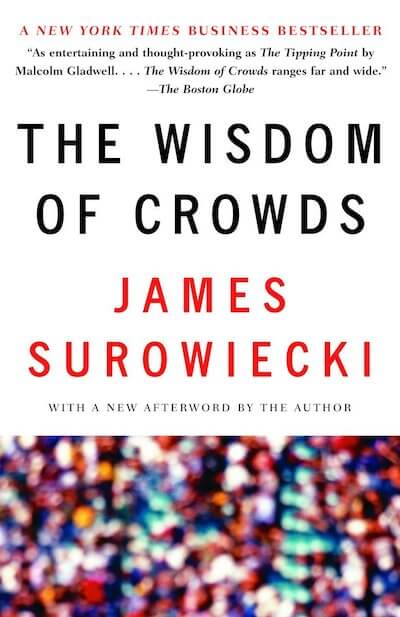
Prefer the print book? Buy on Amazon
As an Amazon Associate, Sumizeit earns from qualifying purchases.
The Wisdom of Crowds Book Summary
This The Wisdom of Crowds Book Summary covers the key ideas, lessons, and takeaways in about 20 minutes.
Short Description:
Diverse, decentralized teams make smarter decisions than individuals alone.
Preview the The Wisdom of Crowds book summary
Below is a preview of Sumizeit’s comprehensive human-written summary of The Wisdom of Crowds by James Surowiecki. The full summary is 15-20 minutes long and covers the book’s key ideas in text, audio, visual, and video formats. Unlock the full 20 Minute Summary
Have you ever wondered why people tend to follow the crowd?
It’s because smart decisions are often made from the majority’s vote.
Putting multiple minds together to make a big choice can help your group to make a more informed decision. That’s because groups are made up of different people coming from different backgrounds, with different perspectives on life.
“Diversity and independence are important because the best collective decisions are the product of disagreement and contest, not consensus or compromise.”- James Surowiecki
But, of course, there is some danger in groups, as well. In his book, “The Wisdom of Crowds” James Surowiecki shares his insight on group thinking and tells how we can encourage the crowds we are apart of to work together cohesively.
Big Groups Solve Problems Better
At a livestock fair that took place in 1906, Francis Galton took the estimates of an ox’s weight based on the visitor’s guesses. No one got it quite right, but the median of the answers was only a pound more than the actual weight of the ox. This means that the group guess was more accurate than the individual’s guess.
Another excellent example of this is the show, “Who Wants to Be A Millionaire?” In this show, the contestants have the option to ask the crowd. When they went with the crowd’s answer, 91% of the time it was correct.
However, group-think is not always a positive thing. Sometimes groups can be wrong based on morals. For example, hate groups and angry mobs.
But, this usually doesn’t happen if your group makes their best effort to stay on task, diversify their team, and work together.
Diversify
Groups are much more effective and wiser when they are diverse. This means having people from different backgrounds and cultures.
There are two kinds of groups:
A heterogeneous group has an abundance of diverse ideas, compared to the homogenous group that has one or two very similar ideas that aren’t being challenged. Therefore, it is much easier for the homogenous group to make a bad decision.
“Diversity and independence are important because the best collective decisions are the product of disagreement and contest, not consensus or compromise.”- James Surowiecki
But, there is value in having experts in your heterogeneous group. It is all about balance!
Bigger Groups Have More Intelligence
Usually the bigger the group, the bigger its diversity. And, when a group is diverse, there are usually more skills at the hands of its members.
When a group has diverse members, it’s easier to take into consideration minority groups when making a decision, because there is usually someone to voice for them within the group.
“Groups are only smart when there is a balance between the information that everyone in the group shares and the information that each of the members of the group holds privately. It's the combination of all those pieces of independent information, some of them right, some of the wrong, that keeps the group-wise.”- James Surowiecki
Bigger groups tend to…
Want the complete 20-minute summary?
- Full structured summary
- Video Summary
- Podcast Summary
- Audio summary
- Key takeaways
- Exercises
- Quiz
- Highlights and notes
- Ask the book with AI
Who should read The Wisdom of Crowds?
The Wisdom of Crowds is essential for business leaders, managers, and anyone involved in group decision-making who want to understand why collective intelligence often outperforms individual expertise. It's also valuable for organizational consultants, policymakers, and teams struggling with groupthink or poor collaboration.
Why does The Wisdom of Crowds matter?
In an increasingly complex world, the ability to harness collective intelligence has become a competitive advantage. James Surowiecki's insights help explain why diverse, decentralized teams make better decisions than hierarchical structures led by single individuals, making this book crucial for anyone seeking to build high-performing organizations in the digital age.
What are the key themes in The Wisdom of Crowds?
- Collective intelligence exceeds individual expertise
- Diversity and independence drive better decisions
- Decentralized structures outperform centralized authority
- Herd behavior and social proof undermine group wisdom
- Coordination and shared responsibility amplify group performance
How can you apply ideas from The Wisdom of Crowds?
- Deliberately recruit diverse team members from different backgrounds, industries, and viewpoints rather than hiring similar people
- Create psychological safety by diminishing social rank barriers, encouraging lower-ranking employees to voice concerns without fear of judgment
- Structure organizations with decentralized decision-making where multiple sub-groups work independently and pool findings rather than waiting for top-down direction
- Establish clear coordination mechanisms and shared responsibilities so team members understand their role in the larger system
- Implement rules and accountability systems that discourage selfish behavior and encourage long-term group success over short-term individual gain
- Invite explicit disagreement and debate during decision-making rather than pushing for quick consensus and false harmony
- Ensure that information from all sources is systematically collected and made visible so leaders and teams can access independent insights
What common mistakes do readers make with The Wisdom of Crowds?
- Assuming that hiring experts with similar backgrounds creates smarter teams, when diverse viewpoints actually produce better decisions
- Allowing social hierarchy to silence junior or lower-ranked employees who may have critical information or perspectives
- Confusing agreement with consent; silence does not mean consensus and may indicate suppressed doubts or concerns
- Concentrating decision-making power in a single charismatic leader rather than distributing authority across the team, increasing the risk of catastrophic errors
Sumizeit Exercises Apply what you've learned
Turn ideas from The Wisdom of Crowds into action with a short guided reflection: identify the biggest takeaway, connect it to your life, and commit to one step you can take in the next 24 hours.
What is the expert analysis of The Wisdom of Crowds?
Overview
The Wisdom of Crowds is a seminal work by James Surowiecki, an American journalist with a rich background in business and finance writing. Drawing on historical anecdotes, psychological insights, and real-world examples, Surowiecki explores the paradoxical idea that large groups of diverse, independent individuals often make better decisions than even the most expert individuals or small, homogeneous groups. The book’s significance lies in its challenge to conventional wisdom about decision-making, leadership, and expertise, offering a nuanced argument about the power and pitfalls of collective intelligence in various domains.
Core Thesis
Surowiecki’s central argument is that under the right conditions—diversity of opinion, independence of members, decentralization of decision-making, and effective aggregation of information—crowds can exhibit remarkable intelligence, often surpassing that of isolated experts or small groups. He contends that the collective judgment of a well-structured group is more accurate and reliable because it pools diverse perspectives and independent information, mitigating individual biases and errors. However, he also cautions against groupthink, herd behavior, and social conformity, which can undermine collective wisdom if diversity and independence are compromised.
Strengths
- Compelling Use of Historical and Contemporary Examples: Surowiecki effectively illustrates his points through memorable cases such as Francis Galton’s ox weight experiment and the "Ask the Audience" lifeline on “Who Wants to Be a Millionaire?”, grounding abstract concepts in tangible evidence.
- Balanced View on Group Dynamics: The book acknowledges both the strengths and vulnerabilities of crowds, offering a nuanced perspective that avoids simplistic glorification of collective decision-making.
- Interdisciplinary Approach: By weaving insights from psychology, sociology, economics, and history, Surowiecki provides a rich, multifaceted understanding of how groups function.
- Practical Implications: The emphasis on diversity, decentralization, and independence offers actionable guidance for organizations, policymakers, and teams seeking to harness collective intelligence effectively.
Critiques & Counterarguments
- Overreliance on Ideal Conditions: The book’s thesis depends heavily on specific conditions being met, such as independence and diversity, which are often difficult to achieve in real-world settings. Many groups fail to meet these criteria, limiting the practical applicability of the wisdom of crowds.
- Underestimation of Expertise: While advocating for crowd wisdom, Surowiecki may underplay the value of deep domain expertise, especially in highly technical or specialized fields where collective opinion can be swayed by misinformation or superficial understanding.
- Social and Psychological Complexities: The analysis of herd behavior and social proof is insightful but could be expanded to incorporate more recent research on cognitive biases, misinformation spread, and the impact of social media, which complicate group decision-making today.
- Competing Research: Studies in behavioral economics and social psychology highlight phenomena such as group polarization and conformity pressures that can exacerbate poor decision-making, challenging the optimistic view that groups naturally outperform individuals.
- Real-World Evidence of Group Failures: Historical and contemporary examples—such as financial bubbles, political mobs, and organizational fiascos like the Columbia Space Shuttle disaster—underscore how groups can collectively make catastrophic errors despite the theoretical advantages of crowd wisdom.
Who Should Read This
The Wisdom of Crowds is ideal for readers interested in the dynamics of decision-making, including business leaders, policymakers, organizational designers, and social scientists. It offers valuable insights for anyone seeking to understand how to structure groups and organizations to maximize collective intelligence and minimize the risks of groupthink and conformity. Additionally, those curious about the intersection of psychology, economics, and social behavior will find Surowiecki’s work both accessible and intellectually stimulating.
Frequently asked questions about the The Wisdom of Crowds book summary
What is The Wisdom of Crowds about?
The Wisdom of Crowds by James Surowiecki explores how diverse groups of independent people often make better decisions than individuals or homogenous expert groups. The book uses real-world examples to show that collective intelligence, when properly structured and diverse, can solve complex problems more accurately than any single expert.
Who should read The Wisdom of Crowds?
Business leaders, managers, organizational consultants, policymakers, and team members involved in decision-making will benefit most from this book. Anyone seeking to build high-performing teams, improve collaborative decision-making, or understand why some organizations outperform others should read it.
What are the main takeaways from The Wisdom of Crowds?
The key takeaways are that diverse, decentralized groups make smarter decisions than individuals or homogenous teams; independence and diversity prevent groupthink; herd behavior and social proof undermine collective wisdom; and teams that build trust, establish clear coordination, and encourage dissent significantly outperform those that enforce conformity.
Why do large diverse groups make better decisions?
Larger, diverse groups contain more perspectives, skills, and independent viewpoints that challenge assumptions and catch errors. They naturally address conflict rather than suppressing it, and they give voice to minority perspectives that single leaders or small homogenous teams would overlook.
What is herd behavior and how does it damage group decisions?
Herd behavior occurs when people follow the crowd simply because others are doing so, abandoning independent judgment. It damages group decisions by replacing actual wisdom with conformity, social proof, and the illusion of consensus rather than critical thinking.
How can organizations prevent groupthink?
Organizations can prevent groupthink by recruiting diverse team members, diminishing social hierarchy to encourage all voices, explicitly inviting disagreement and debate, and structuring decisions in decentralized ways where independent thinking is valued over quick consensus.
What is the difference between heterogeneous and homogenous groups?
Heterogeneous groups consist of people from different backgrounds, ages, genders, and religions, generating diverse ideas and better decisions. Homogenous groups share similar backgrounds and expertise, often reinforcing the same thinking and making them vulnerable to poor decisions.
How does decentralization improve group decision-making?
Decentralized structures distribute decision-making power across multiple independent groups rather than concentrating it with a single leader. This approach generates more ideas, catches critical problems that centralized authority might miss, and reduces the risk of catastrophic errors from overconfident leaders.
About Sumizeit
Sumizeit is a profitable Scomy LLC company based in Miami, Florida. Our founders, Clemens Raemy and Weina Scott, are successful entrepreneurs with several exits. Sumizeit is a popular book summary app / micro learning app used by busy professionals and entrepreneurs with over 2,500 non-fiction book summaries and 10,000 podcast summaries in text, audio, visual, podcast, and video format. We also have stellar retention tools to make ideas stick - such as flashcards with spaced repetition, quizzes, streaks, highlighting and notes, daily challenges, riddles, mini-courses, meditation, and more. You won't only learn the idea, but also remember it. Over 90% of our users change their habits with Sumizeit.
Upgrade Now
Here's why readers love Sumizeit
Join thousands of learners getting smarter every day
"Great experience. Detailed summaries. Loved the gamification feature. Makes learning fun. Good customer service. I recommend Sumizeit to anyone. You'll learn a lot."
"I always felt busy but still wanting to keep up with the book discussion in my friend group. This was a great supplement to help me keep reading the books I find fun while keeping up with important books."
"I love this website. Instead of scrolling social media, I find myself learning a lot. I use it everyday. I recommend this app for anyone who is too busy and wants to get up to speed with their favorite books."
The Wisdom of Crowds Book Summary PDF
Looking for a The Wisdom of Crowds Book Summary PDF you can save and revisit offline? Our The Wisdom of Crowds Book Summary PDF captures the book’s core ideas in a clean, printable format — the key frameworks, takeaways, and structure without the fluff. Download the The Wisdom of Crowds Book Summary PDF when you want a reference you can annotate, share with your team, or review on the go. Get your The Wisdom of Crowds Book Summary PDF from the download page below.
Download The Wisdom of Crowds Book Summary PDFPeople also liked these summaries
Readers who explored The Wisdom of Crowds often enjoyed these titles next.





Ready to read the whole thing?
- Full structured summary
- Video Summary
- Podcast Summary
- Audio summary
- Key takeaways
- Exercises
- Quiz
- Highlights and notes
- Ask the book with AI
Featured Book Titles
Popular Book Summaries at sumizeit, leading book summary app