

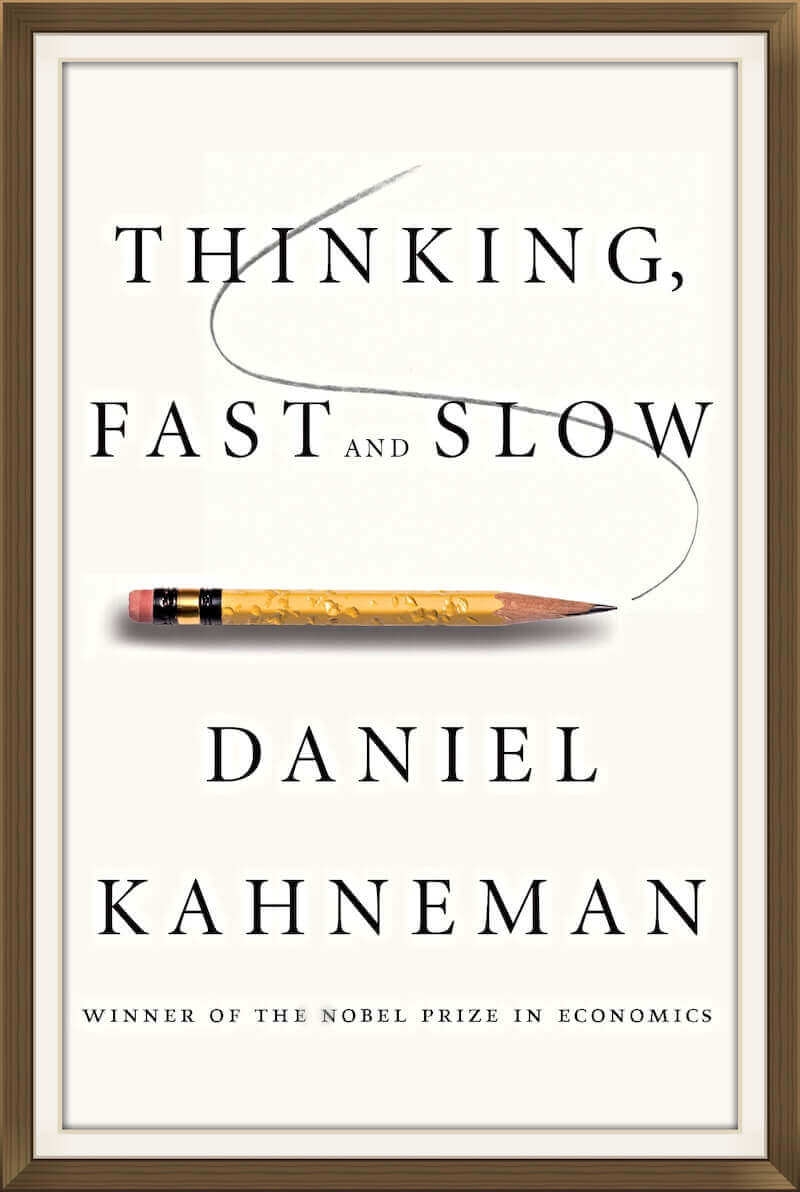
Thinking, Fast and Slow is a landmark study of how we think, decide, and act. Kahneman reveals that human reasoning is less a triumph of logic than a compromise between intuition and effort. Our “fast” System 1 allows us to survive and make quick judgments, but it’s riddled with biases. Our “slow” System 2 offers precision and control but tires easily, often ceding authority to intuition.
The book’s ultimate message is humility. Recognizing the limits of our rationality doesn’t make us weaker—it makes us wiser. By learning when to trust our instincts and when to slow down and analyze, we can make better financial, moral, and personal decisions. Awareness of our biases won’t erase them, but it helps us design systems and habits that protect us from our own mental traps.
Helps with these goals
As an Amazon Associate, Sumizeit earns from qualifying purchases.
In Thinking, Fast and Slow, Nobel laureate Daniel Kahneman invites readers on an extraordinary exploration of how the mind works. Drawing on decades of groundbreaking research in psychology and behavioral economics, he explains that our thoughts are governed by two interacting systems—one fast and intuitive, the other slow and deliberate. These systems help us navigate the world efficiently but also expose us to predictable errors in judgment. Through vivid experiments, real-world examples, and collaborations with the late Amos Tversky, Kahneman demonstrates how even the smartest minds are prone to bias, illusion, and flawed reasoning.
The book doesn’t just describe how we think—it reveals why we so often think incorrectly and what that means for everything from investing and planning to happiness and morality.
Kahneman introduces the dual-process theory of the mind:
System 1 is fast, instinctive, and emotional. It operates automatically, processing impressions, emotions, and patterns without conscious effort. It’s the part of the brain that lets us complete familiar tasks like reading words, detecting hostility in a voice, or driving a car on an empty road.
System 2 is slow, deliberate, and logical. It activates when we need to focus—solving a math problem, comparing mortgage rates, or writing an essay. Because it consumes more energy, we tend to avoid using it unless absolutely necessary.
These systems constantly interact. System 1 generates impressions; System 2 either endorses or corrects them. The problem, Kahneman explains, is that System 2 is lazy : it often accepts System 1’s intuitions as fact.
For example, when asked, “A bat and a ball cost $1.10 in total. The bat costs $1 more than the ball. How much does the ball cost?” most people instantly answer 10 cents—a System 1 error. The correct answer is 5 cents, but it requires System 2’s analytical effort. This simple puzzle reveals how easily our brains jump to conclusions.
System 1 also creates illusions of truth. When information feels familiar or fluent, we assume it’s accurate—a phenomenon called cognitive ease. Advertisers exploit this by repeating slogans or showing familiar imagery. As Kahneman puts it, “A reliable way to make people believe falsehoods is frequent repetition, because familiarity is not easily distinguished from truth.”
Kahneman shows that our attention and self-control are finite. Every act of self-discipline—resisting dessert, staying polite under stress, or focusing on a difficult task—drains mental resources. This depletion weakens System 2, making us more impulsive and prone to error.
In one study, judges deciding parole cases were more lenient right after lunch and harsher as they grew hungrier and fatigued. The same person, in different mental states, produced different judgments—proof that rationality depends on physiological and emotional conditions.
Similarly, when people are mentally overloaded, they default to System 1 shortcuts. This explains why investors buy high and sell low, why leaders make rash decisions under pressure, and why we tend to misjudge probabilities when stressed.
Because System 1 seeks efficiency, it replaces complex questions with simpler ones—a process called substitution. These mental shortcuts, or heuristics, help us function but often lead to systematic bias.
We estimate how likely something is based on how easily examples come to mind. After seeing news of shark attacks, we overestimate their frequency, even though heart disease kills millions more. The easier something is to recall, the more probable it feels. This also explains why people fear plane crashes but ignore daily driving risks.
We judge by resemblance rather than logic. When told about a quiet, analytical woman named Linda who studied philosophy and cares about social justice, most people guess she’s a “bank teller active in the feminist movement.” Statistically, that’s impossible—it’s always more probable she’s just a bank teller. Yet System 1 favors stories that feel true over those that are mathematically correct.
Emotions powerfully distort reasoning. People rate nuclear power as less risky when they associate it with clean energy, and more risky when reminded of Chernobyl. System 1 blurs the line between emotional reaction and factual judgment, leading us to make “gut” decisions that feel right but defy logic.
To counteract these biases, Kahneman recommends techniques like deliberately seeking contrary evidence, slowing down decision processes, and using base rates or statistical data instead of intuition.
Humans are storytellers by nature. We weave narratives from limited information, turning random events into coherent stories that feel true. This gives rise to overconfidence, one of the most pervasive cognitive biases.
Stock traders, for instance, believe they can outperform markets despite evidence showing that most professionals fail to beat index funds. Entrepreneurs routinely underestimate costs and timelines. Kahneman calls this the planning fallacy—the belief that “this time will be different.”
To illustrate, he recounts how his own research team predicted it would take two years to complete a psychology textbook. An expert reminded them that similar projects had taken seven to ten years, yet they ignored him. It took them eight. The inside view —focusing on one’s unique case—clouded judgment, while the outside view —using data from similar projects—would have produced a more accurate forecast.
Anchoring occurs when the first piece of information we see exerts a disproportionate influence on later judgments. In one study, participants spun a random wheel numbered from 0 to 100, then guessed the percentage of African countries in the UN. Those who saw higher numbers guessed higher percentages.
Anchoring affects negotiations, retail pricing, and even sentencing decisions in court. A high initial offer in a salary discussion or “suggested retail price” in a store unconsciously sets expectations, even if we know it’s arbitrary.
To combat anchoring, Kahneman suggests actively generating multiple reference points and questioning initial figures. Still, he admits, the bias is so deeply ingrained that complete immunity is rare.
Kahneman’s prospect theory, developed with Amos Tversky, transformed economics by proving that humans don’t make rational financial choices. Instead, we evaluate outcomes relative to a reference point and are far more sensitive to losses than to equivalent gains.
This loss aversion explains why investors hold losing stocks too long, why people refuse to sell at a small loss, and why we’ll go to great lengths to avoid losing $100—but not as far to gain $100. Losses, he notes, “loom larger than gains.”
Prospect theory also introduced concepts like:
Diminishing sensitivity: The difference between $100 and $200 feels larger than between $1,100 and $1,200.
Overweighting of small probabilities: We buy lottery tickets and insurance for the same reason—our brains exaggerate rare events.
The endowment effect: We value what we own more highly than identical items we don’t. In an experiment, people given a coffee mug demanded twice as much to sell it as others were willing to pay to buy it.
How choices are framed shapes decisions more than the facts themselves. A doctor telling patients that a treatment has a “90% survival rate” evokes more confidence than one who says it has a “10% mortality rate.”
Similarly, people are more likely to support a policy framed as “saving 200 lives” than one framed as “allowing 400 deaths,” even though they’re equivalent. Framing influences political debates, marketing campaigns, and public health messaging.
Kahneman advises reframing problems in multiple ways to expose hidden assumptions. By shifting from “gains vs. losses” to “final outcomes,” we can make choices that align better with long-term goals rather than short-term emotional reactions.
We are irrationally attached to past investments. This sunk cost fallacy explains why people stay in unhappy relationships, finish bad movies, or continue funding failing projects—they don’t want to “waste” what’s already been spent. Rationally, sunk costs are irrelevant; only future costs and benefits matter.
Closely related is mental accounting, our tendency to treat money differently depending on where it comes from. A $50 lottery win might feel like “free money” to splurge, while the same $50 from salary goes toward bills. This compartmentalization creates inconsistent financial behavior and obscures the bigger financial picture. Kahneman urges adopting a broad framing —viewing decisions as part of an overall portfolio rather than in isolation.
Kahneman’s later work distinguishes between the experiencing self, which lives events in real time, and the remembering self, which constructs the story afterward. The remembering self dominates decision-making, but it doesn’t always represent reality.
In one medical study, patients who endured longer colonoscopies but with less pain at the end remembered the procedure as less unpleasant than those with shorter but more intensely painful experiences. The peak-end rule shows that memory emphasizes the most intense and final moments, not duration.
This explains why people prefer vacations that end well, even if the overall experience was mediocre, and why our memories of happiness often differ from how we actually felt. True well-being, Kahneman suggests, requires aligning these two selves—experiencing joy in the moment and creating memories that reflect it accurately.
We exaggerate the importance of whatever we’re currently thinking about. This focusing illusion skews happiness judgments and life choices. People assume moving to California will make them happier because of the weather, but research shows climate has little effect on long-term satisfaction. What matters most is the quality of daily experiences—relationships, purpose, and health—not isolated factors that dominate our thoughts.
Kahneman’s advice: recognize when a single element is crowding out perspective. Pause, broaden focus, and remember that the things you obsess over today often fade in significance tomorrow.
Kahneman concludes by discussing choice architecture—structuring decisions to guide people toward better outcomes without restricting freedom. Governments, businesses, and educators can use small design tweaks, or nudges, to improve behavior.
Examples include:
Automatically enrolling employees in retirement savings plans but allowing opt-outs.
Placing healthy food at eye level in cafeterias.
Providing clear feedback about energy use compared to neighbors to encourage conservation.
While powerful, Kahneman warns that nudging carries ethical responsibilities: transparency, respect for autonomy, and alignment with people’s own long-term interests.
Thinking, Fast and Slow is a landmark study of how we think, decide, and act. Kahneman reveals that human reasoning is less a triumph of logic than a compromise between intuition and effort. Our “fast” System 1 allows us to survive and make quick judgments, but it’s riddled with biases. Our “slow” System 2 offers precision and control but tires easily, often ceding authority to intuition.
The book’s ultimate message is humility. Recognizing the limits of our rationality doesn’t make us weaker—it makes us wiser. By learning when to trust our instincts and when to slow down and analyze, we can make better financial, moral, and personal decisions. Awareness of our biases won’t erase them, but it helps us design systems and habits that protect us from our own mental traps.
Daniel Kahneman (1934–2024) was an Israeli-American psychologist and Nobel Prize–winning pioneer of behavioral economics. With collaborator Amos Tversky, he revolutionized our understanding of decision-making by showing that humans are not rational agents but deeply influenced by cognitive biases and emotional shortcuts.
Their research produced enduring concepts such as the heuristics and biases framework, prospect theory, and loss aversion, transforming economics, public policy, and finance. Kahneman’s work reshaped fields from medicine to marketing and inspired the creation of “nudge theory,” which applies psychology to improve real-world decisions.
Despite his monumental achievements, Kahneman was known for his modesty and relentless self-criticism. In his later years, he continued to refine his own theories and mentor new generations of scholars. Thinking, Fast and Slow remains his most influential work—an elegant synthesis of science and storytelling that forever changed how we understand the human mind.
Looking for a Thinking, Fast and Slow Book Summary PDF you can save and revisit offline? Our Thinking, Fast and Slow Book Summary PDF captures the book’s core ideas in a clean, printable format — the key frameworks, takeaways, and structure without the fluff. Download the Thinking, Fast and Slow Book Summary PDF when you want a reference you can annotate, share with your team, or review on the go. Get your Thinking, Fast and Slow Book Summary PDF from the download page below.
Download Thinking, Fast and Slow Book Summary PDFGet full access to 2,500+ book summaries with audio and video
Start Free Trial →