


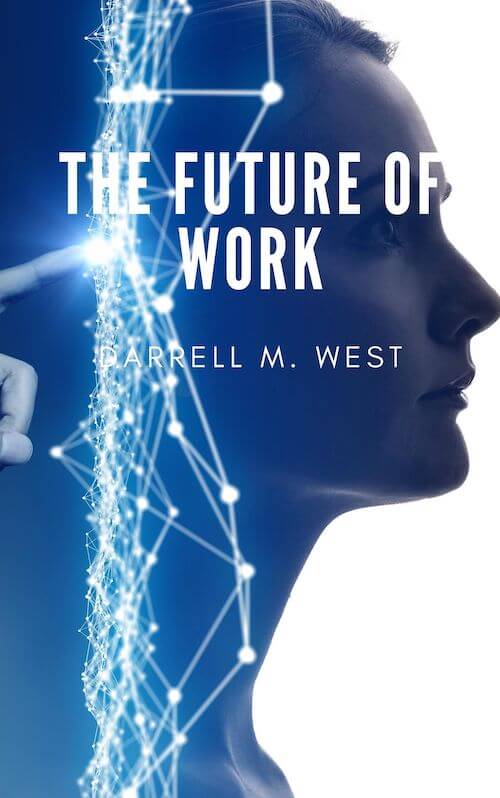
Prefer the print book? Buy on Amazon
As an Amazon Associate, Sumizeit earns from qualifying purchases.
The Future of Work Book Summary
This The Future of Work Book Summary covers the key ideas, lessons, and takeaways in about 20 minutes.
Want the complete 20-minute summary?
- Full structured summary
- Video Summary
- Podcast Summary
- Audio summary
- Key takeaways
- Exercises
- Quiz
- Highlights and notes
- Ask the book with AI
Not ready to upgrade?
Get this summary + 2 more picks sent to your inbox, free.
What is in the The Future of Work book summary?
Below is a preview of Sumizeit’s expert-written summary of The Future of Work by Darrell M. West. The full summary covers the book’s key ideas in text, audio, and video.
Darrell M. West has done extensive research into how automation and robotics will shape the future outlook on the economy. In The Future of Work: Robots, AI and Automation, West addresses the effects on both employment and society in general. An estimated 65% of children today will be doing jobs that don’t yet exist and jobs overall will be diminishing as automation replaces the human workforce. The importance of government to anticipate and address these impending challenges is vital.
Artificial Intelligence is Impacting Society
The significant effects of artificial intelligence (AI) and robotics on employment and the economy are only beginning to surface, but the future brought on by automation is both exciting and alarming.
It is thrilling to see all the ways life can be improved by technology. AI can augment human capability by maximizing decision-making capabilities as well as operational capacities with complex algorithms. Such activities as finance, transportation, defense, and even space exploration are all enhanced by the possibilities created with AI. Technology can process huge amounts of data to rapidly-produce solutions to multifaceted problems.
AI enhances public safety with such technology as body cameras on police officers. It can oversee the safety of water supplies with the ability to detect dangerous chemicals. Traffic congestion can be reduced as well as pollution through ever-improving technology.
At the same time, it is disturbing to recognize how the Internet of Things (IoT) infringes on personal privacy, as most devices don’t have high levels of protection. Critics point out that virtual reality headsets collect a massive amount of information such as head movements, eye rolls, facial expressions, and other data that can create a “heatmap” of a person’s behavior and emotion. Such data is highly personal and experts warn that its use should be controlled, as one example of the intimate data that is being collected which threatens privacy.
Employment is being Dangerously Disrupted by Technology
In addition to threats to personal privacy, it is equally if not more upsetting to see how quickly AI and robotics are replacing the work of human beings. The replacement employment generated by technology is not equal to the number of jobs that have been taken over. Industrialized society is on the threshold of a world with much less work.
Cornell University engineer Hod Lipson commented, “For a long time the common understanding was that technology was destroying jobs but also creating new and better ones. Now the evidence is that technology is destroying jobs and indeed creating new and better ones, but also fewer ones.” Because of the recession in 2008-09, many companies downsized their employees for budget reasons. After learning to operate on lighter workforces, especially using automation, those jobs were not brought back at the same numbers.
Businesses no longer need large workforces to perform essential tasks. Today, companies can function well with smaller staff as well as reliance on independent contractors or even outsourcing certain tasks to other countries for much less expense.
Want the complete 20-minute summary?
- Full structured summary
- Video Summary
- Podcast Summary
- Audio summary
- Key takeaways
- Exercises
- Quiz
- Highlights and notes
- Ask the book with AI
Who should read The Future of Work?
The Future of Work is essential for policymakers, business leaders, educators, and workers concerned about how automation will reshape employment. Anyone seeking to understand the economic and social implications of AI and robotics—or preparing for career transitions in an automated world—will find this book invaluable. Parents wondering what skills their children need and professionals contemplating career longevity should read this forward-looking analysis.
Why does The Future of Work matter?
Automation and AI are already eliminating jobs faster than new ones are being created, yet most institutions haven't adapted their policies or education systems accordingly. Darrell M. West's research reveals that without deliberate government intervention and societal restructuring, widespread unemployment and economic inequality will intensify. Understanding these trends now is crucial for individuals and organizations to prepare for and shape the future of work rather than be blindsided by it.
What are the key themes in The Future of Work?
- Technological displacement of human workers at an unprecedented scale
- The gap between job elimination and job creation in an automated economy
- Privacy and security threats from AI and connected devices
- Necessity of redefining employment and social safety nets
- Critical need for education reform and lifelong learning
- Economic inequality widening as wealth concentrates among technology owners
- Government's essential role in managing technological transitions
- The emerging 'fissured workplace' of contract and temporary work
Want the complete 20-minute summary?
- Full structured summary
- Video Summary
- Podcast Summary
- Audio summary
- Key takeaways
- Exercises
- Quiz
- Highlights and notes
- Ask the book with AI
How can you apply ideas from The Future of Work?
- Pursue continuous skill development in critical thinking, data analysis, communication, and teamwork—the competencies automation cannot easily replicate
- Prioritize STEM education and technical literacy for yourself and your children to remain competitive in future job markets
- Advocate for education system reform in your community to shift away from outdated curricula toward skills needed in an automated economy
- Support policy discussions and government initiatives for new social contracts that redefine employment and establish safety nets for displaced workers
- Build resilience by developing multiple income streams and exploring alternative work models like freelancing, volunteering, and contract roles
- Engage with your employer on reskilling programs and understand how automation may affect your current role in the next five years
- Invest time in understanding how AI and robotics are transforming your industry and prepare transition strategies accordingly
What common mistakes do readers make with The Future of Work?
- Assuming automation will create as many new jobs as it eliminates, rather than preparing for structural unemployment
- Focusing exclusively on traditional employment pathways when the definition of 'work' is fundamentally being redefined
- Delaying education and skill development until job displacement becomes a personal crisis rather than building adaptability proactively
- Underestimating how quickly automation will affect your field—waiting until your job is threatened leaves little time to retrain
- Ignoring privacy implications of connected devices and AI systems that collect intimate behavioral data
Sumizeit Exercises Apply what you've learned
Turn ideas from The Future of Work into action with a short guided reflection: identify the biggest takeaway, connect it to your life, and commit to one step you can take in the next 24 hours.
What is the expert analysis of The Future of Work?
Overview
The Future of Work: Robots, AI, and Automation is authored by Darrell M. West, a prominent political scientist and technology policy expert affiliated with the Brookings Institution. West’s extensive research into the intersection of technology, governance, and society lends considerable weight to his examination of how automation and artificial intelligence (AI) are reshaping labor markets and economic structures. This book is significant for its timely exploration of the profound disruptions technology poses to employment, social contracts, and public policy, making it a vital contribution to contemporary debates on the future of work.
Core Thesis
West’s central argument is that the rapid advancement of AI and robotics is fundamentally transforming the nature of employment, leading to a net reduction in traditional jobs and necessitating a radical rethinking of work, social welfare, and education systems. He contends that automation will displace vast numbers of workers without creating sufficient new employment opportunities, thereby exacerbating economic inequality and social instability. To mitigate these challenges, West advocates for proactive government intervention, expanded definitions of employment to include non-traditional work, and a robust commitment to lifelong learning and STEM education.
Strengths
- Comprehensive Scope: West adeptly integrates technological, economic, and social dimensions, providing a holistic view of how automation impacts not only jobs but also privacy, public safety, and societal norms.
- Policy Relevance: The book offers concrete policy prescriptions, such as redefining employment and expanding social contracts, which are essential for navigating the transition to a highly automated economy.
- Empirical Anchoring: West supports his claims with a range of data points and expert opinions, including insights from economists, CEOs, and government officials, which bolster the credibility of his projections.
- Focus on Education and Adaptation: The emphasis on lifelong learning and the urgent need to reform educational curricula to prepare workers for future demands is both prescient and actionable.
- Balanced Tone: While acknowledging the benefits of AI in enhancing capabilities and efficiency, West does not shy away from the potentially destabilizing consequences, offering a nuanced perspective.
Critiques & Counterarguments
- Optimism Bias in Job Displacement Estimates: Some research suggests that while automation disrupts certain sectors, it also creates new industries and roles that are difficult to predict but significant in scale, potentially offsetting job losses more than West anticipates.
- Oversimplification of Employment Trends: The portrayal of a “fissured workplace” and contract labor as predominantly negative may overlook the growing preference among some workers for flexible, gig-based employment that offers autonomy and diversified income streams.
- Technological Determinism: West’s argument occasionally leans toward technological determinism, underestimating the role of human agency, organizational innovation, and policy frameworks in shaping how technology affects work.
- Limited Consideration of Global Variability: The book primarily focuses on the U.S. context, which may not fully capture how different economic, cultural, and regulatory environments worldwide mediate the impact of automation.
- Contrasting Views on Universal Basic Income (UBI): While West calls for expanded social contracts, he stops short of deeply engaging with UBI proposals, which some scholars argue are crucial to addressing income displacement caused by automation.
Who Should Read This
This book is essential reading for policymakers, economists, business leaders, and scholars interested in the intersection of technology and labor economics. It also offers valuable insights for educators and social planners tasked with preparing societies for the disruptive effects of AI and automation. For readers seeking a rigorous, policy-oriented analysis of how technological innovation challenges traditional employment paradigms and demands systemic adaptation, West’s work provides a thoughtful and well-researched foundation.
Frequently asked questions about the The Future of Work book summary
What is The Future of Work about?
The Future of Work: Robots, AI, and Automation by Darrell M. West examines how automation and artificial intelligence are fundamentally transforming employment and the economy. West explores the consequences of job displacement, privacy threats, education gaps, and the need for new social policies to address widespread technological unemployment.
Who should read The Future of Work?
This book is essential for policymakers, business leaders, educators, workers, and parents who want to understand how automation will reshape employment. Anyone concerned about job security, career longevity, or preparing the next generation for an automated economy will benefit from West's research-driven insights.
What are the main takeaways from The Future of Work?
The key takeaways include that automation is eliminating jobs faster than creating them, education systems need immediate reform to teach future-ready skills, employment itself must be redefined to include non-traditional work, and government intervention is essential to prevent widespread unemployment and inequality. West emphasizes that 65% of children will work jobs that don't yet exist, making adaptability and lifelong learning critical survival skills.
How many jobs will automation actually eliminate?
West cites research suggesting that up to 375 million livelihoods globally may disappear due to new technologies. In the U.S., Lawrence Summers warned that a quarter of middle-aged men could be unemployed within a generation if current trends continue, and potentially a third of men aged 25-54 by 2050.
What does West propose as a solution to technological unemployment?
West advocates for redefining employment to include volunteering, parenting, mentoring, and part-time work as legitimate forms of valuable contribution. He calls for government intervention through new social contracts, education reform prioritizing STEM and critical thinking, and wealth redistribution mechanisms to ensure displaced workers can sustain themselves.
Why is education reform so critical according to The Future of Work?
Current education systems teach skills needed fifty years ago rather than preparing students for tomorrow's economy. With 65% of children working jobs that don't yet exist, schools must emphasize critical thinking, data analysis, communication, teamwork, and STEM proficiency instead of outdated curricula.
What privacy concerns does West raise about AI and connected devices?
West highlights that IoT devices collect intimate behavioral data—including eye movements, facial expressions, and head movements—with minimal security protections. This data can create detailed heatmaps of a person's behavior and emotions, posing significant privacy threats that require stronger regulation and consumer awareness.
About Sumizeit
Sumizeit is a profitable Scomy LLC company based in Miami, Florida. It has been helping readers learn from nonfiction books for 7 years with expert-written summaries in text, audio, podcast, and video.
Want the complete 20-minute summary?
- Full structured summary
- Video Summary
- Podcast Summary
- Audio summary
- Key takeaways
- Exercises
- Quiz
- Highlights and notes
- Ask the book with AI
Here's why readers love Sumizeit
Join thousands of learners getting smarter every day
"Great experience. Detailed summaries. Loved the gamification feature. Makes learning fun. Good customer service. I recommend Sumizeit to anyone. You'll learn a lot."
"I always felt busy but still wanting to keep up with the book discussion in my friend group. This was a great supplement to help me keep reading the books I find fun while keeping up with important books."
"I love this website. Instead of scrolling social media, I find myself learning a lot. I use it everyday. I recommend this app for anyone who is too busy and wants to get up to speed with their favorite books."
The Future of Work Book Summary PDF
Looking for a The Future of Work Book Summary PDF you can save and revisit offline? Our The Future of Work Book Summary PDF captures the book’s core ideas in a clean, printable format — the key frameworks, takeaways, and structure without the fluff. Download the The Future of Work Book Summary PDF when you want a reference you can annotate, share with your team, or review on the go. Get your The Future of Work Book Summary PDF from the download page below.
Download The Future of Work Book Summary PDFPeople also liked these summaries
Readers who explored The Future of Work often enjoyed these titles next.



Want the complete 20-minute summary?
- Full structured summary
- Video Summary
- Podcast Summary
- Audio summary
- Key takeaways
- Exercises
- Quiz
- Highlights and notes
- Ask the book with AI
Featured Book Titles
Popular Book Summaries at sumizeit, leading book summary app