
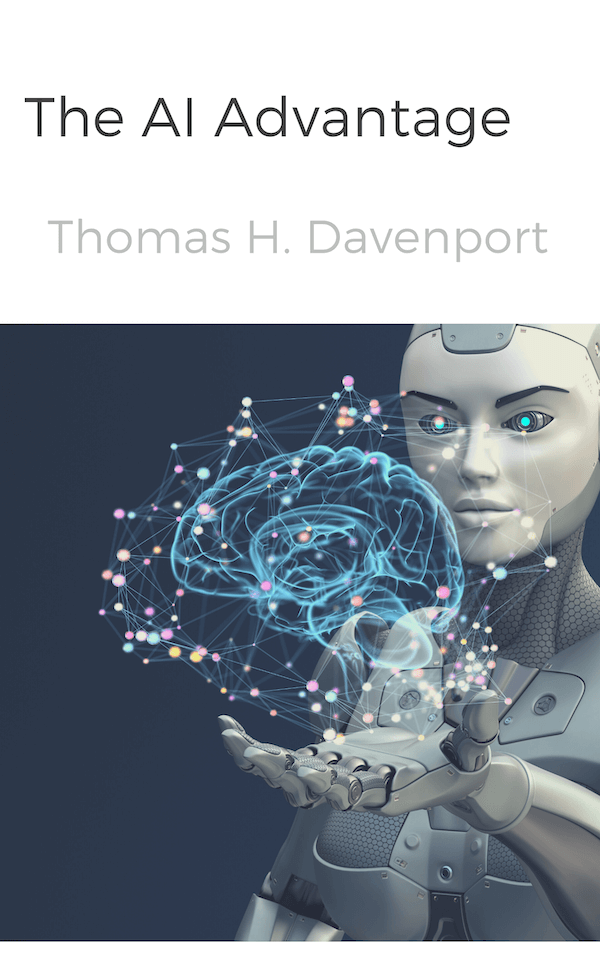
The AI Advantage Book Summary
This The AI Advantage Book Summary covers the key ideas, lessons, and takeaways in about 20 minutes.
Want the complete 20-minute summary?
- Full structured summary
- Video Summary
- Podcast Summary
- Audio summary
- Key takeaways
- Exercises
- Quiz
- Highlights and notes
- Ask the book with AI
What is in the The AI Advantage book summary?
Below is a preview of Sumizeit’s expert-written summary of The AI Advantage by Thomas H. Davenport. The full summary covers the book’s key ideas in text, audio, and video.
Artificial Intelligence encompasses a broad range of technologies and provides a wide range of possibilities that will completely transform work, government, and society. For now, it is mostly only big corporations and tech startups that have fully embraced the complex challenges and vast potential of AI.
Companies that are effectively able to utilize AI must first have a cognitive strategy in place to ensure they are assigning the new technology to the appropriate task, which will boost productivity and allow them to really reap the benefits of AI. Cognitive technologies can help companies automate tasks, analyze and model data, and make better predictions. Some job positions may eventually be fully automated, while some employees may only have their jobs augmented by AI technology, which will free them up to pursue more critical thinking, human decision-making tasks. Regardless, AI will eventually revolutionize the workplace, and governments and organizations should be prepared to help workers adjust to the changes. There are social, ethical, and technical implications to AI technology, so transparency is essential to help mitigate potential negative effects.
Artificial Intelligence Is No Longer A Thing of The Future
Artificial Intelligence no longer simply belongs to the realm of science fiction. It is a real technology that is being actively used today, in industries like academia, finance, and tech. Artificial Intelligence is also called “cognitive technologies,” because it is a technology by which machines are endowed with certain human capabilities. These capabilities can range from quick and simple tasks, like recognizing images, too many more complex tasks, like machine learning.
There are five main technologies that fall under the umbrella of Artificial Intelligence or AI. First, there is Statistical Machine Learning, in which machines can learn and identify patterns, and make inferences about relationships between the data. Neural Networks are a more complex type of machine learning, in which algorithms mimic the human brain by recognizing relationships, which they can then categorize and use to make predictions and assessments. Natural Language Processing is the process by which machines analyze and interpret the text and spoken language. A subset of this technology is Statistical Natural Language Processing, in which machine learning is used to analyze large chunks of language data and interpret the data to find statistically significant correlations. Another type of AI, Semantic Neural Language Processing, represents the semantics of an expression in logical form by analyzing language’s rules and relationships. Lastly, Robotics and Robotic Process Automation utilize robots to follow procedures to complete a task, including watching a human complete the task and then mimicking them.
According to a 2017 Deloitte study, AI is used across industries for such purposes as automating tasks, detecting fraud, and using algorithms to improve money lending processes.
AI Early Adopters
The first organizations to jump on board the AI revolution have been big corporations and tech start-ups. In fact, new AI has spurred a tech revolution, and entrepreneurs are launching new companies to take advantage of the new technology.
Want the complete 20-minute summary?
- Full structured summary
- Video Summary
- Podcast Summary
- Audio summary
- Key takeaways
- Exercises
- Quiz
- Highlights and notes
- Ask the book with AI
Who should read The AI Advantage?
The AI Advantage is essential reading for business leaders, policymakers, and tech professionals who need to understand how artificial intelligence will reshape their organizations and society. If you're responsible for strategic decisions about technology adoption, workforce planning, or policy in an AI-driven economy, this book provides the frameworks and insights you need to navigate the transformation ahead.
Why does The AI Advantage matter?
Artificial intelligence is no longer theoretical—it's actively transforming how organizations operate, how jobs evolve, and how societies function. Thomas H. Davenport's The AI Advantage cuts through the hype to explain what AI actually does, how to implement it effectively, and how to address the real social and ethical challenges it creates. Understanding these dynamics is critical now, before AI adoption accelerates even further across industries.
What are the key themes in The AI Advantage?
- Developing a cognitive strategy for AI implementation
- Matching AI technologies to the right organizational tasks
- The human side of automation and workforce transformation
- Transparency and ethical considerations in AI deployment
- The five stages of workplace automation
- AI early adoption patterns across industries and countries
- New job creation emerging from AI integration
What are the key lessons from the The AI Advantage book summary?
AI requires strategic thinking, not just technology adoption
Successful organizations don't simply deploy AI tools; they develop a cognitive strategy aligned with their specific goals, data assets, and business models to ensure technology addresses real problems.
The right technology for the right task determines success
Organizations must carefully assess which AI applications—process automation, cognitive insight, or cognitive engagement—best solve their specific challenges rather than pursuing AI adoption broadly.
Pilot projects reveal hidden implementation obstacles
Running small-scale AI experiments helps identify knowledge gaps, technical bottlenecks, and infrastructure limitations before full-scale deployment wastes resources.
Big data and internal talent are crucial competitive advantages
Organizations with large datasets and employees who have strong statistics and analysis backgrounds can leverage existing talent for AI implementation without hiring exclusively specialized AI experts.
Robotic Process Automation works best for routine, structured tasks
This simpler form of AI excels at automating repetitive data entry and procedural work but cannot handle tasks requiring judgment, creativity, or critical thinking.
AI augments jobs more often than it replaces them entirely
Rather than wholesale job elimination, AI typically frees employees from routine work to focus on higher-value activities like decision-making, strategy, and human interaction.
Five stages guide employee transition through automation
Organizations should prepare workers for stepping in (monitoring), stepping up (applying AI to basics), stepping aside (enabling human collaboration), stepping narrowly (identifying automation boundaries), and stepping forward (designing new AI systems).
New job categories emerge from AI integration
AI creates demand for roles like trainers (teaching AI new skills), sustainers (maintaining systems), and explainers (translating technical concepts for non-technical workers).
Machine learning enables better predictions and risk detection
By identifying patterns in data, AI helps organizations make more accurate forecasts, catch fraud earlier, and make more informed business decisions than humans working alone.
Natural language processing brings human-machine communication closer
As speech recognition accuracy approaches 99 percent, AI will soon handle conversations naturally, automating customer service and enabling voice-controlled systems at scale.
Machine vision expands beyond image recognition to emotional assessment
AI can now identify human emotions like confusion or boredom, opening applications in education, marketing, and user experience—though raising privacy and surveillance concerns.
Algorithms can embed hidden biases with real-world consequences
AI systems may discriminate against specific populations unintentionally; organizations must actively audit and explain their algorithms to prevent harm.
Transparency is essential to public trust and ethical deployment
Companies should openly communicate how they use AI, what data it processes, and what safeguards protect against misuse—both to build employee confidence and address societal concerns.
Government policy must address workforce disruption
Policymakers should consider job guarantees, retraining programs, robot taxes, or universal basic income to mitigate the inequality and social dislocation AI automation may cause.
Integration with legacy systems is a major practical challenge
Building AI on top of older technology infrastructure is difficult and expensive, requiring careful planning and adequate computing power to avoid costly failures.
Corporate culture and leadership commitment drive AI success
AI implementation fails without visible commitment from senior leaders and a culture that embraces change, experimentation, and continuous learning.
Different AI technologies have vastly different implementation complexity
Statistical machine learning and robotic process automation are relatively straightforward, while deep learning requires massive labeled datasets and specialized expertise.
Geographic variation in AI adoption reflects policy differences
Countries like China and Singapore aggressively fund and pursue AI, while others like the United States lag in government adoption, creating competitive advantages for proactive nations.
Hiring strategy varies based on organizational ambition and resources
Some organizations pursue aggressive talent acquisition for AI skills, while others gradually build capability through upskilling existing employees and external partnerships.
AI is not a single technology but a family of complementary tools
Understanding the five main AI categories—machine learning, neural networks, natural language processing, semantic processing, and robotics—helps organizations choose the right tools for specific problems.
Want the complete 20-minute summary?
- Full structured summary
- Video Summary
- Podcast Summary
- Audio summary
- Key takeaways
- Exercises
- Quiz
- Highlights and notes
- Ask the book with AI
How can you apply ideas from The AI Advantage?
- Develop a cognitive strategy that ties AI initiatives to core business goals and existing data assets before purchasing any technology
- Pilot AI projects in high-impact departments first to identify technical and organizational challenges before scaling across the company
- Assess your workforce's existing data, statistics, and analysis skills to build on internal talent rather than hiring exclusively external AI experts
- Redesign job descriptions and workflow to identify which tasks should be automated versus augmented, positioning employees for higher-value work
- Create clear communication plans and training programs to help non-technical employees understand how AI affects their roles and career paths
- Audit AI algorithms and datasets for hidden biases before deployment, especially if systems affect hiring, lending, or customer service decisions
- Establish transparent policies on how AI will be used, what data it processes, and what safeguards protect employee and customer privacy
What common mistakes do readers make with The AI Advantage?
- Pursuing broad AI adoption without first clarifying which specific organizational problems AI actually solves
- Underestimating integration challenges with legacy systems and legacy data, leading to expensive delays and failed pilots
- Assuming AI will eliminate entire job categories rather than planning to redeploy humans to higher-value work AI cannot do
- Deploying AI without preparing employees through training and transparent communication, causing resistance and implementation failure
Sumizeit Exercises Apply what you've learned
Turn ideas from The AI Advantage into action with a short guided reflection: identify the biggest takeaway, connect it to your life, and commit to one step you can take in the next 24 hours.
What is the expert analysis of The AI Advantage?
Overview
The AI Advantage is a seminal work by Thomas H. Davenport, a distinguished scholar and practitioner in information technology and management. Davenport’s extensive credentials—including his role as President’s Distinguished Professor at Babson College and his advisory position at Deloitte Analytics—lend considerable authority to his exploration of artificial intelligence (AI) in contemporary business contexts. This book stands out for its pragmatic approach to AI adoption, targeting business leaders, policymakers, and technology professionals who seek a nuanced understanding of how AI can be strategically integrated into organizations.
Core Thesis
Davenport’s central argument is that AI is no longer a futuristic concept but a present-day imperative that demands a well-crafted cognitive strategy for effective implementation. He contends that AI technologies—ranging from robotic process automation to advanced machine learning—can significantly enhance organizational productivity by automating routine tasks, improving data analysis, and augmenting human decision-making. Crucially, Davenport emphasizes that successful AI adoption requires transparency and ethical considerations to mitigate social risks such as job displacement, inequality, and algorithmic bias. The book advocates for a balanced approach where AI complements human labor rather than wholly replacing it, while urging governments and organizations to prepare for the attendant societal transformations.
Strengths
l>Critiques & Counterarguments
l>Who Should Read This
The AI Advantage is essential reading for business executives and organizational leaders who must navigate the complexities of AI integration to maintain competitive advantage. Policymakers and regulators will find its insights valuable for understanding the ethical and social dimensions of AI deployment. Additionally, technology professionals and early adopters will benefit from its clear exposition of AI technologies and strategic implementation frameworks. The book’s accessible yet rigorous approach makes it suitable for readers seeking a balanced, informed perspective on AI’s transformative potential without succumbing to hype or dystopian fears.
Frequently asked questions about the The AI Advantage book summary
What is The AI Advantage about?
The AI Advantage by Thomas H. Davenport is a practical guide to understanding and implementing artificial intelligence in organizations. The book explains what AI actually does, how different AI technologies work best for different tasks, how to build a cognitive strategy for AI adoption, and how organizations and governments should address the social and ethical implications of automation.
Who should read The AI Advantage?
Business leaders, executives, policymakers, tech professionals, and anyone responsible for organizational strategy or workforce planning should read this book. It's essential for decision-makers who need to understand how AI will transform their industry, what implementation looks like in practice, and how to prepare their organizations for rapid technological change.
What are the main takeaways from The AI Advantage?
Key takeaways include: organizations need a strategic cognitive plan for AI, not just ad-hoc technology adoption; the right AI tools must match specific business tasks; AI augments human workers more often than replacing them entirely; transparency and ethical considerations are essential; governments must help mitigate job displacement through policy; and new job categories emerge even as some roles are automated.
What are the five main types of AI technologies discussed?
The AI Advantage identifies statistical machine learning (pattern recognition), neural networks (mimicking human brain reasoning), natural language processing (interpreting text and speech), semantic processing (understanding meaning and relationships), and robotics/robotic process automation (automating routine procedures). Each has different implementation complexity and best-use scenarios.
How should organizations implement AI according to Davenport?
Davenport recommends developing a cognitive strategy first, identifying which organizational problems AI can solve, running pilot projects to uncover obstacles, leveraging internal talent where possible, assessing workforce capabilities, and planning how jobs will be transformed through automation or augmentation. Implementation must align with business goals and data assets.
What does The AI Advantage say about job displacement and new job creation?
While The AI Advantage acknowledges AI will automate certain tasks and potentially disrupt millions of jobs, Davenport emphasizes that new job categories emerge around AI—trainers, sustainers, and explainers—and many roles shift toward higher-value human work. The book outlines five stages employees transition through as automation increases.
Why does The AI Advantage emphasize transparency in AI deployment?
Davenport stresses that transparency is crucial because algorithms can embed unintentional biases, harm specific populations, or be misused by governments. Companies should openly communicate how they use AI, protect against negative externalities, and governments should address workforce disruption through policy to mitigate AI's social and ethical downsides.
About Sumizeit
Sumizeit is a profitable Scomy LLC company based in Miami, Florida. It has been helping readers learn from nonfiction books for 7 years with expert-written summaries in text, audio, podcast, and video.
Want the complete 20-minute summary?
- Full structured summary
- Video Summary
- Podcast Summary
- Audio summary
- Key takeaways
- Exercises
- Quiz
- Highlights and notes
- Ask the book with AI
Here's why readers love Sumizeit
Join thousands of learners getting smarter every day
"Great experience. Detailed summaries. Loved the gamification feature. Makes learning fun. Good customer service. I recommend Sumizeit to anyone. You'll learn a lot."
"I always felt busy but still wanting to keep up with the book discussion in my friend group. This was a great supplement to help me keep reading the books I find fun while keeping up with important books."
"I love this website. Instead of scrolling social media, I find myself learning a lot. I use it everyday. I recommend this app for anyone who is too busy and wants to get up to speed with their favorite books."
The AI Advantage Book Summary PDF
Looking for a The AI Advantage Book Summary PDF you can save and revisit offline? Our The AI Advantage Book Summary PDF captures the book’s core ideas in a clean, printable format — the key frameworks, takeaways, and structure without the fluff. Download the The AI Advantage Book Summary PDF when you want a reference you can annotate, share with your team, or review on the go. Get your The AI Advantage Book Summary PDF from the download page below.
Download The AI Advantage Book Summary PDFPeople also liked these summaries
Readers who explored The AI Advantage often enjoyed these titles next.


Want the complete 20-minute summary?
- Full structured summary
- Video Summary
- Podcast Summary
- Audio summary
- Key takeaways
- Exercises
- Quiz
- Highlights and notes
- Ask the book with AI
Featured Book Titles
Popular Book Summaries at sumizeit, leading book summary app
