


As an Amazon Associate, Sumizeit earns from qualifying purchases.
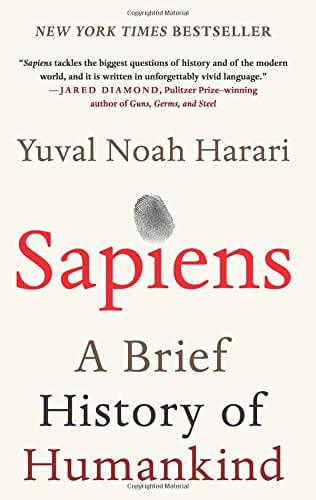
Sapiens Book Summary
This Sapiens Book Summary covers the key ideas, lessons, and takeaways in about 20 minutes.
Helps with these goals
Want the complete 20-minute summary?
- Full structured summary
- Video Summary
- Podcast Summary
- Audio summary
- Key takeaways
- Exercises
- Quiz
- Highlights and notes
- Ask the book with AI
What is in the Sapiens book summary?
Below is a preview of Sumizeit’s expert-written summary of Sapiens by Yuval Noah Harari. The full summary covers the book’s key ideas in text, audio, and video.
Through the study of physics, we have learned the story of the Big Bang, which occurred about 13.5 billion years ago in the skies.
And within the last 70,000 years, Homo sapiens appeared. Since their appearance, humankind has gone through three dynamic revolutions:
“Culture tends to argue that it forbids only that which is unnatural. But from a biological perspective, nothing is unnatural. Whatever is possible is by definition also natural. A truly unnatural behavior, one that goes against the laws of nature, simply cannot exist, so it would need no prohibition.”
― Yuval Noah Harari
Currently, we are in the scientific revolution which started about five centuries ago. It is progressing at rapid speeds, but we are still unsure of the final outcome.
The Cognitive Revolution
We, as a species, are not the only humans to have walked the face of the earth. All of our ancestors were the genus Homo. Homo sapiens, however, appeared and disrupted the natural order by bringing in advances of language, cognition or thinking, and technology.
Now, we are currently at another turning point in humankind with our own existence, as humans are being rivaled by the introduction of artificial intelligence.
For over two million years, we lived with our thinking processes and capacity for learning without advantages to match. Homo sapiens were for a long time in the middle of the food chain. Now, we are at the top so our advantages now match our intellect.
For thousands and thousands of years, Neanderthals were superior to Sapiens. When Sapiens first encountered Neanderthals in the Middle East, they were quickly overpowered and the Sapiens fled back to Africa, where they came from.
But 70,000 years passed, and Sapiens once again decided to leave the comfort of Africa. On their way to Asia and Europe and even Australia, they overpowered Neanderthals.
The Cognitive Revolution is documented through the appearances of sewing needles, boats, oil lamps, and art throughout history. But, the greatest development that resulted from the Cognitive Revolution, was language.
Language helped to communicate danger to other beings and it also helped to keep information stored safely in the brain.
For example, an animal can warn its species that there is an enemy approaching. However, only a human can warn their tribe of the possibility of danger based on an enemy’s signs, such as footprints or tree rubs. Humans can store the information they have seen and present it to their tribe later, whereas animals can only warn against immediate danger in the present to the animals around them.
“You could never convince a monkey to give you a banana by promising him limitless bananas after death in monkey heaven.”
― Yuval Noah Harari
The Cognitive Revolution and language also brought humankind the gifts of spirituality, religion, and the supernatural. Or in other words, it gave us the ability to understand and think about things we cannot see or touch.
But, with more intellectual thinking came war, hierarchies, and politics.
By understanding our hunting-and-gathering…
Want the complete 20-minute summary?
- Full structured summary
- Video Summary
- Podcast Summary
- Audio summary
- Key takeaways
- Exercises
- Quiz
- Highlights and notes
- Ask the book with AI
Who should read Sapiens?
Sapiens is ideal for anyone curious about the big picture of human history and our place in the world today. Whether you're a student, professional, or lifelong learner, this book appeals to those who want to understand how cognitive breakthroughs, agricultural shifts, and scientific advances have shaped modern civilization. It's particularly valuable for people concerned about humanity's future, including the rise of artificial intelligence and technological transformation.
Why does Sapiens matter?
Sapiens provides essential context for understanding contemporary challenges by revealing how humans came to dominate the planet and build complex societies. In an era of rapid technological change and uncertainty about AI, Harari's analysis of human revolutions helps us recognize patterns and question assumptions about progress, hierarchy, and human exceptionalism. The book challenges readers to think critically about taken-for-granted aspects of modern life—from money to religion to science itself—and consider what may come next.
What are the key themes in Sapiens?
- The role of language and imagination in human dominance
- How revolutions reshape human society and consciousness
- The gap between biological nature and cultural belief systems
- Money, religion, and empire as unifying forces
- The double-edged sword of scientific and technological progress
- The future threat of artificial intelligence to human supremacy
What are the key lessons from the Sapiens book summary?
Language enabled humans to imagine things that don't exist
Unlike other animals that warn of immediate danger, humans can communicate abstract concepts and future possibilities through language. This capacity for shared imagination about gods, nations, and laws allowed us to cooperate at unprecedented scales.
Agriculture was a mixed blessing, not purely progress
While farming enabled larger populations and civilization, it also increased human labor, disease, and hierarchy. Archaeological evidence shows that early farmers suffered more physical hardship than their hunter-gatherer ancestors.
Money is valuable only because we collectively agree it is
Money has no intrinsic worth; its value depends entirely on shared belief and social consensus. This makes it one of humanity's most powerful inventions for enabling trade and cooperation across large societies.
Writing transformed how societies organize and control information
The invention of writing allowed humans to record complex information, manage large populations, and create standardized systems of law and bureaucracy that individual brains could never manage alone.
Patriarchy is cultural, not biological
There is no genetic evidence that men are naturally superior to women. Patriarchal systems are self-perpetuating social constructs rather than inevitable biological realities.
Religion unified people through shared moral narratives
Religion's primary function was creating social order and shared values among large groups by providing moral frameworks that made cooperation possible, regardless of whether supernatural claims were true.
Empires have been the dominant model for 2,500 years
Despite modern liberal skepticism about empires, they have proven remarkably durable at standardizing law, currency, and culture across large territories and populations.
Science became powerful when linked to technology and resources
Historical science focused on understanding concepts; only when empires invested in science for practical control and conquest did it accelerate into the transformative force we know today.
Modern behaviors reflect our prehistoric ancestral environment
Humans overeat sugary foods and hoard resources because our ancestors lived in scarcity. Understanding our evolutionary past illuminates seemingly irrational modern behaviors.
The Cognitive Revolution happened relatively recently in human history
Though Homo sapiens existed earlier, the Cognitive Revolution about 70,000 years ago—marked by advanced language, tools, and symbolic thinking—separated us from other human species and set us on our current trajectory.
Multiple societies independently developed agriculture around the same time
Agriculture was not invented in one place and spread; rather, it emerged independently across different regions simultaneously, suggesting it was a response to similar environmental and population pressures.
Plants domesticated humans as much as humans domesticated plants
Agricultural societies became dependent on crops for survival, creating a feedback loop where humans invested enormous effort tending plants that would not survive without human care.
Numbers became crucial to social organization and hierarchy
Once farming introduced the concept of measurable surplus, quantification became central to determining wealth, status, and power—enabling the rise of complex administrative systems.
Global unity has always been humanity's pattern, not independence
No culture or society has ever developed completely independently; all civilizations have been interconnected, traded with, or influenced by others, creating an increasingly unified global network.
We may be approaching a turning point where our creations surpass us
Just as Homo sapiens replaced other human species, artificial intelligence may eventually displace humans as the dominant intelligent species on Earth if we are not deliberate about how we develop it.
Evolution continues but follows patterns established by past revolutions
History shows cycles of growth and collapse, yet overall complexity increases. Understanding these patterns helps us anticipate what might emerge from our current scientific revolution.
Cultural beliefs shape what societies consider natural and normal
What cultures forbid as unnatural is often simply defined by their current values; biologically, nothing humans can do is truly unnatural, since whatever is possible is by definition part of nature.
Want the complete 20-minute summary?
- Full structured summary
- Video Summary
- Podcast Summary
- Audio summary
- Key takeaways
- Exercises
- Quiz
- Highlights and notes
- Ask the book with AI
How can you apply ideas from Sapiens?
- Examine your own cultural beliefs about gender, hierarchy, and normalcy by recognizing them as social constructs rather than biological inevitabilities
- Use historical perspective to understand how your habits and preferences reflect ancestral survival strategies rather than current needs
- Recognize that institutions like money, religion, and law derive power from collective belief—understanding this can inform how you evaluate their legitimacy
- Think critically about technological progress by considering both its benefits and its unintended harms, as illustrated by science's dual legacy
- Consider how shared narratives and imagination bind modern societies together, and reflect on which shared stories you're participating in
- Evaluate claims about 'natural order' in society skeptically, knowing that most hierarchies are maintained through cultural reinforcement rather than biology
- Prepare for future disruption by studying how humans have adapted through previous revolutions and what patterns might repeat
What common mistakes do readers make with Sapiens?
- Assuming progress is linear and always beneficial—agriculture and science created problems alongside solutions
- Believing that cultural norms reflect biological reality rather than recognizing them as collective agreements that could be different
- Underestimating the power of shared imagination and narrative in shaping human behavior and society
- Treating the Scientific Revolution as purely positive without acknowledging its role in creating weapons of mass destruction and environmental damage
Sumizeit Exercises Apply what you've learned
Turn ideas from Sapiens into action with a short guided reflection: identify the biggest takeaway, connect it to your life, and commit to one step you can take in the next 24 hours.
What is the expert analysis of Sapiens?
Overview
Sapiens: A Brief History of Humankind, authored by Yuval Noah Harari, is a landmark work that synthesizes vast swathes of human history into a compelling narrative. Harari, an Israeli historian and professor at the Hebrew University of Jerusalem, brings a multidisciplinary lens—drawing from history, anthropology, philosophy, and biology—to explore the evolutionary and cultural trajectory of Homo sapiens. His ability to distill complex macro-historical processes into accessible yet thought-provoking prose has made Sapiens a global phenomenon, translated into over 45 languages and widely regarded as a modern classic in popular history.
Core Thesis
Harari’s central argument is that human history is defined by three transformative revolutions: the Cognitive Revolution (~70,000 years ago), which endowed Homo sapiens with advanced language and abstract thinking; the Agricultural Revolution (~12,000 years ago), which shifted humans from foraging to farming and fundamentally altered social structures; and the Scientific Revolution (beginning ~500 years ago), which has accelerated technological progress and reshaped human understanding of the universe. These revolutions have successively expanded human capacity for cooperation, domination, and innovation, culminating in a present where artificial intelligence and biotechnology threaten to redefine what it means to be human.
Strengths
- Interdisciplinary Synthesis: Harari excels at weaving insights from diverse fields—history, biology, economics, and philosophy—into a coherent narrative that captures the broad sweep of human development.
- Accessible yet Profound: The book’s lucid prose and engaging storytelling make complex ideas approachable without sacrificing intellectual rigor, appealing to both specialists and general readers.
- Novel Perspectives on Human Culture: By framing religion, money, and empires as shared myths or imagined orders, Harari challenges conventional understandings of social cohesion and power.
- Provocative Reflections on the Future: The discussion of artificial intelligence and biotechnology as potential disruptors of the human species invites readers to critically consider ethical and existential questions.
- Historical Contextualization: The book situates contemporary issues within an evolutionary and historical framework, enriching the reader’s grasp of present-day challenges.
Critiques & Counterarguments
- Oversimplification of Complex Processes: Some critics argue that Harari’s broad strokes gloss over nuances, particularly in the Agricultural Revolution, where the transition was uneven and multifaceted rather than a singular event.
- Speculative Future Projections: The extrapolation about Homo sapiens’ potential obsolescence due to biotechnology and AI, while stimulating, rests on uncertain technological trajectories and philosophical assumptions about consciousness and identity.
- Limited Engagement with Alternative Anthropological Views: Harari’s narrative occasionally sidelines competing interpretations, such as those emphasizing the role of environmental factors or cultural contingency over cognitive shifts.
- Questioning the Unifying Role of Money and Empires: While money and empires have historically unified societies, recent scholarship highlights their roles in exploitation, inequality, and resistance movements, complicating the notion of unification as inherently positive.
- Critique from Evolutionary Psychology and Neuroscience: Some research contests the portrayal of language and cognition as sudden revolutions, suggesting more gradual evolutionary developments with overlapping timelines.
Who Should Read This
Sapiens is ideal for intellectually curious readers who seek a panoramic understanding of human history beyond traditional chronological accounts. It appeals to those interested in the intersections of science, philosophy, and history, as well as readers contemplating humanity’s future in the face of technological upheaval. Scholars and students in the humanities and social sciences will find it a stimulating entry point, while general audiences will appreciate its narrative clarity and provocative insights. Ultimately, it is a must-read for anyone eager to grasp the grand narrative of human existence and its implications for our collective destiny.
Frequently asked questions about the Sapiens book summary
What is Sapiens about?
Sapiens by Yuval Noah Harari is a sweeping history of humankind from the emergence of Homo sapiens around 70,000 years ago to the present day. The book organizes human history into three major revolutions—the Cognitive Revolution, the Agricultural Revolution, and the Scientific Revolution—and argues that each transformed human society in profound ways. Harari explores how language, imagination, farming, writing, money, and religion allowed humans to cooperate at scale and eventually dominate the planet, while also raising concerns about artificial intelligence potentially displacing humanity from its current position of dominance.
Who should read Sapiens?
Sapiens appeals to anyone interested in understanding the big picture of human history and our place in the modern world. It's valuable for students, professionals, and curious learners who want context for contemporary issues like technology, AI, and global cooperation. The book is also essential for people concerned about humanity's future and those who enjoy questioning conventional assumptions about what is natural, inevitable, or progressive.
What are the main takeaways from Sapiens?
The main takeaways are that three major revolutions—Cognitive, Agricultural, and Scientific—fundamentally reshaped human society by granting us powerful tools like language, farming, and scientific method. Understanding these revolutions reveals how humans became dominant despite our biological limitations and shows the power of shared imagination and collective belief. A critical takeaway is recognizing that what we consider natural or inevitable is often culturally constructed, and that our current scientific revolution may be creating a turning point where artificial intelligence threatens humanity's place as the dominant intelligent species.
How does Harari explain human dominance over other species?
Harari credits the Cognitive Revolution, which occurred roughly 70,000 years ago, as the pivotal moment when Homo sapiens developed advanced language and the ability to imagine things that don't exist. This allowed humans to create shared fictions like gods, nations, and laws that unified large groups of people. Unlike other species, humans could warn of danger based on abstract signs, store complex information, and cooperate at scales far beyond our physical capabilities—abilities that eventually allowed us to dominate the planet.
What does Sapiens say about agriculture?
Sapiens challenges the assumption that agriculture was purely progressive. While farming enabled larger populations and complex civilizations, Harari argues it also increased human labor, disease, and hierarchy. Archaeological evidence shows early farmers suffered more physically than their hunter-gatherer ancestors. Agriculture emerged independently in different regions around the same time, and in a sense, humans became domesticated by plants as much as plants were domesticated by humans, creating mutual dependence that drove further societal complexity.
What is Harari's view on the future of humanity?
Harari expresses concern that artificial intelligence may represent a turning point where humanity loses its dominance, similar to how Homo sapiens replaced other human species. He suggests that if current trends continue, humans as we know them may disappear within a century as our technological creations become superior to us. His message is that we are at a critical juncture where the choices we make about how to develop AI and biotechnology will determine whether humans remain the dominant intelligent species on Earth.
About Sumizeit
Sumizeit is a profitable Scomy LLC company based in Miami, Florida. It has been helping readers learn from nonfiction books for 7 years with expert-written summaries in text, audio, podcast, and video.
Want the complete 20-minute summary?
- Full structured summary
- Video Summary
- Podcast Summary
- Audio summary
- Key takeaways
- Exercises
- Quiz
- Highlights and notes
- Ask the book with AI
Here's why readers love Sumizeit
Join thousands of learners getting smarter every day
"Great experience. Detailed summaries. Loved the gamification feature. Makes learning fun. Good customer service. I recommend Sumizeit to anyone. You'll learn a lot."
"I always felt busy but still wanting to keep up with the book discussion in my friend group. This was a great supplement to help me keep reading the books I find fun while keeping up with important books."
"I love this website. Instead of scrolling social media, I find myself learning a lot. I use it everyday. I recommend this app for anyone who is too busy and wants to get up to speed with their favorite books."
Sapiens Book Summary PDF
Looking for a Sapiens Book Summary PDF you can save and revisit offline? Our Sapiens Book Summary PDF captures the book’s core ideas in a clean, printable format — the key frameworks, takeaways, and structure without the fluff. Download the Sapiens Book Summary PDF when you want a reference you can annotate, share with your team, or review on the go. Get your Sapiens Book Summary PDF from the download page below.
Download Sapiens Book Summary PDFPeople also liked these summaries
Readers who explored Sapiens often enjoyed these titles next.



Want the complete 20-minute summary?
- Full structured summary
- Video Summary
- Podcast Summary
- Audio summary
- Key takeaways
- Exercises
- Quiz
- Highlights and notes
- Ask the book with AI
Featured Book Titles
Popular Book Summaries at sumizeit, leading book summary app