


As an Amazon Associate, Sumizeit earns from qualifying purchases.
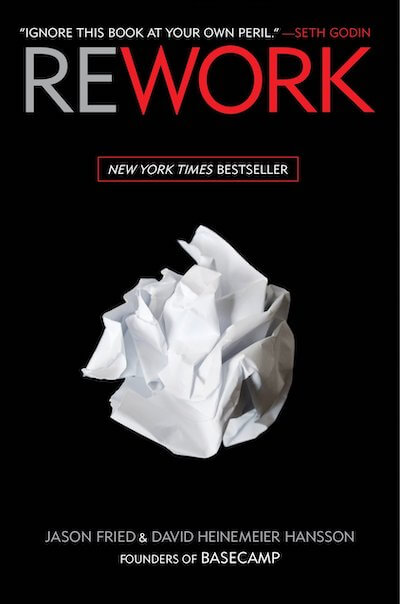
Rework Book Summary
This Rework Book Summary covers the key ideas, lessons, and takeaways in about 20 minutes.
Helps with these goals
Want the complete 20-minute summary?
- Full structured summary
- Video Summary
- Podcast Summary
- Audio summary
- Key takeaways
- Exercises
- Quiz
- Highlights and notes
- Ask the book with AI
What is in the Rework book summary?
Below is a preview of Sumizeit’s expert-written summary of Rework by Jason Fried, David Heinemeier Hansson. The full summary covers the book’s key ideas in text, audio, and video.
Rework (2010) provides insights on how to start a successful internet-based business. It is relevant and timely in the context of our current e-commerce economies. The authors explain the need to adopt a success-based attitude as a starting point toward thriving in business. They argue that the size of the business may not matter but growth, in terms of profitability and sustainability, are key factors of a successful business . The authors reject the outdated term “entrepreneur” and instead ask readers to consider themselves starters of businesses. Readers are shown how to make use of low-cost technology to start businesses and to be problem-solvers. The authors conclude by showing that the main aim of business is not to sell merchandise but to build relationships with clients.
Chapter One: FIRST
Today, anyone can be in business thanks to computers which are are now accessible at a reasonable price.
One person can easily do the tasks of several people or even an entire department thanks to technology.
Doing business is cheaper and requires less time. One can work from home at a minimum cost and generate extra cash.
Chapter two: TAKE DOWNS
The “real world” is a depressing place and always resists change--it contains what people already know and do. You don’t have to live in the reality created by others who assume that society isn’t capable of change. Such people will try to convince you that your ideas are impossible.
Working with plans is dangerous since plans are based on past decisions. Plans resist improvisation which is necessary when running a business.
Disregard long-term plans and focus on achieving short-terms targets. It is better to work without a plan rather than stick to one that does not respond to changing business environments.
Chapter three: GO!
To make a dent in the world, you must do something that is important, meaningful, and noticeable. Craigslist is a good example of a company that made a dent-they disrupted the newspaper business.
The best innovations aim to fulfill the personal needs of their innovator. In the processing of solving a personal need, great products and services are normally produced.
The test of success is not in concepts and ideas but in execution. Ideas are a dime dozen-cheap and plentiful. The real question is how well you turn ideas into a business that can generate income.
Try not to take too much money from investors when starting a business because you may be forced to do what investors want you to do versus what you want to do with your business and what your customers expect your business to offer.
Chapter four: PROGRESS
Most people see a half empty glass instead of a half-full glass. Stop complaining and start seeing opportunities in constraints. Constraints are hidden opportunities that can be turned around to achieve astonishing success.
People don’t remember the runners-up but the winner in a contest. Do you want your product to be the runner up or the winner?
Want the complete 20-minute summary?
- Full structured summary
- Video Summary
- Podcast Summary
- Audio summary
- Key takeaways
- Exercises
- Quiz
- Highlights and notes
- Ask the book with AI
Who should read Rework?
Rework is for entrepreneurs, small business owners, and anyone tired of traditional business advice that doesn't match reality. If you're starting a business on a shoestring budget, juggling multiple roles, or questioning whether expensive business plans and hiring are actually necessary, this book speaks directly to you. Freelancers, solopreneurs, and lean startup founders will find practical, no-nonsense strategies they can implement immediately.
Why does Rework matter?
In an era of remote work, bootstrapped startups, and rapid market shifts, Rework challenges outdated assumptions about how businesses must operate. The book proves that size and venture capital aren't prerequisites for success—profitability, focus, and smart constraints are. Its message remains urgently relevant today as more people reject corporate structures and launch ventures from their laptops.
What are the key themes in Rework?
- Action over planning: execution matters infinitely more than elaborate business plans
- Constraints as advantages: limitations force creativity and reveal hidden opportunities
- Simplicity and focus: do one thing exceptionally well rather than many things adequately
- Building relationships: successful business is about customer loyalty, not just sales
- Culture and people: small, aligned teams outperform larger, disconnected ones
- Authenticity as competitive advantage: showing your real self and flaws builds trust competitors can't replicate
What are the key lessons from the Rework book summary?
Ideas are Worthless Without Execution
Everyone has ideas, but almost nobody executes them. The real value lies in taking action and turning vague concepts into actual products that generate revenue.
Say No to Protect Your Vision
Saying yes to everything leads to overwhelm and dilutes focus. Strategic no's allow you to set priorities and stay true to what matters most.
Constraints Drive Innovation
Limitations force creative problem-solving. Instead of viewing constraints as obstacles, reframe them as opportunities that lead to surprising breakthroughs.
You Are Your Product
The best defense against competitors is making yourself inseparable from your offering. Personal brand, values, and unique perspective cannot be copied.
Start Small and Stay Lean
You don't need massive capital, a huge team, or elaborate plans to launch. Lean operations keep you agile and force disciplined decision-making.
Skip the Long-Term Plans
Detailed five-year plans become obsolete quickly. Focus on short-term targets and remain responsive to what actually happens in your market.
Teaching Builds Loyalty Better Than Ads
You can buy attention with advertising, but you earn lasting trust by teaching and sharing knowledge. This creates deeper customer relationships than traditional marketing.
Hire for What They've Done, Not Years
Experience on a resume means little. Look at actual accomplishments and demonstrate capability. A talented newcomer outperforms a veteran coasting on credentials.
Let Employees Outgrow You
It's healthy when customers or staff eventually need something bigger than you offer. Making room for them to leave creates space for fresh growth.
Simplify Your Communication
Clear, plain language eliminates misunderstanding and miscommunication. Say what you mean and avoid jargon that clouds the message.
Avoid Decision-Making in the Heat of the Moment
Let ideas cool before acting. Taking time to reflect allows you to make calmer, clearer decisions rather than reacting emotionally.
Marketing Happens in Every Interaction
Marketing isn't just ads and campaigns. Every email, phone call, invoice, and customer conversation is an opportunity to reinforce your brand and values.
Show Your Imperfections
Flaws and vulnerabilities make you human and relatable. Audiences respond to authentic, imperfect people more than polished, artificial personas.
Test Jobs Before Hiring
Do the job yourself first to understand what it actually requires. This insight lets you hire the right person and evaluate their performance meaningfully.
Use Urgency Sparingly
Overusing words like ASAP trains people to ignore them. Reserve urgency language for truly critical moments so it retains real meaning.
Embrace Being Unknown While You Can
Small, unknown businesses have freedom to experiment and fail without devastating consequences. Enjoy that risk-taking phase before fame demands caution.
Respond to Crisis Transparently
When problems arise, tell your story yourself. This prevents rumors and misinformation from spreading and demonstrates accountability.
Don't Over-Engineer Details
Getting lost in minutiae causes delays and team disagreement. Sometimes 'good enough' is better than perfect, and getting it done beats endless refinement.
Respect Culture to Drive Results
How you treat people shapes company culture. Respect, clear expectations, and listening during change make employees more receptive and engaged.
Inspiration Has an Expiration Date
Ideas last forever, but the motivation to act on them fades. Strike while inspired rather than planning to execute someday.
Want the complete 20-minute summary?
- Full structured summary
- Video Summary
- Podcast Summary
- Audio summary
- Key takeaways
- Exercises
- Quiz
- Highlights and notes
- Ask the book with AI
How can you apply ideas from Rework?
- Launch with minimal funding by using low-cost or free tools instead of waiting for investor capital
- Create a simple one-page product roadmap instead of a 50-page business plan; update it monthly based on real market feedback
- Teach your market through blog posts, videos, or guides that explain your process; this builds authority and loyalty simultaneously
- Personally fulfill a customer role before hiring someone for it; this teaches you what success actually looks like
- Set a strict rule: only use 'ASAP' for true emergencies; everything else gets normal priority
- When facing a constraint (small budget, limited staff, tight timeline), brainstorm how it forces creative solutions rather than treating it as a setback
- Document and share your imperfections and early mistakes; customers relate to and trust founders who are real
What common mistakes do readers make with Rework?
- Believing you need perfect planning and massive capital before launching; many successful businesses started with neither
- Saying yes to every opportunity, feature request, or partnership; this dilutes focus and exhausts resources
- Waiting for the 'right time' or perfect conditions to act; inspiration fades, so act while motivated
- Hiring based on years of experience rather than demonstrated capability and cultural fit; tenure doesn't guarantee results
Sumizeit Exercises Apply what you've learned
Turn ideas from Rework into action with a short guided reflection: identify the biggest takeaway, connect it to your life, and commit to one step you can take in the next 24 hours.
What is the expert analysis of Rework?
Overview
Rework, authored by Jason Fried and David Heinemeier Hansson, stands as a seminal work in contemporary business literature, particularly for entrepreneurs and small business owners navigating the digital economy. Published in 2010, the book emerges from the practical experiences of its authors—founders of 37signals, a company known for pioneering web-based productivity tools such as Basecamp. Fried and Hansson leverage their dual expertise in software development and business management to challenge conventional entrepreneurial dogma, offering a contrarian yet accessible blueprint for building sustainable, profitable ventures in an era defined by technological democratization and rapid change.
Core Thesis
The central argument of Rework is a radical simplification of the entrepreneurial process: success does not stem from grandiose plans, massive scaling, or traditional notions of entrepreneurship, but rather from immediate action, embracing constraints, and focusing on meaningful, manageable goals. The authors reject the archetype of the entrepreneur as a visionary risk-taker, instead positioning business founders as pragmatic starters who leverage low-cost technology and prioritize relationship-building over mere sales. The book advocates for agility over rigid planning, authenticity over polished marketing, and the cultivation of unique value that cannot be easily replicated by competitors.
Strengths
- Pragmatic and Action-Oriented Advice: Fried and Hansson’s emphasis on starting immediately and iterating aligns well with lean startup principles, making the book highly practical for readers overwhelmed by traditional business planning.
- Challenging Conventional Wisdom: By questioning the value of long-term plans, the cult of entrepreneurship, and investor dependency, the book disrupts entrenched business paradigms and encourages independent thinking.
- Focus on Constraints as Opportunities: The reframing of limitations as catalysts for innovation is a powerful psychological and strategic insight that resonates across industries.
- Clear, Concise Communication: The authors’ advocacy for simplicity in language and processes reduces barriers to understanding and implementation, enhancing the book’s accessibility.
- Integration of Personal Experience: The narrative is enriched by the authors’ real-world successes, lending credibility and relatability to their prescriptions.
Critiques & Counterarguments
- Oversimplification of Complex Challenges: While the book’s minimalist approach is refreshing, it may underestimate the complexities of scaling businesses, managing diverse teams, or navigating regulatory environments that require more nuanced strategies.
- Limited Empirical Evidence: The book relies heavily on anecdotal evidence from the authors’ experiences, lacking rigorous data or case studies to substantiate broader applicability.
- Potential Neglect of Strategic Planning: The dismissal of long-term plans could be risky in industries where forecasting and compliance are critical, such as healthcare or manufacturing.
- Competing Schools of Thought: Traditional business frameworks emphasize strategic foresight, risk management, and stakeholder engagement—areas where Rework offers limited guidance, potentially alienating readers who require comprehensive planning tools.
- Real-World Contradictions: The advice to avoid external investment may not hold for startups requiring significant capital to innovate or compete globally, suggesting that the book’s model suits primarily bootstrapped or small-scale ventures.
Who Should Read This
Rework is ideally suited for aspiring entrepreneurs, small business owners, freelancers, and creative professionals who seek a no-nonsense, agile approach to building and sustaining a business in the digital age. It appeals to those disillusioned by traditional business dogma and eager to embrace innovation through simplicity and immediacy. Additionally, startup founders who prioritize culture, customer relationships, and iterative progress over rapid scaling will find the book’s insights particularly valuable. However, readers engaged in highly regulated or capital-intensive industries may need to supplement Rework with more comprehensive strategic resources.
Frequently asked questions about the Rework book summary
What is Rework about?
Rework by Jason Fried and David Heinemeier Hansson is a practical guide to starting and running successful businesses without relying on traditional business wisdom. The book challenges conventional assumptions about planning, hiring, funding, and growth, advocating instead for lean operations, clear focus, and customer-centric thinking.
Who should read Rework?
Rework is ideal for entrepreneurs, small business owners, freelancers, and anyone considering launching a startup. It's especially valuable if you're bootstrapping with limited resources, tired of corporate bureaucracy, or skeptical of traditional business advice that requires massive teams and capital.
What are the main takeaways from Rework?
Key takeaways include: execution matters far more than ideas, constraints spark innovation rather than limiting it, focus beats size, saying no protects your vision, and every customer interaction is marketing. The book emphasizes starting small, staying lean, building authentic relationships, and acting while inspired rather than planning endlessly.
Does Rework work for established businesses or only startups?
While Rework focuses on startup philosophy, its principles apply to any business at any stage. Established companies can use the book to streamline operations, improve culture, eliminate unnecessary processes, and refocus on what matters most to customers.
How does Rework differ from other business books?
Rework stands out by rejecting business school orthodoxy and offering contrarian advice backed by the authors' real experience building 37signals. Rather than advocating growth-at-all-costs or complex strategies, the book champions simplicity, pragmatism, and the idea that smaller, focused businesses often outperform bloated ones.
Is Rework still relevant if it was published in 2010?
Absolutely. The core principles about focus, execution, authentic customer relationships, and lean operations remain timeless. The rise of remote work, bootstrapped startups, and digital tools has made Rework even more relevant than when first published.
What's the book's stance on hiring and company culture?
Rework argues that hiring should be based on demonstrated capability rather than credentials, and that small, aligned teams create better culture than large departments filled with strangers. The authors emphasize treating people with respect and involving them in workplace changes.
About Sumizeit
Sumizeit is a profitable Scomy LLC company based in Miami, Florida. It has been helping readers learn from nonfiction books for 7 years with expert-written summaries in text, audio, podcast, and video.
Want the complete 20-minute summary?
- Full structured summary
- Video Summary
- Podcast Summary
- Audio summary
- Key takeaways
- Exercises
- Quiz
- Highlights and notes
- Ask the book with AI
Here's why readers love Sumizeit
Join thousands of learners getting smarter every day
"Great experience. Detailed summaries. Loved the gamification feature. Makes learning fun. Good customer service. I recommend Sumizeit to anyone. You'll learn a lot."
"I always felt busy but still wanting to keep up with the book discussion in my friend group. This was a great supplement to help me keep reading the books I find fun while keeping up with important books."
"I love this website. Instead of scrolling social media, I find myself learning a lot. I use it everyday. I recommend this app for anyone who is too busy and wants to get up to speed with their favorite books."
Rework Book Summary PDF
Looking for a Rework Book Summary PDF you can save and revisit offline? Our Rework Book Summary PDF captures the book’s core ideas in a clean, printable format — the key frameworks, takeaways, and structure without the fluff. Download the Rework Book Summary PDF when you want a reference you can annotate, share with your team, or review on the go. Get your Rework Book Summary PDF from the download page below.
Download Rework Book Summary PDFPeople also liked these summaries
Readers who explored Rework often enjoyed these titles next.



Want the complete 20-minute summary?
- Full structured summary
- Video Summary
- Podcast Summary
- Audio summary
- Key takeaways
- Exercises
- Quiz
- Highlights and notes
- Ask the book with AI
Featured Book Titles
Popular Book Summaries at sumizeit, leading book summary app