


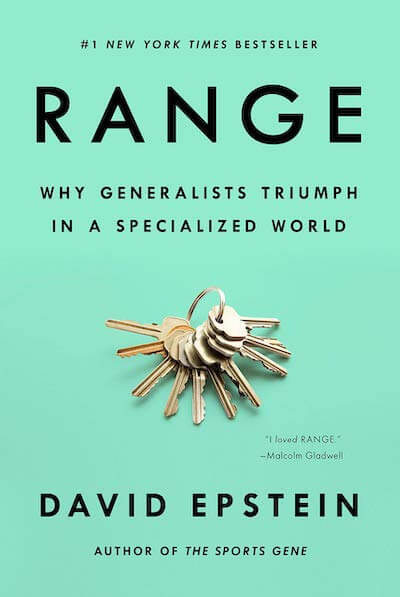
Range Book Summary
This Range Book Summary covers the key ideas, lessons, and takeaways in about 20 minutes.
Want the complete 20-minute summary?
- Full structured summary
- Video Summary
- Podcast Summary
- Audio summary
- Key takeaways
- Exercises
- Quiz
- Highlights and notes
- Ask the book with AI
What is in the Range book summary?
Below is a preview of Sumizeit’s expert-written summary of Range by David Epstein. The full summary covers the book’s key ideas in text, audio, and video.
There is no single key that will unlock every kind of door. That is due to a basic principle: when something is specialized, it's not universally useful. This is great when we’re talking about the key leading to your front door. Not so great if it's your skillset. The book Range: Why Generalists Triumph in a Specialized World discusses the value of having a range of skills versus a single specialization. This can be crucial, especially since:
Specialization is not the only way to excellence
Take for instance: Tiger Woods and Roger Federer. They have one big thing in common: they’re both star athletes. Tiger Woods showed signs of skill with golf from the time he was a child, practiced golf exclusively, and went on to become legendary. Roger Federer had a significantly different experience. As a kid growing up, he just loved any sport with a ball. It was a while before he was introduced to tennis. Instead, he played many different sports, even refusing to move into a more advanced tennis league because he wanted to hang out with his friends. This is called sampling, and we will say more about that later. He was a “late specializer”. Meaning that he chose tennis after trying out many different sports. After his success, studies began to crop up indicating this was the pathway of many experts in different sports. They tried out a bunch of different sports, then settled on a sport to specialize in later on.
Though some areas certainly do require Tiger Wood’s level of specialization, many others benefit from people with range. Range is the ability to perform many different tasks well. Roger Federer developed this by trying out many different sports in his youth before he chose one to specialize in. Often, people feel specialization is the only way to achieve or enjoyment. If you operate on this line of thinking, you need to ask yourself:
Are chess and golf representative of all activities that matter to you?
If so, then yes, specialization is important. In chess, this is essential. Kids have to be younger than 12 when they learn to play chess or they will never be grandmasters. Talk about pressure and specialization. However, even amongst these super talented kids, specialization often creates a reliance on pattern-finding. People who specialize can get so familiar with certain patterns and problems that solving novel tasks become nearly impossible for them. People who are highly specialized can appear to be superhuman: especially chess players and golfers, but they’ve just developed the skill of recognizing patterns. This can be helpful… but not always. This is because:
Unfortunately, the world is not golf or tennis, it's Martian tennis.
Meaning the rules are constantly changing, and it's up to you to figure them out. In a game of bridge, when the rules were slightly altered, experts had a harder time playing. Scientists inducted into the highest-ranked national academies tend to have hobbies outside of their domain.
Want the complete 20-minute summary?
- Full structured summary
- Video Summary
- Podcast Summary
- Audio summary
- Key takeaways
- Exercises
- Quiz
- Highlights and notes
- Ask the book with AI
Who should read Range?
Range is ideal for professionals, students, and entrepreneurs who feel pressured to specialize early or worry that their varied interests are a liability. If you're navigating career transitions, leading teams across disciplines, or questioning whether a narrow focus is truly the path to success, this book offers a refreshing counterargument backed by research and real-world examples.
Why does Range matter?
In a world that increasingly celebrates early specialization and deep expertise, David Epstein challenges the assumption that narrowing your focus is the only road to excellence. Today's complex problems—from innovation to organizational management—often require the ability to synthesize ideas across domains, making the generalist perspective more valuable than ever. Understanding when breadth beats depth could reshape how you approach your education, career, and problem-solving.
What are the key themes in Range?
- Generalists outperform specialists in dynamic, unpredictable environments
- Early sampling of diverse skills builds stronger foundational thinking
- Overspecialization creates cognitive rigidity and pattern dependence
- Interdisciplinary thinking and analogical reasoning drive innovation
- Organizational and team success depends on lateral communication and diverse perspectives
- Struggle and slow learning produce more durable, transferable knowledge
What are the key lessons from the Range book summary?
Late specialization often beats early specialization
Athletes like Roger Federer who sampled multiple sports before choosing one often achieve greater success than those who specialize from childhood. The sampling period builds broader competencies that transfer to the chosen domain.
Pattern recognition creates blind spots
Experts become so attuned to familiar patterns that they struggle with novel problems. This rigidity can actually worsen with experience, even as confidence increases.
The world rewards adaptability, not fixed expertise
Unlike chess or golf, most real-world challenges have changing rules and require the ability to apply knowledge across unfamiliar contexts, favoring generalists.
Narrow academic training doesn't transfer to novel problems
Students who develop expertise in a single subject often cannot apply their reasoning skills to problems outside that domain, leaving them unprepared for careers that require flexibility.
Sampling before specialization maximizes learning
Research on musicians and learners shows that sampling multiple approaches, then narrowing focus with structured practice, produces superior mastery compared to early specialization.
Conceptual understanding beats rote learning
Musicians who develop a conceptual grasp of principles across instruments find their own voice and adapt more easily than those who memorize specific songs or techniques.
Blind optimism derails planning and estimation
Focusing only on your own project while ignoring similar past efforts leads to unrealistic assessments. Comparing to outside reference points provides crucial reality checks.
Diverse teams solve novel problems faster
Groups with varied professional backgrounds identify solutions more quickly than homogeneous teams because they bring different cognitive toolkits to unfamiliar challenges.
Cross-domain inspiration fuels creative breakthroughs
Innovations like the assembly line and the difference engine emerged when leaders borrowed methodologies from unexpected industries and adapted them to their own.
Hierarchical communication structures stifle problem-solving
When information flows only through a single leader, lower-level employees cannot voice critical concerns, leading to missed warnings and organizational failures.
Lateral communication improves safety and innovation
Open lines of communication across all organizational levels allow diverse perspectives to surface, preventing disasters and enabling better decision-making.
Struggle is essential to deep learning
Learners who work through problems without hints may progress slowly, but they retain knowledge better and transfer skills more effectively than those given easy paths.
Hints undermine long-term retention
Students and even animals who receive hints learn to read the hints rather than solve problems, resulting in poor performance when hints are removed.
Effortful processing creates abstract mental models
Learning the same concept across multiple contexts forces learners to develop deeper, more flexible understanding rather than relying on specific examples.
Career changes compound rather than erase skill development
Transitioning between fields doesn't waste prior learning; instead, the diverse experiences and abstract reasoning skills accumulated strengthen new pursuits.
Credentialed experts can become worse with age if too narrow
Highly specialized experts may lose adaptability over time despite growing confidence, making them less equipped to handle unprecedented challenges.
Later career pivots often succeed more than early ventures
Research shows that founders in their 50s with accumulated diverse experience are more likely to create successful companies than younger, less-experienced entrepreneurs.
Growth mindset enables continuous reinvention
Viewing abilities as developable rather than fixed encourages people to acquire new skills and adapt when circumstances change, avoiding the trap of rigid expertise.
Want the complete 20-minute summary?
- Full structured summary
- Video Summary
- Podcast Summary
- Audio summary
- Key takeaways
- Exercises
- Quiz
- Highlights and notes
- Ask the book with AI
How can you apply ideas from Range?
- Encourage your children or team members to try multiple activities before specializing, building breadth before depth
- When estimating project costs or timelines, actively compare your situation to similar past projects outside your immediate field to avoid optimistic bias
- Hire and build teams with diverse professional backgrounds to improve problem-solving for unfamiliar challenges
- Look outside your industry for analogies and methodologies that could improve your own operations and strategy
- Establish lateral communication channels in your organization so employees at all levels feel empowered to raise concerns
- When teaching or training, resist the urge to provide hints; let people struggle through problems for deeper learning
- Periodically revisit and teach the conceptual principles behind your expertise rather than just the surface techniques to ensure transferable knowledge
What common mistakes do readers make with Range?
- Assuming that early specialization is necessary for excellence, when sampling and breadth often produce stronger foundations and adaptability
- Using only internal perspectives when planning, ignoring reference points from similar projects in other domains and falling into overoptimistic estimates
- Building teams or organizations where information flows only through a single decision-maker, preventing important feedback from lower levels
- Providing excessive guidance or hints when teaching, which creates dependence on hints rather than genuine problem-solving ability
Sumizeit Exercises Apply what you've learned
Turn ideas from Range into action with a short guided reflection: identify the biggest takeaway, connect it to your life, and commit to one step you can take in the next 24 hours.
What is the expert analysis of Range?
Overview
Range: Why Generalists Triumph in a Specialized World is a compelling exploration of the value of breadth over narrow specialization, authored by David Epstein, an investigative reporter known for his rigorous analysis of sports science and human performance. Epstein challenges the prevailing cultural narrative that early and intense specialization is the sole path to excellence, drawing on diverse examples from athletics, music, science, and business to argue for the power of generalist approaches in an increasingly complex and unpredictable world. His background in environmental science, astronomy, and journalism equips him with a multidisciplinary lens that enriches his critique of specialization’s limits.
Core Thesis
Epstein’s central argument is that while specialization can be effective in domains with stable rules and patterns—such as golf or chess—many real-world challenges demand adaptability, creativity, and the ability to integrate knowledge across fields. He posits that “range,” or the development of diverse skills and experiences through sampling, enables individuals and organizations to navigate novel problems more successfully than those confined to narrow expertise. This thesis confronts the dominant paradigm by emphasizing the cognitive flexibility and innovative potential that come from cross-disciplinary learning and late specialization.
Strengths
- Interdisciplinary Evidence: Epstein’s use of examples from sports, music, science, and business provides a rich, multifaceted foundation for his claims, illustrating the universal applicability of generalist strategies.
- Nuanced Understanding of Expertise: The book distinguishes between domains where early specialization is necessary and those where it is limiting, avoiding a one-size-fits-all prescription.
- Practical Applications: Epstein translates his insights into actionable advice for education, career development, and organizational management, bridging theory and practice.
- Engaging Narrative Style: The integration of compelling stories—such as the contrasting paths of Tiger Woods and Roger Federer—makes complex cognitive science accessible and relatable.
- Challenge to Conventional Wisdom: By questioning the fetishization of early specialization, Epstein invites readers to reconsider entrenched societal and educational norms.
Critiques & Counterarguments
- Potential Oversimplification of Specialization: While Epstein acknowledges that some fields require early specialization, the book occasionally underplays the depth of expertise and mastery that specialization can yield, especially in highly technical or scientific domains where incremental knowledge accumulation is critical.
- Selection Bias in Examples: The celebrated cases of late specializers like Federer may not represent the broader population, and success stories of early specializers are often underemphasized, which could skew the generalizability of the argument.
- Limited Engagement with Cognitive Load Theory: The book could benefit from deeper integration with psychological research on cognitive load and expertise development, which sometimes supports focused practice over broad sampling.
- Contrasting Research on Deliberate Practice: Scholars like Anders Ericsson emphasize the role of deliberate, focused practice in achieving expertise, suggesting that breadth might impede the depth of skill acquisition necessary for elite performance.
- Real-World Constraints: In many professional and educational contexts, systemic pressures and resource limitations make prolonged sampling impractical, a challenge the book acknowledges but does not fully resolve.
Who Should Read This
Range is essential reading for educators, career counselors, organizational leaders, and anyone grappling with questions of skill development and adaptability in complex environments. It offers valuable insights for students and professionals contemplating career paths in a rapidly changing world, as well as for innovators seeking to foster creativity through interdisciplinary thinking. Readers interested in the psychology of learning, talent development, and the future of work will find Epstein’s arguments both provocative and instructive, prompting a reevaluation of how we define and cultivate expertise.
Frequently asked questions about the Range book summary
What is Range about?
Range: Why Generalists Triumph in a Specialized World by David Epstein argues that cultivating diverse skills and broad knowledge often leads to greater success, innovation, and adaptability than narrow specialization. The book challenges the popular notion that early specialization is the only path to excellence, using research and examples from sports, music, science, and business to show why generalists excel in unpredictable environments.
Who should read Range?
Range is valuable for anyone navigating career decisions, organizational leadership, or skill development—particularly those feeling pressure to specialize early or worried that varied interests are a weakness. It appeals to entrepreneurs, students, managers, and professionals who want to understand how breadth of knowledge drives innovation and problem-solving in complex, dynamic fields.
What are the main takeaways from Range?
The core message is that sampling diverse experiences before specializing, embracing struggle in learning, and maintaining cognitive flexibility outperform early narrow focus. Key practical insights include building diverse teams for better problem-solving, using outside reference points to avoid blind optimism, fostering lateral communication in organizations, and viewing career changes as skill-building rather than wasted time.
Why do generalists outperform specialists in some fields?
Specialists develop strong pattern recognition but can become cognitively rigid, struggling with novel problems that don't fit familiar patterns. Generalists, having encountered diverse contexts and approaches, develop more abstract mental models and can apply knowledge across domains, making them better equipped for the unpredictable challenges of dynamic fields.
Does Range suggest you should never specialize?
No. Range advocates for sampling multiple approaches and building breadth before specializing, rather than avoiding specialization entirely. Some fields like chess require early focus, but even then, the research shows that combining sampling with later specialization produces better outcomes and more adaptable thinkers than pure early specialization.
How does struggle help with learning, according to Range?
Epstein presents research showing that learners who work through problems without hints may progress slowly but retain knowledge far better than those given easy paths or hints. Effortful processing forces the brain to build deeper, more flexible understanding and abstract mental models rather than relying on specific examples or patterns.
What does Range say about organizational structure and communication?
Range warns against rigid hierarchical structures where communication flows only through a single leader, as this prevents lower-level employees from voicing critical concerns and insights. The book advocates for lateral communication across all organizational levels, allowing diverse perspectives to surface and improving both safety and innovation.
About Sumizeit
Sumizeit is a profitable Scomy LLC company based in Miami, Florida. It has been helping readers learn from nonfiction books for 7 years with expert-written summaries in text, audio, podcast, and video.
Want the complete 20-minute summary?
- Full structured summary
- Video Summary
- Podcast Summary
- Audio summary
- Key takeaways
- Exercises
- Quiz
- Highlights and notes
- Ask the book with AI
Here's why readers love Sumizeit
Join thousands of learners getting smarter every day
"Great experience. Detailed summaries. Loved the gamification feature. Makes learning fun. Good customer service. I recommend Sumizeit to anyone. You'll learn a lot."
"I always felt busy but still wanting to keep up with the book discussion in my friend group. This was a great supplement to help me keep reading the books I find fun while keeping up with important books."
"I love this website. Instead of scrolling social media, I find myself learning a lot. I use it everyday. I recommend this app for anyone who is too busy and wants to get up to speed with their favorite books."
Range Book Summary PDF
Looking for a Range Book Summary PDF you can save and revisit offline? Our Range Book Summary PDF captures the book’s core ideas in a clean, printable format — the key frameworks, takeaways, and structure without the fluff. Download the Range Book Summary PDF when you want a reference you can annotate, share with your team, or review on the go. Get your Range Book Summary PDF from the download page below.
Download Range Book Summary PDFPeople also liked these summaries
Readers who explored Range often enjoyed these titles next.



Want the complete 20-minute summary?
- Full structured summary
- Video Summary
- Podcast Summary
- Audio summary
- Key takeaways
- Exercises
- Quiz
- Highlights and notes
- Ask the book with AI
Featured Book Titles
Popular Book Summaries at sumizeit, leading book summary app
