


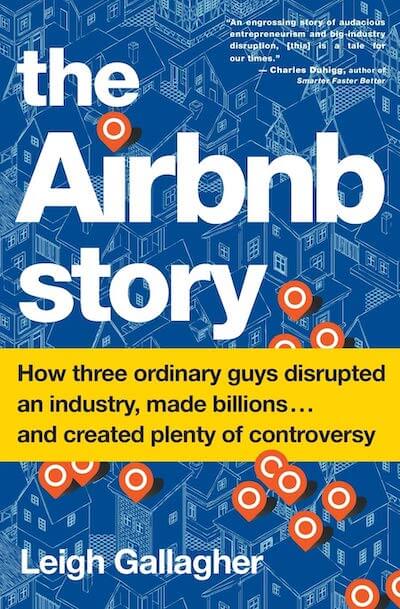
Prefer the print book? Buy on Amazon
As an Amazon Associate, Sumizeit earns from qualifying purchases.
The Airbnb Story Book Summary
This The Airbnb Story Book Summary covers the key ideas, lessons, and takeaways in about 20 minutes.
Short Description:
Airbnb started as a creative solution and transformed the hospitality industry.
Helps with these goals
Preview the The Airbnb Story book summary
Below is a preview of Sumizeit’s comprehensive human-written summary of The Airbnb Story by Leigh Gallagher. The full summary is 15-20 minutes long and covers the book’s key ideas in text, audio, visual, and video formats. Unlock the full 20 Minute Summary
Airbnb has completely changed the way people vacation.
Instead of crashing in a fancy hotel room in a new city, people opt to take over or even share other people’s oftentimes eccentric pads for the night, a week, or a month.
But, how did this concept come to be?
“It seemed silly to let a perfectly good apartment sit empty while I traveled when there were so many visitors to San Francisco in need of a place to stay, who wanted to experience a city as I preferred to: in a local’s home, outside the tourist bubble of a hotel.”-Leigh Gallagher
In “The Airbnb Story” by Leigh Gallagher you will learn the origin of this billion-dollar company that has reinvented the hospitality business.
How It All Started
In 2007, two poor designers, Brian Chesky and Joe Gebbia were living in San Francisco struggling to pay rent on their $1,150 apartment.
With some creative thinking that they had both learned from the Rhode Island School of Design, they decided to rent out space in their apartment for people who were traveling to attend the Industrial Designers Society of America conference happening in San Francisco.
They created a deal that people could rent an air mattress in their apartment for $80 a night. They called this plan the AirBed and Breakfast. To gain the attention of attendees to the conference, they posted ads on design blogs.
Within a few days, they were booked. With quick success, they started brainstorming how they could take this further by helping others use their apartments to make money as well.
To get out the news of their project they first went to the South by Southwest festival in Austin and the DNC in Colorado in 2008.
In order to be taken seriously, the two designers hired Nathan Blecharczyk a coder and engineer.
Although they had a great team, it was hard for them to get people to open their homes to strangers. They decided to create ads on small local blogs in order to gain traction.
And, it worked! The ads fueled a buzz and a New York Times article was even written up. After that 800 people signed up for the service and 80 bookings were made.
The Cereal Marketing Stunt
The quick buzz suddenly died and the team knew they needed to do something in order to keep their success.
Because of their work at the DNC, they decided it would be clever to appeal voters by offering Obama O’s and Cap’n McCain cereals as breakfast at their bed and breakfasts. All they had to do was rebox cereal and sell their newly named product. They earned $30,000 with this cereal marketing stunt.
Paul Graham, a tech billionaire, was intrigued by the designer duo after their clever marketing stunt. He personally didn’t like the idea of the AirBed and Breakfast, but he admired their determination and clever thinking. He decided to offer them a three-month mentor period.
Graham encouraged the two to temporarily move…
Want the complete 20-minute summary?
- Full structured summary
- Video Summary
- Podcast Summary
- Audio summary
- Key takeaways
- Exercises
- Quiz
- Highlights and notes
- Ask the book with AI
Who should read The Airbnb Story?
The Airbnb Story is essential reading for entrepreneurs, business students, and anyone curious about how disruptive startups challenge established industries. It's particularly valuable for those interested in understanding the journey from a desperate idea to a global platform, as well as leaders navigating growth, trust-building, and social responsibility in the sharing economy.
Why does The Airbnb Story matter?
The Airbnb Story reveals how a $1,150 apartment rental problem became a $100+ billion company that fundamentally reshaped hospitality and travel. In today's sharing economy, understanding how Airbnb built trust between strangers, handled regulatory battles, and addressed systemic bias offers crucial lessons for any platform-based business. Leigh Gallagher's account shows that success requires far more than a clever idea—it demands adaptability, mission-driven hiring, and the courage to confront hard truths about your own platform.
What are the key themes in The Airbnb Story?
- Building trust between strangers on a digital platform
- Mission-driven hiring and company culture
- Navigating regulatory challenges and legal opposition
- Addressing discrimination and bias in marketplace design
- Simplification through thoughtful user experience design
- Scaling operations across currencies, timezones, and geographies
- Balancing growth with community responsibility
How can you apply ideas from The Airbnb Story?
- Apply the three-click rule to any digital product: identify what users want to do most and ensure it requires minimal friction
- When hiring, prioritize cultural fit and mission alignment over resume credentials and speed of hiring
- Create mechanisms for users to build personal connection and trust in marketplace designs—welcome packets, profiles, reviews
- Establish 24-hour customer support channels for both sides of a two-sided marketplace to catch and resolve trust issues immediately
- Proactively study your platform for bias and discrimination using third-party research rather than assuming good intentions prevent harm
- Build regulatory relationships early by showing local governments how your business model aligns with their stated values
What common mistakes do readers make with The Airbnb Story?
- Assuming that good intentions and transparent design prevent discrimination—algorithms can amplify bias regardless of founder values
- Ignoring early warning signs of problems like safety incidents or discrimination by treating them as isolated cases rather than systemic
- Growing too fast without hiring employees who genuinely believe in the mission, which dilutes company culture
- Treating regulatory opposition as purely adversarial rather than as an opportunity to clarify your values and prove your business model benefits the community
Sumizeit Exercises Apply what you've learned
Turn ideas from The Airbnb Story into action with a short guided reflection: identify the biggest takeaway, connect it to your life, and commit to one step you can take in the next 24 hours.
What is the expert analysis of The Airbnb Story?
Overview
The Airbnb Story by Leigh Gallagher offers a compelling narrative of the rise of Airbnb, a company that revolutionized the hospitality industry through innovation and a human-centric approach to travel. Gallagher, a seasoned business journalist and senior editor-at-large at Fortune, brings her expertise in business reporting and storytelling to illuminate the entrepreneurial journey of Airbnb’s founders and the broader implications of their disruptive model. The book is significant not only as a business case study but also as a cultural chronicle of how Airbnb reshaped notions of travel, trust, and community in the digital age.
Core Thesis
Gallagher’s central argument is that Airbnb’s success stems from its founders’ creative problem-solving, commitment to fostering genuine human connections, and adaptive business strategies that challenged traditional hospitality norms. The book posits that Airbnb’s model—transforming underutilized private spaces into vibrant, personalized travel experiences—has fundamentally altered how people vacation and engage with cities worldwide. This transformation is framed as both a business innovation and a social phenomenon, with Airbnb’s mission deeply rooted in trust-building and community values.
Strengths
- Rich Narrative Detail: Gallagher’s journalistic background ensures a well-researched and engaging recounting of Airbnb’s early struggles, marketing ingenuity, and strategic pivots, such as the famed cereal marketing stunt and the shift from air mattresses to full home rentals.
- Human-Centered Focus: The emphasis on Airbnb’s mission to create authentic human exchanges adds depth, highlighting how personal touches like welcome packets and host-guest interactions underpin the platform’s success.
- Balanced Coverage of Challenges: The book does not shy away from addressing Airbnb’s legal battles, safety issues, and racial discrimination controversies, providing a nuanced view of the company’s growing pains and ethical dilemmas.
- Contextualization within Broader Trends: By situating Airbnb’s growth alongside shifts in consumer behavior, technology, and urban dynamics, Gallagher offers readers insight into the socio-economic forces that enabled the platform’s rise.
- Authoritative Voice: Gallagher’s credentials and access to key figures lend credibility and insider perspective, enriching the narrative with firsthand accounts and expert commentary.
Critiques & Counterarguments
- Potential Oversimplification of Success Factors: While the book credits creativity and human connection as Airbnb’s core strengths, it may underplay the role of broader economic conditions, such as the 2008 financial crisis, which increased demand for affordable travel options and alternative income streams.
- Limited Critical Analysis of Regulatory Impact: The discussion of legal challenges is informative but could benefit from deeper exploration of how Airbnb’s model disrupts housing markets and urban communities, with some scholars arguing that it exacerbates gentrification and housing shortages.
- Racial Discrimination Treatment: Although Gallagher covers Airbnb’s racial bias issues and responses, some critics might argue the book is somewhat optimistic about the company’s efforts, given ongoing systemic challenges and the complexity of eradicating implicit bias on peer-to-peer platforms.
- Competing Perspectives on Trust and Safety: The book emphasizes trust-building mechanisms, yet alternative research highlights persistent safety concerns and incidents that question whether platform-based trust can fully substitute for regulated hospitality standards.
- Emerging Market Dynamics: The rapid growth in foreign markets like China is noted, but the analysis could be expanded to consider how cultural differences and government regulations in various countries shape Airbnb’s adaptability and sustainability globally.
Who Should Read This
The Airbnb Story is ideal for readers interested in entrepreneurship, innovation, and the intersection of technology and society. Business professionals, startup founders, and students of business and hospitality will find valuable lessons in scaling a disruptive venture and navigating complex regulatory landscapes. Additionally, those fascinated by contemporary cultural shifts in travel and community engagement will appreciate Gallagher’s insightful portrayal of Airbnb’s impact. The book also serves as a thoughtful resource for policymakers and urban planners seeking to understand the challenges and opportunities presented by the sharing economy.
Frequently asked questions about the The Airbnb Story book summary
What is The Airbnb Story about?
The Airbnb Story by Leigh Gallagher chronicles the rise of Airbnb from a desperate idea born in 2007 when two broke designers rented out air mattresses to pay rent, into a global platform that has fundamentally transformed the hospitality industry. The book covers the founders' journey, their marketing innovations, how they built trust between strangers, the challenges they faced including racial discrimination and legal battles, and their vision for the future of travel and belonging.
Who should read The Airbnb Story?
The Airbnb Story is ideal for entrepreneurs, startup founders, business students, and anyone interested in how disruptive companies challenge incumbents and transform industries. It's also valuable for leaders building two-sided marketplaces, those navigating regulatory environments, and anyone seeking to understand how platform companies can address bias and build responsible growth.
What are the main takeaways from The Airbnb Story?
Key takeaways include: creative desperation can spark innovation, hiring for mission fit matters more than speed, human connection is a competitive advantage, simplicity requires enormous complexity behind the scenes, trust requires immediate response to failures, and profitability doesn't mean you've solved all problems. The book also emphasizes that transparency about failures, commitment to community values, and continuous innovation are essential for sustainable platform growth.
How did Airbnb overcome safety and discrimination issues?
Airbnb addressed safety by establishing a 24-hour support hotline, implementing review systems, conducting background checks, and hiring a dedicated safety team. For racial discrimination, the company initially resisted findings but eventually issued a public apology and launched the Open Door Policy to help users report discrimination. They began working to help hosts recognize their own biases rather than pretending the problem didn't exist.
What marketing strategy helped Airbnb gain early traction?
Airbnb's breakthrough came with the Obama O's and Cap'n McCain cereal stunt during the 2008 election cycle, which generated $30,000 in revenue and caught media attention. This unconventional, culturally timely marketing demonstrated that creative risk-taking could build buzz. The founders also used targeted ads on design blogs and traveled to conferences to build personal relationships with early hosts.
How did Airbnb handle regulatory challenges in cities like New York?
Rather than fighting all regulations, Airbnb negotiated with cities to show that it supported individual hosts, not commercial operators. In New York, the company signed Community Compact pledges that limited hosts to one listing per person, protected affordable housing, and allowed cities to tax bookings. This strategy proved that Airbnb could align with community values while operating legally.
What role did Paul Graham play in Airbnb's success?
Paul Graham, a tech billionaire, was intrigued by Chesky and Gebbia's creative determination despite not initially believing in the business concept. He offered a three-month mentorship and encouraged them to move to New York where most users lived. Graham's backing and guidance helped them refine their model, expand beyond air mattresses, and gain credibility with future investors.
Why did Airbnb require welcome packets from hosts?
Airbnb required welcome packets and host communication to create human connection and personal touch in what could otherwise be a purely transactional rental. By encouraging hosts to share local secrets and be open to guest questions, Airbnb transformed the experience from staying in a hotel room into staying in a local's home. This strategy aligned with the company's core mission of creating meaningful human exchange.
About Sumizeit
Sumizeit is a profitable Scomy LLC company based in Miami, Florida. Our founders, Clemens Raemy and Weina Scott, are successful entrepreneurs with several exits. Sumizeit is a popular book summary app / micro learning app used by busy professionals and entrepreneurs with over 2,500 non-fiction book summaries and 10,000 podcast summaries in text, audio, visual, podcast, and video format. We also have stellar retention tools to make ideas stick - such as flashcards with spaced repetition, quizzes, streaks, highlighting and notes, daily challenges, riddles, mini-courses, meditation, and more. You won't only learn the idea, but also remember it. Over 90% of our users change their habits with Sumizeit.
Upgrade Now
Here's why readers love Sumizeit
Join thousands of learners getting smarter every day
"Great experience. Detailed summaries. Loved the gamification feature. Makes learning fun. Good customer service. I recommend Sumizeit to anyone. You'll learn a lot."
"I always felt busy but still wanting to keep up with the book discussion in my friend group. This was a great supplement to help me keep reading the books I find fun while keeping up with important books."
"I love this website. Instead of scrolling social media, I find myself learning a lot. I use it everyday. I recommend this app for anyone who is too busy and wants to get up to speed with their favorite books."
The Airbnb Story Book Summary PDF
Looking for a The Airbnb Story Book Summary PDF you can save and revisit offline? Our The Airbnb Story Book Summary PDF captures the book’s core ideas in a clean, printable format — the key frameworks, takeaways, and structure without the fluff. Download the The Airbnb Story Book Summary PDF when you want a reference you can annotate, share with your team, or review on the go. Get your The Airbnb Story Book Summary PDF from the download page below.
Download The Airbnb Story Book Summary PDFPeople also liked these summaries
Readers who explored The Airbnb Story often enjoyed these titles next.


Ready to read the whole thing?
- Full structured summary
- Video Summary
- Podcast Summary
- Audio summary
- Key takeaways
- Exercises
- Quiz
- Highlights and notes
- Ask the book with AI
Featured Book Titles
Popular Book Summaries at sumizeit, leading book summary app