Question 1 of 5
What is the first of the ten lessons McRaven emphasizes from Navy SEAL training?
The summary states that making your bed is the first of the ten lessons and a simple task that sets up the day.


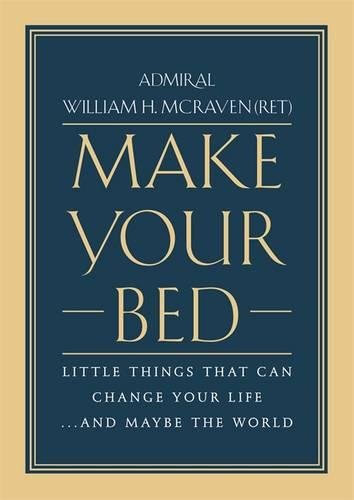
Prefer the print book? Buy on Amazon
As an Amazon Associate, Sumizeit earns from qualifying purchases.
This Make Your Bed Book Summary covers the key ideas, lessons, and takeaways in about 20 minutes.
Helps with these goals
Want a Free Weekly Read?
Get a free summary every week straight to your mailbox.
Below is a preview of Sumizeit’s comprehensive human-written summary of Make Your Bed by Admiral William H. McRaven. The full summary is 15-20 minutes long and covers the book’s key ideas in text, audio, visual, and video formats. Unlock the full 20 Minute Summary
In Navy SEAL training, there is a focus on ten lessons that teach individuals how to foster human connections, build on small achievements, eliminate superficial judgment, learn from failed attempts, practice risk-taking, enjoy being challenged, stand strong, and understand the unfairness of life itself.
The book, “Make Your Bed: Little Things That Can Change Your Life...And Maybe the World” by Admiral William H. McRaven is a rewrite of a commencement speech that was given by the author to the class of 2014 at the University of Texas at Austin.
“I realized that the past failures had strengthened me, taught me that no one is immune from mistakes. True leaders must learn from their failures, use the lessons to motivate themselves, and not be afraid to try again or make the next tough decision.”- William H. McRaven
McRaven emphasizes the ten important lessons by sharing his own experiences of military training, showing how it helped to create the person he is today.
Making your bed is the first of the ten lessons. This simple task is an accomplishment that sets up individuals to build upon it throughout their day.
“Making my bed correctly was not going to be an opportunity for praise. It was expected of me. It was my first task of the day, and doing it right was important. It demonstrated my discipline. It showed my attention to detail, and at the end of the day it would be a reminder that I had done something well, something to be proud of, no matter how small the task.”- William H. McHaven
Many studies suggest that by starting with a small achievement in the morning, before doing anything else, ensures that you will keep striving to success throughout the day. This small task doesn’t have to be literally making the bed, it could also be washing the dishes, sending an email, or working out. It could be anything that sets your intentions for the day.
In “The Power of Habit” by Charles Duhigg, he calls these daily habits, “keystone habits.” These are small habits that actually make a huge impact on an individual’s life. It is a habit that inspires other good habits to follow.
For example, exercising is a keystone habit because other healthy habits tend to follow such as healthy eating and not smoking.
Keystone habits can also be thought of as daily victories. There are the “small wins” that inspire and lead to “big wins.”
Because of his military training, McRaven began to understand the importance of not giving up in life and always following through. McRaven, through training, gained ultimate willpower.
Until recent years, willpower has been thought of to be a trait that we are simply born with. But in, “The Power of Habit” by Charles Duhigg, the author sheds light on studies from the ‘80s that argue that willpower is something that can actually be learned.
Around the year 2000, studies began to perceive willpower as a…
Make Your Bed is essential reading for anyone seeking personal transformation through practical, actionable steps. Whether you're a professional navigating career challenges, a student building discipline, or someone facing life obstacles, this book offers concrete lessons applicable at any life stage.
In a world that often feels overwhelming and beyond our control, Make Your Bed reminds us that small, intentional actions compound into major life changes. Admiral McRaven's military-tested framework provides readers with proven mental and behavioral tools to build resilience, accountability, and success regardless of external circumstances.
Turn ideas from Make Your Bed into action with a short guided reflection: identify the biggest takeaway, connect it to your life, and commit to one step you can take in the next 24 hours.
Make Your Bed: Little Things That Can Change Your Life...And Maybe the World is authored by Admiral William H. McRaven, a retired four-star Navy admiral with a distinguished military career spanning over 37 years. The book distills the essence of his Navy SEAL training into ten practical lessons aimed at fostering resilience, discipline, and leadership in everyday life. Originating from a widely acclaimed commencement speech delivered in 2014 at the University of Texas at Austin, McRaven’s work has garnered attention for its accessible yet profound insights into personal development and success.
At its core, McRaven’s book argues that transformative change in life—and by extension, the world—can begin with small, disciplined actions and an unwavering mindset. The central insight is that success is not predicated on grand gestures but on consistent adherence to fundamental principles such as accountability, perseverance, teamwork, and embracing life’s inherent unfairness. By internalizing these lessons, individuals can cultivate mental toughness and leadership qualities necessary to overcome adversity and achieve their goals.
Make Your Bed is ideally suited for readers seeking a concise, motivational guide grounded in discipline and resilience. It appeals to individuals at transitional life moments—such as students, early-career professionals, or those facing personal challenges—who benefit from clear, actionable advice. Leaders and managers interested in fostering grit and accountability within their teams may also find value in McRaven’s principles. However, readers looking for a comprehensive exploration of systemic factors affecting success or those desiring a deeply nuanced psychological treatise might find the book’s scope limited.
Try a few questions from the Make Your Bed quiz. Unlock the full summary for the full quiz and answers that will help the ideas stick.
Question 1 of 5
The summary states that making your bed is the first of the ten lessons and a simple task that sets up the day.
Question 2 of 5
The summary says the book is a rewrite of a commencement speech given by the author to the class of 2014 at the University of Texas at Austin.
Question 3 of 5
The summary specifically gives exercising as an example of a keystone habit because other healthy habits tend to follow.
Question 4 of 5
The summary lists goal setting, visualization, positive self-talk, and arousal control as the four steps; delegation is not listed.
Question 5 of 5
The summary explains McRaven believes people should be accountable and have an internal locus of control to be in control of their own destiny and more successful.
Make Your Bed by Admiral William H. McRaven is a collection of ten lessons from Navy SEAL basic training that teach how small daily actions, personal accountability, and resilience can transform your life. Originally delivered as a commencement speech at the University of Texas, the book demonstrates how military-tested principles apply to personal success, overcoming fear, building teamwork, and accepting life's inherent unfairness.
Anyone seeking practical, actionable guidance for personal growth should read Make Your Bed, including professionals facing career challenges, students building discipline, individuals navigating major life transitions, and people struggling with resilience or accountability. The lessons apply across all life contexts—personal, professional, academic, and relational—making it valuable for readers at any stage of development.
The main takeaways include: start each day with a small completed task to build momentum; develop personal accountability rather than blaming external circumstances; overcome fear through structured mental preparation (visualization, goal-setting, positive self-talk); prioritize teamwork and genuine human connection; accept that life is inherently unfair and focus on what you control; and recognize that discipline and willpower are learnable skills that strengthen with practice. Together, these lessons demonstrate that ordinary people can achieve extraordinary results through intentional daily actions and mental resilience.
Start by establishing one small morning ritual—making your bed, exercising, or completing a specific task—to create daily wins. When facing challenges, use the four-step fear management process: set clear goals, visualize success, practice positive self-talk, and control your arousal through breathing. Build stronger relationships intentionally, reframe setbacks as learning opportunities rather than failures, and shift your language from external blame to personal accountability. These practices work best when implemented consistently over time rather than all at once.
Making your bed literally means neatly completing this simple morning task, but symbolically it represents any small, intentional action that demonstrates discipline and creates a sense of accomplishment before the day begins. McRaven emphasizes that this creates what psychologists call a keystone habit—a small win that inspires larger wins throughout the day. The bed-making itself is less important than the principle: starting your day with one thing done well, no matter how small.
No, Make Your Bed is written for a general audience and applies to all people regardless of military background. While Admiral McRaven draws examples from his Navy SEAL training, he explicitly designed the book around universal human challenges and solutions. The lessons address fear, failure, teamwork, resilience, and accountability—issues everyone faces in careers, relationships, health, and personal growth.
McRaven emphasizes that failures and setbacks are inevitable and that the defining factor is not whether you fail, but how you respond. He teaches readers to extract lessons from failures rather than being defeated by them, to view obstacles as opportunities for growth, and to maintain hope even during difficult periods. This perspective shift—from seeing failure as proof of inability to seeing it as data for improvement—is central to building resilience and continued success.
Sumizeit is a profitable Scomy LLC company based in Miami, Florida. It has been helping readers learn from nonfiction books for 7 years with expert-written summaries in text, audio, podcast, and video.
Join thousands of learners getting smarter every day
"Great experience. Detailed summaries. Loved the gamification feature. Makes learning fun. Good customer service. I recommend Sumizeit to anyone. You'll learn a lot."
"I always felt busy but still wanting to keep up with the book discussion in my friend group. This was a great supplement to help me keep reading the books I find fun while keeping up with important books."
"I love this website. Instead of scrolling social media, I find myself learning a lot. I use it everyday. I recommend this app for anyone who is too busy and wants to get up to speed with their favorite books."
Looking for a Make Your Bed Book Summary PDF you can save and revisit offline? Our Make Your Bed Book Summary PDF captures the book’s core ideas in a clean, printable format — the key frameworks, takeaways, and structure without the fluff. Download the Make Your Bed Book Summary PDF when you want a reference you can annotate, share with your team, or review on the go. Get your Make Your Bed Book Summary PDF from the download page below.
Download Make Your Bed Book Summary PDFReaders who explored Make Your Bed often enjoyed these titles next.
Popular Book Summaries at sumizeit, leading book summary app