


As an Amazon Associate, Sumizeit earns from qualifying purchases.
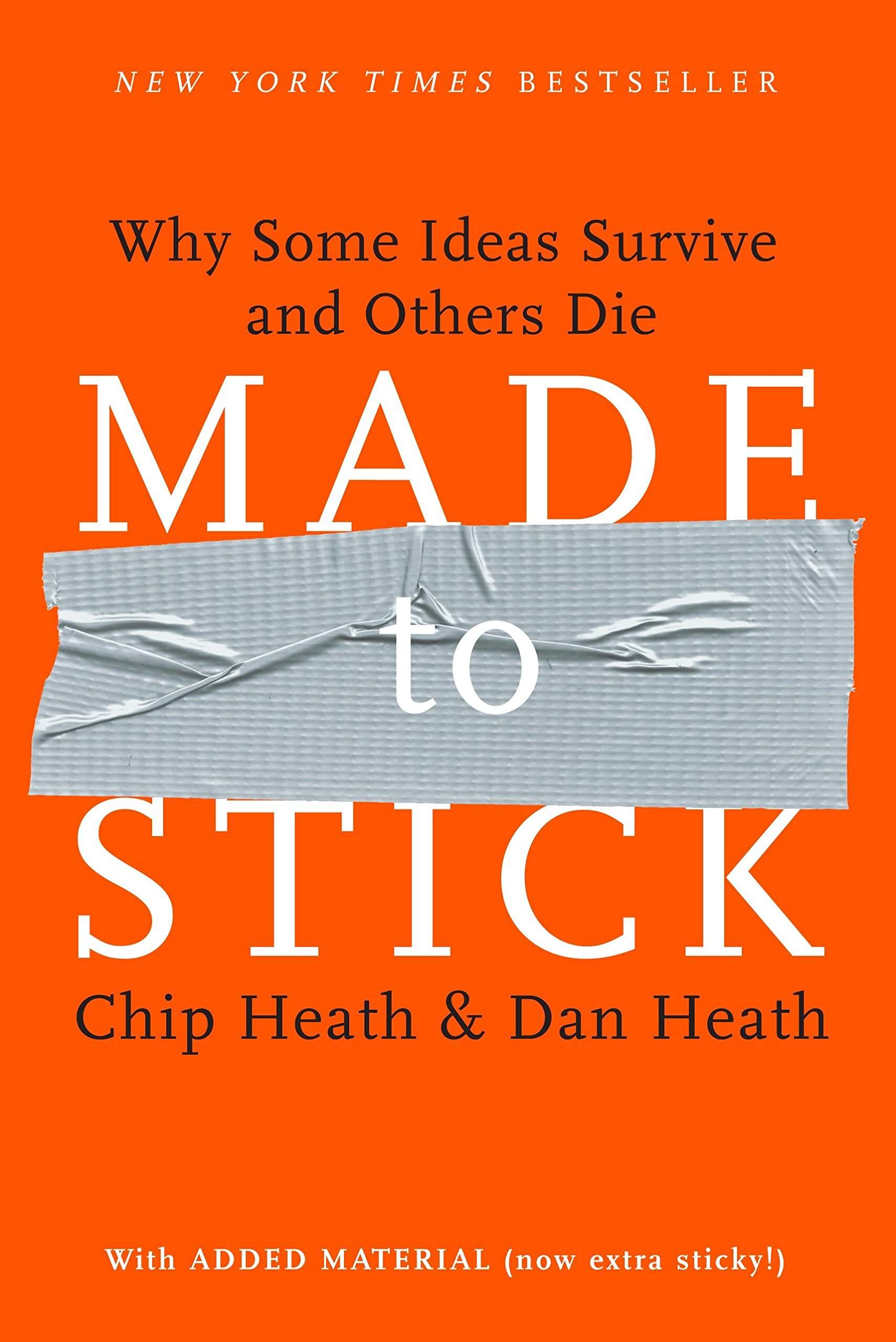
Made to Stick Book Summary
This Made to Stick Book Summary covers the key ideas, lessons, and takeaways in about 20 minutes.
Helps with these goals
Want the complete 20-minute summary?
- Full structured summary
- Video Summary
- Podcast Summary
- Audio summary
- Infographic
- Key takeaways
- Exercises
- Quiz
- Highlights and notes
- Ask the book with AI
What is in the Made to Stick book summary?
Below is a preview of Sumizeit’s expert-written summary of Made to Stick by Chip and Dan Heath. The full summary covers the book’s key ideas in text, audio, and video.
"When an expert asks, 'Will people understand my idea?,' her answer will be Yes, because she herself understands." ‐ Chip & Dan Heath
The curse of knowledge makes us believe that other people share our interests and care about our ideas as much as we do. It makes it hard for us to share our message with others.
Ideas that are sticky:
Chip Heath graduated from Texas A&M University with a bachelor of science degree in industrial engineering. He later earned a PhD in psychology from Stanford University. He currently works as a professor of organizational behavior at Stanford Graduate School of Business, where he taught courses on organizational behavior, negotiation, international strategy, and social entrepreneurship. His book, co-written with his brother, Dan Heath, Made to Stick, was named “Best Business Book of the Year” and was on the BusinessWeek bestseller list for 24 months and has been translated to at least 25 languages.
Dan Heath is a bestselling American author, speaker, and professor at Duke University. He is the co-author of Made to Stick. He works as a columnist for Fast Company magazine, and since 2018, started hosting a podcast Choiceology about behavioral economics.
Want the complete 20-minute summary?
- Full structured summary
- Video Summary
- Podcast Summary
- Audio summary
- Infographic
- Key takeaways
- Exercises
- Quiz
- Highlights and notes
- Ask the book with AI
Who should read Made to Stick?
Made to Stick is essential for anyone who needs to communicate ideas effectively—marketers, entrepreneurs, educators, leaders, and anyone who wants their message to be remembered and acted upon. Whether you're pitching a business idea, teaching a concept, or trying to influence others, this book provides the framework to make your message unforgettable.
Why does Made to Stick matter?
In a world saturated with information and competing messages, the ability to communicate ideas that actually stick is more valuable than ever. Made to Stick reveals why some ideas spread and persist while others fade, offering practical principles grounded in psychology and real-world examples. Understanding these principles can transform how you persuade, influence, and inspire others in any context.
What are the key themes in Made to Stick?
- The curse of knowledge and why experts struggle to explain their ideas simply
- Simplicity as the foundation of memorable communication
- The power of concrete language over abstract jargon
- Emotional resonance and personal stories as drivers of belief and action
- Credibility through specific details and vivid examples
- The role of surprise and breaking expectations
- Narrative structure as a tool for engagement and problem-solving
What are the key lessons from the Made to Stick book summary?
The Curse of Knowledge
Experts automatically assume others share their understanding and context, making it nearly impossible for them to explain their ideas clearly without deliberate effort to step into their audience's shoes.
Keep It Simple
A sticky idea has a single, clear core message that audiences can grasp and remember. Trying to communicate everything dilutes your message and ensures nothing sticks.
Focus Over Comprehensiveness
Limiting yourself to one primary message forces discipline and clarity, as shown by Bill Clinton's campaign slogan 'It's the economy, stupid.'
Use Unexpected Elements
Breaking patterns and violating audience expectations creates surprise, which captures attention and makes ideas more memorable than predictable messages.
Speak in Concrete Language
Replace abstract concepts and jargon with specific, sensory-rich language that everyone interprets similarly, like describing a target customer as 'an unemployed college professor' rather than 'upscale budget-conscious.'
Leverage Specific Details
Vivid, precise details like 'a seventy-three-year-old man named Thomas Dwyer' build credibility and overcome skepticism far more effectively than generalizations.
Make Ideas Credible
Credibility comes from specific examples, vivid anecdotes, and concrete evidence rather than broad claims or statistics that feel abstract.
Tap Into Emotions
People are moved to action by personal stories about individuals rather than statistics about masses; emotional connection drives behavior change and charitable giving.
The Power of Individual Stories
A story about one struggling person creates empathy and motivation, while information about millions often paralyzes audiences into inaction.
Tell Stories with Conflict
Stories with visible obstacles and goals engage audiences actively, making them care about outcomes and mentally participate in problem-solving.
Create Curiosity Through Narrative
Well-told stories naturally prompt audiences to ask 'What happens next?' keeping attention and engagement sustained throughout your message.
Structure Matters in Communication
The way you organize your message—whether as a simple statement, concrete example, or engaging story—determines how effectively it takes root in people's minds.
Avoid Information Overload
When people receive too many facts and ideas, their retention plummets; selectivity in what you emphasize makes the difference between stickiness and forgettability.
Deploy Vivid Sensory Details
Descriptions that engage the senses are more memorable and universally understood than abstract language or technical terminology.
Match Message to Audience Reality
Effective communication accounts for what your audience already knows and cares about, avoiding the false assumption that your expertise is self-evident to others.
Use Stories to Shift Thinking
Narrative structures naturally move audiences from passive listening into active problem-solving and mental engagement with ideas.
Balance Surprise with Credibility
Unexpected elements grab attention, but specific details and examples must follow to make audiences believe and trust your message.
Simplicity Requires Discipline
Boiling down complex ideas to their essence is harder than listing everything you know, but it's essential for making ideas stick.
Want the complete 20-minute summary?
- Full structured summary
- Video Summary
- Podcast Summary
- Audio summary
- Infographic
- Key takeaways
- Exercises
- Quiz
- Highlights and notes
- Ask the book with AI
How can you apply ideas from Made to Stick?
- Craft elevator pitches by identifying the single most important thing you want people to remember, then testing it with unfamiliar audiences
- Develop marketing messages using the SUCCESs framework—ensuring they're simple, unexpected, concrete, credible, emotional, and structured as stories
- Train teams to explain complex concepts by translating jargon into specific, sensory language that clients or users can easily understand
- Create persuasive presentations by leading with a surprising insight or challenge, then supporting it with vivid anecdotes and concrete examples
- Design educational content by replacing abstract definitions with personal stories and real-world examples that illustrate principles in action
- Build organizational culture by communicating values through memorable stories of individuals who embody those values, not through mission statements
- Improve sales pitches by focusing on a single benefit or outcome rather than listing multiple features, and backing that benefit with a specific customer success story
What common mistakes do readers make with Made to Stick?
- Assuming your audience understands your idea as well as you do because it's obvious to you—failing to account for the curse of knowledge
- Cramming too many ideas or points into a single message, diluting impact and leaving nothing memorable
- Using abstract, professional language and jargon instead of concrete examples that resonate across different audiences
- Relying on statistics and mass numbers instead of individual stories; people feel more motivated by one person's struggle than millions in need
Sumizeit Exercises Apply what you've learned
Turn ideas from Made to Stick into action with a short guided reflection: identify the biggest takeaway, connect it to your life, and commit to one step you can take in the next 24 hours.
What is the expert analysis of Made to Stick?
Overview
Made to Stick is a seminal work by brothers Chip and Dan Heath that explores why some ideas thrive while others fade into obscurity. Chip Heath, a Stanford professor with a background in psychology and organizational behavior, and Dan Heath, a bestselling author and behavioral economics commentator, combine their expertise to dissect the anatomy of memorable communication. This book has garnered acclaim for its practical framework and has influenced fields ranging from marketing to education, underscoring its significance in understanding how to craft messages that resonate deeply and endure.
Core Thesis
The Heath brothers argue that the "curse of knowledge"—our inability to imagine what it is like not to know something—hampers effective communication. To overcome this, ideas must be made “sticky” by adhering to six principles: simplicity, unexpectedness, concreteness, credibility, emotional resonance, and storytelling. By applying these criteria, communicators can ensure their messages are not only understood but also remembered and acted upon. The central insight is that stickiness is not a matter of luck or innate talent but a replicable formula grounded in cognitive psychology and narrative theory.
Strengths
- Clarity and Accessibility: The Heaths distill complex psychological concepts into an accessible, actionable framework, making the book valuable for both scholars and practitioners.
- Practical Examples: The use of vivid, real-world anecdotes—such as Bill Clinton’s “It’s the economy, stupid” slogan—grounds abstract principles in tangible scenarios.
- Interdisciplinary Approach: By integrating insights from psychology, marketing, and storytelling, the book transcends disciplinary boundaries and appeals to a broad audience.
- Memorable Framework: The SUCCESs model (Simple, Unexpected, Concrete, Credible, Emotional, Stories) offers a mnemonic device that facilitates application and retention.
- Emphasis on Emotion and Storytelling: Highlighting emotional engagement and narrative structure aligns with contemporary understanding of how humans process and retain information.
Critiques & Counterarguments
- Potential Oversimplification: While the SUCCESs framework is elegant, it risks reducing complex communication dynamics to a formula, potentially neglecting contextual nuances such as cultural differences or medium-specific constraints.
- Limited Empirical Rigor: Some of the book’s claims rely heavily on anecdotal evidence and case studies rather than large-scale, peer-reviewed research, which may limit generalizability.
- Emotional Appeal vs. Rationality: The emphasis on emotional resonance might undervalue the role of rational argumentation in certain domains, such as scientific communication or policy debates, where data and logic are paramount.
- Competing Theories: Alternative models, such as Kahneman’s dual-process theory, suggest that cognitive biases and heuristics complicate message reception beyond the scope of stickiness principles.
- Changing Media Landscape: The book predates the dominance of social media algorithms and rapid information cycles, which may affect how stickiness operates in digital environments compared to traditional contexts.
Who Should Read This
Made to Stick is essential reading for professionals engaged in communication-intensive fields—marketers, educators, leaders, entrepreneurs, and writers—who seek to craft messages that captivate and endure. It is equally valuable for scholars interested in applied psychology and narrative studies. Readers looking for a practical, theory-informed toolkit to enhance persuasion and information retention will find this book particularly rewarding. However, those seeking exhaustive empirical validation or nuanced cultural analyses may need to supplement it with more specialized literature.
Frequently asked questions about the Made to Stick book summary
What is Made to Stick about?
Made to Stick by Chip and Dan Heath is about why some ideas are remembered and acted upon while others are forgotten. The book identifies six key principles—simplicity, unexpectedness, concreteness, credibility, emotion, and story—that make ideas sticky and memorable in the minds of audiences.
Who should read Made to Stick?
Anyone who needs to communicate ideas effectively should read this book: marketers, entrepreneurs, business leaders, educators, nonprofit professionals, and anyone who wants to persuade or influence others. It's particularly valuable for people struggling to explain complex ideas clearly or make their messages memorable.
What are the main takeaways from Made to Stick?
The main takeaways are that sticky ideas follow the SUCCESs framework: keep ideas Simple with one core message, make them Unexpected by breaking patterns, use Concrete language instead of jargon, establish Credibility with specific details, create Emotional connections through personal stories, and Structure ideas as narratives. The book also warns against the curse of knowledge—the false assumption that others understand your idea as well as you do.
How can I apply Made to Stick principles to my business?
Start by identifying the single most important message you want customers or colleagues to remember, then craft it using the SUCCESs framework. Replace jargon with concrete examples, support claims with vivid anecdotes rather than statistics, and structure pitches or presentations as engaging stories with clear stakes and obstacles. Test your message with people unfamiliar with your work to ensure it's genuinely sticky.
What is the 'curse of knowledge' explained in Made to Stick?
The curse of knowledge is the cognitive bias that makes experts believe others share their understanding and context. Because experts understand their field deeply, they unconsciously assume their explanations are clear, when in fact they're often filled with jargon and missing crucial foundational information that non-experts need to understand.
How do stories make ideas stick?
Stories naturally engage audiences by creating curiosity, presenting problems and obstacles, and inviting mental participation as people wonder what happens next. Stories with clear goals and conflicts shift audiences into problem-solving mode, making them care about outcomes and retain the underlying ideas far better than direct statements or lists of facts.
Why do concrete examples work better than statistics?
Concrete language with specific, sensory details is universally understood and memorable, whereas statistics and abstract numbers feel impersonal and often fail to motivate action. A story about one struggling individual creates empathy and emotional connection, while information about millions can paradoxically paralyze audiences into inaction.
About Sumizeit
Sumizeit is a profitable Scomy LLC company based in Miami, Florida. It has been helping readers learn from nonfiction books for 7 years with expert-written summaries in text, audio, podcast, and video.
Want the complete 20-minute summary?
- Full structured summary
- Video Summary
- Podcast Summary
- Audio summary
- Infographic
- Key takeaways
- Exercises
- Quiz
- Highlights and notes
- Ask the book with AI
Here's why readers love Sumizeit
Join thousands of learners getting smarter every day
"Great experience. Detailed summaries. Loved the gamification feature. Makes learning fun. Good customer service. I recommend Sumizeit to anyone. You'll learn a lot."
"I always felt busy but still wanting to keep up with the book discussion in my friend group. This was a great supplement to help me keep reading the books I find fun while keeping up with important books."
"I love this website. Instead of scrolling social media, I find myself learning a lot. I use it everyday. I recommend this app for anyone who is too busy and wants to get up to speed with their favorite books."
Made to Stick Book Summary PDF
Looking for a Made to Stick Book Summary PDF you can save and revisit offline? Our Made to Stick Book Summary PDF captures the book’s core ideas in a clean, printable format — the key frameworks, takeaways, and structure without the fluff. Download the Made to Stick Book Summary PDF when you want a reference you can annotate, share with your team, or review on the go. Get your Made to Stick Book Summary PDF from the download page below.
Download Made to Stick Book Summary PDFPeople also liked these summaries
Readers who explored Made to Stick often enjoyed these titles next.


Want the complete 20-minute summary?
- Full structured summary
- Video Summary
- Podcast Summary
- Audio summary
- Infographic
- Key takeaways
- Exercises
- Quiz
- Highlights and notes
- Ask the book with AI
Featured Book Titles
Popular Book Summaries at sumizeit, leading book summary app