


As an Amazon Associate, Sumizeit earns from qualifying purchases.
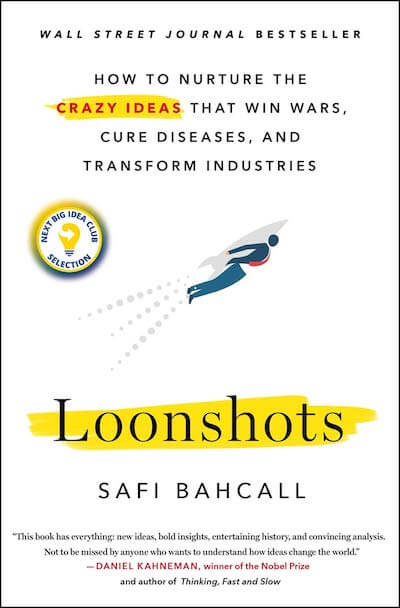
Loonshots Book Summary
This Loonshots Book Summary covers the key ideas, lessons, and takeaways in about 20 minutes.
Helps with these goals
Want the complete 20-minute summary?
- Full structured summary
- Video Summary
- Podcast Summary
- Audio summary
- Key takeaways
- Exercises
- Quiz
- Highlights and notes
- Ask the book with AI
What is in the Loonshots book summary?
Below is a preview of Sumizeit’s expert-written summary of Loonshots by Safi Bahcall. The full summary covers the book’s key ideas in text, audio, and video.
‘Loonshots’ is another term for crazy risky ideas, which turn successful.
Loonshots are born from one person’s brain. However, in order for a loonshot to catch on, a team of people must be behind it supporting and encouraging it.
“Just because a theory might be a bit wacky, however, doesn’t mean there isn’t something to the observation.”- Safi Bahcall
In “Loonshots: How to Nurture the Crazy Ideas That Win Wars, Cure Diseases, and Transform Industries” by Safi Bahcall, you will learn what it takes to cultivate a crazy idea of your own and how loonshots can change the world, as well as make your company a market leader.
The Tools You Need
Teams today can cultivate loonshots with these simple tools:
Loonshots Win Wars
For teams to stay on top and be successful, they must have radical and innovative ideas. That’s where loonshots come in.
However, companies also must have their simple strategic staples that will keep their team running.
A great example of this is WWII. While fighting the Germans, the Allied forces were desperate for new technology. But, they had no time to sit and wait patiently while scientists experimented. So, they had to use what they had in order to stay afloat. Theses were their simple tools.
But, in order to beat the Germans, they needed new technology. New technology was developed under the Office of Scientific Research and Development (OSRD) created by President Roosevelt.
The OSRD worked with military men to determine the most common and threatening in-the-field problems so they could work to address them. This led to the OSRD developing the technology that ultimately won them the war!
This example also shows phase separation at its finest. It is two different structures of problem-solving working toward the same shared goal.
The military, in nature, has a very strict set of guidelines that they must adhere to. However, the OSRD had the freedom to think outside the box and get creative.
When these two structural puzzle pieces come together, dynamic equilibrium happens. This is when both the strict and creative pieces fit together to give each other equal support.
Loonshots Are Fragile
A lot of people think that since loonshots are so genius they tend to escape common obstacles. But, that’s simply not the case. Every idea must overcome barriers over and over again until they succeed.
For example, Akira Endo, a well-known Japanese researcher, developed statins, or lipid-lowering medications, by studying fungi that could actually block cholesterol.
The first barrier that Endo encountered was that the US believed that people needed cholesterol for their cells to function, so blocking it was seen as dangerous.
The second barrier was because of his research findings, which showed insignificant results.
And the third barrier was that cancer began in some of the animals that he tested on during his research.
The pharmaceutical company, Merck, worked with Endo to disprove that statins would cause cancer. The drug proved sufficient to help people with severely high-cholesterol.
Statins then were…
Want the complete 20-minute summary?
- Full structured summary
- Video Summary
- Podcast Summary
- Audio summary
- Key takeaways
- Exercises
- Quiz
- Highlights and notes
- Ask the book with AI
Who should read Loonshots?
Loonshots is for leaders, entrepreneurs, and innovators who want to harness radical ideas without abandoning operational excellence. Whether you run a startup, manage a team within a large organization, or lead a company facing market disruption, this book shows you how to create the conditions for breakthrough thinking while maintaining the stable systems your business depends on.
Why does Loonshots matter?
In today's fast-moving world, incremental improvement is no longer enough—organizations that survive and thrive are those that can nurture breakthrough innovations alongside their core operations. Safi Bahcall reveals why most companies fail at this balance and provides a practical framework rooted in physics principles to help you avoid the traps that have derailed giants like IBM and Polaroid. Understanding how to structure your teams, incentives, and decision-making processes for loonshots is now essential competitive advantage.
What are the key themes in Loonshots?
- Separating radical innovation from operational efficiency through phase separation
- The fragility of breakthrough ideas and how to protect them from organizational antibodies
- How incentives and organizational structure determine whether employees embrace risk or play it safe
- The Moses Trap: how past success can blind leaders to emerging market shifts
- Dynamic equilibrium: balancing the bold with the practical for maximum impact
- False failures versus true failures: the importance of investigating apparent setbacks
What are the key lessons from the Loonshots book summary?
Loonshots Are Individual Ideas That Require Team Support
While breakthrough ideas originate from individual minds, their success depends entirely on organizational support and a team willing to champion them through repeated obstacles and setbacks.
Phase Separation Protects Fragile Ideas
Separating your innovative teams from operational teams shields early-stage, high-risk work from the pressures and incentives that optimize for short-term returns, allowing radical thinking to flourish.
Dynamic Equilibrium Creates Synergy
The magic happens when separated groups communicate and collaborate as equals—neither dominating the other—much like the OSRD and military collaboration that won WWII through technological innovation.
The Magic Number: Organizational Size Matters
Teams under 150 people naturally align around shared mission, but beyond that threshold, individual career incentives typically override collective goals unless incentive structures are deliberately redesigned.
False Failures Hide Real Opportunities
Most breakthrough ideas appear to fail multiple times before succeeding; the key skill is distinguishing false failures (which merit deeper investigation) from true dead ends, as Akira Endo demonstrated with statins.
P-Type and S-Type Loonshots Fail Differently
Product innovations (P-type) fail quickly and visibly, while strategic failures (S-type) emerge slowly and are masked by market complexity, making them harder to spot until damage is severe.
The Moses Trap: Past Success Creates Blind Spots
Leaders who built empires on specific innovations often unconsciously reject emerging strategic shifts that contradict their winning formula, as Edwin Land did by dismissing digital photography despite inventing it.
Salary vs. Equity: Different Incentives Drive Different Behaviors
Salary-based rewards encourage political maneuvering and office popularity, while equity-based rewards (hard or soft) align employees with project outcomes and encourage them to take calculated risks.
Organizational Support Is the Third Critical Pillar
Beyond separation and communication, breakthrough teams need substantial organizational backing to navigate the multiple failures that precede success—this is what allows ideas to survive long enough to prove their worth.
Ask the Right Questions to Unlock False Failures
Investigating why an idea appeared to fail—rather than accepting failure at face value—often reveals hidden insights that become the foundation for eventual success.
Decision-Making Should Be Distributed, Not Centralized
The Moses Trap emerges when leaders make unilateral calls about which loonshots merit pursuit; distributed decision-making by teams closer to the problem prevents organizational blindspots.
Incentive Structures Shape Organizational Culture Faster Than Mission Statements
How you reward behavior—through promotion, equity, recognition, or skill development—determines whether your culture embraces or rejects radical ideas, often overriding stated values.
Indie Studios and Major Studios Need Each Other
The film industry model demonstrates how radical-experiment organizations (indie studios) and stability-focused institutions (major studios) can coexist and strengthen each other when properly connected.
Phase Transitions Occur Predictably as Companies Scale
As organizations grow, employee incentives naturally shift from mission-alignment to rank-seeking; this phase transition happens reliably, but can be counteracted through intentional structural redesign.
Investigate the Decision Behind the Failure, Not Just the Failure Itself
Understanding the reasoning that led to a setback—and whether that reasoning was sound even if the outcome was wrong—prevents repeating the same blind spots.
Critical Mass of Support Increases Loonshot Survival Odds
Breakthrough ideas fail frequently; protecting them requires not just a single champion but a critical mass of organizational commitment and resources to weather early rejection and setbacks.
Skill-Based Assignment Encourages Risk-Taking More Than Popularity-Based Assignment
When projects are allocated based on capability and growth potential rather than office relationships, employees are more motivated to pursue challenging, high-impact work over safe, politically advantageous assignments.
Wacky Ideas Often Contain Hidden Truths Worth Investigating
Initial rejection of unconventional ideas isn't evidence they're wrong; many breakthroughs seemed absurd until systematic investigation revealed the insight beneath the unconventional surface.
Loonshots Win Wars, Markets, and Industries
History—from WWII to pharma to computing—repeatedly shows that organizations that can nurture, protect, and execute on breakthrough ideas while maintaining operational excellence dominate their fields.
Want the complete 20-minute summary?
- Full structured summary
- Video Summary
- Podcast Summary
- Audio summary
- Key takeaways
- Exercises
- Quiz
- Highlights and notes
- Ask the book with AI
How can you apply ideas from Loonshots?
- Create a separate innovation unit with its own leadership, budget, and incentive structure, shielded from the pressures of your core business
- Redesign compensation for loonshot teams to emphasize equity (stock options, bonuses tied to project success, recognition) over salary-based promotions
- Establish regular communication channels and joint projects between your innovation and operations teams to ensure dynamic equilibrium without diluting either group's focus
- Audit your decision-making processes to identify Moses Trap patterns—places where past success may be causing you to reject emerging strategic shifts
- Train leaders and teams to investigate apparent failures by asking 'why did this seem to fail?' rather than accepting surface-level conclusions
- Set a deliberate organizational size limit for loonshot teams (aim for under 150 to preserve mission-alignment) or redesign incentives if you must grow beyond that threshold
- Study your industry's equivalents of indie studios and major studios; design partnerships or internal structures that replicate that productive separation and collaboration
What common mistakes do readers make with Loonshots?
- Assuming that brilliant ideas automatically succeed without recognizing they must survive repeated rejection, investigation, and false failures before proving their worth
- Failing to separate innovation teams from operations, forcing breakthrough thinkers to compete for resources and approval using the same criteria as incremental improvements
- Overweighting salary and promotion incentives while neglecting equity-based rewards, which inadvertently creates cultures that punish risk-taking and reward office politics
- Allowing a single leader (or leadership group) to gate-keep which loonshots get pursued, creating hidden blindspots exactly like the Moses Trap that derailed Polaroid and IBM
Sumizeit Exercises Apply what you've learned
Turn ideas from Loonshots into action with a short guided reflection: identify the biggest takeaway, connect it to your life, and commit to one step you can take in the next 24 hours.
What is the expert analysis of Loonshots?
Overview
Loonshots: How to Nurture the Crazy Ideas That Win Wars, Cure Diseases, and Transform Industries is authored by Safi Bahcall, a physicist and entrepreneur with a rich background in theoretical physics and business innovation. Drawing on his scientific rigor and executive experience, Bahcall offers a compelling framework for understanding how radical, high-risk ideas—termed "loonshots"—can be cultivated within organizations to drive transformative breakthroughs. The book stands out for bridging scientific concepts with practical business strategy, making it significant for leaders seeking to foster innovation in complex environments.
Core Thesis
Bahcall’s central argument is that groundbreaking innovations often arise from "loonshots," which are initially perceived as crazy or risky ideas. However, nurturing these ideas requires a deliberate organizational structure that balances creative freedom with disciplined execution. This involves separating teams working on radical innovations from those maintaining core operations (phase separation), while ensuring ongoing communication and collaboration (dynamic equilibrium). The author emphasizes that loonshots are fragile and prone to failure, necessitating robust support systems to distinguish false failures from true ones. Ultimately, the book posits that organizations that master this balance can sustain competitive advantage and drive revolutionary change.
Strengths
- Interdisciplinary Approach: Bahcall synthesizes insights from physics, biology, military history, and business, enriching the discussion with diverse examples such as WWII technology development and pharmaceutical innovation.
- Actionable Framework: The concepts of phase separation, dynamic equilibrium, and the Moses Trap provide practical tools for leaders to structure teams and incentives effectively to foster innovation.
- Nuanced Understanding of Failure: By distinguishing between false failures and true failures, the book encourages a more sophisticated approach to experimentation and risk-taking.
- Engaging Case Studies: Historical and contemporary examples, including IBM’s strategic missteps and the development of statins, ground the theory in real-world contexts, enhancing credibility and relatability.
- Clarity and Accessibility: Despite its complex subject matter, the book is written in a clear, engaging style that makes challenging ideas accessible to a broad audience.
Critiques & Counterarguments
- Overreliance on Organizational Structure: While phase separation and dynamic equilibrium are compelling, the book may understate the role of external market forces, serendipity, and individual genius beyond structural factors.
- Potential Oversimplification of Incentives: The dichotomy between salary and equity incentives, though insightful, may not fully capture the complexity of human motivation, which includes intrinsic factors like passion, purpose, and culture.
- Limited Engagement with Alternative Innovation Models: Competing frameworks, such as open innovation, agile methodologies, or design thinking, receive less attention, which might limit the book’s applicability in rapidly evolving tech sectors.
- Historical Examples May Feel Selective: The emphasis on successful loonshots could introduce survivorship bias, overlooking numerous failed radical innovations that did not yield positive outcomes despite similar organizational conditions.
- Challenges in Scaling the Model: The "magic number" of 150 employees as an ideal size for nurturing loonshots is provocative but may be difficult to generalize across industries with different dynamics and scales.
Who Should Read This
Loonshots is essential reading for senior executives, innovation managers, entrepreneurs, and organizational theorists who grapple with how to foster creativity and breakthrough ideas within established institutions. It also appeals to readers interested in the intersection of science and business strategy, offering a fresh perspective on managing risk and failure. Those involved in R&D, corporate strategy, or startup ecosystems will find Bahcall’s insights particularly valuable for designing environments where transformative ideas can flourish without being prematurely extinguished.
Frequently asked questions about the Loonshots book summary
What is Loonshots about?
Loonshots: How to Nurture the Crazy Ideas That Win Wars, Cure Diseases, and Transform Industries by Safi Bahcall is a guide to creating organizational structures that enable breakthrough innovations. The book reveals why most companies struggle to nurture radical ideas while maintaining operational excellence, and provides a physics-inspired framework—phase separation, dynamic equilibrium, and incentive alignment—for building cultures where both visionary thinking and practical execution thrive together.
Who should read Loonshots?
This book is essential for leaders, entrepreneurs, executives, and managers who want to drive innovation without compromising their core business. It's particularly valuable for anyone leading teams that have experienced success and now face the challenge of staying relevant in a changing market, or who recognize their organization is too risk-averse to compete against more agile innovators.
What is the magic number in Loonshots?
The magic number is 150 employees. Below this threshold, teams naturally stay mission-aligned because individuals haven't developed competing career incentives. Above 150, organizational culture shifts toward rank-seeking and politics unless incentive structures are deliberately redesigned to reward equity (stock, bonuses, skill development, recognition) over salary-based promotion.
What is the Moses Trap?
The Moses Trap is a pattern where leaders, blinded by past success with a particular type of innovation, unconsciously reject emerging strategic shifts in their market. Companies like Polaroid and IBM fell into this trap: Edwin Land rejected digital photography and IBM outsourced software development to Microsoft, both decisions that ultimately led to massive market losses. The trap occurs when leaders make unilateral judgments about which ideas merit pursuit rather than distributing decision-making.
How does phase separation work in organizations?
Phase separation means creating two distinct operational structures: one for steady-growth, operational work and another for high-risk, early-stage innovations. These groups operate under different rules, incentives, and timelines, protecting fragile ideas from the pressures that optimize for short-term returns. The WWII example of the military working alongside the OSRD (Office of Scientific Research and Development) demonstrates phase separation at its finest.
What's the difference between false failures and true failures in Loonshots?
A false failure is when an idea appears to have failed but investigation reveals there's still merit worth pursuing. A true failure is a genuine dead end. Bahcall emphasizes that most breakthrough ideas experience multiple false failures before succeeding; the critical skill is asking 'why did this seem to fail?' rather than accepting surface-level conclusions. Akira Endo's development of statins involved overcoming what looked like insurmountable obstacles until deeper investigation proved them surmountable.
About Sumizeit
Sumizeit is a profitable Scomy LLC company based in Miami, Florida. It has been helping readers learn from nonfiction books for 7 years with expert-written summaries in text, audio, podcast, and video.
Want the complete 20-minute summary?
- Full structured summary
- Video Summary
- Podcast Summary
- Audio summary
- Key takeaways
- Exercises
- Quiz
- Highlights and notes
- Ask the book with AI
Here's why readers love Sumizeit
Join thousands of learners getting smarter every day
"Great experience. Detailed summaries. Loved the gamification feature. Makes learning fun. Good customer service. I recommend Sumizeit to anyone. You'll learn a lot."
"I always felt busy but still wanting to keep up with the book discussion in my friend group. This was a great supplement to help me keep reading the books I find fun while keeping up with important books."
"I love this website. Instead of scrolling social media, I find myself learning a lot. I use it everyday. I recommend this app for anyone who is too busy and wants to get up to speed with their favorite books."
Loonshots Book Summary PDF
Looking for a Loonshots Book Summary PDF you can save and revisit offline? Our Loonshots Book Summary PDF captures the book’s core ideas in a clean, printable format — the key frameworks, takeaways, and structure without the fluff. Download the Loonshots Book Summary PDF when you want a reference you can annotate, share with your team, or review on the go. Get your Loonshots Book Summary PDF from the download page below.
Download Loonshots Book Summary PDFPeople also liked these summaries
Readers who explored Loonshots often enjoyed these titles next.



Want the complete 20-minute summary?
- Full structured summary
- Video Summary
- Podcast Summary
- Audio summary
- Key takeaways
- Exercises
- Quiz
- Highlights and notes
- Ask the book with AI
Featured Book Titles
Popular Book Summaries at sumizeit, leading book summary app