


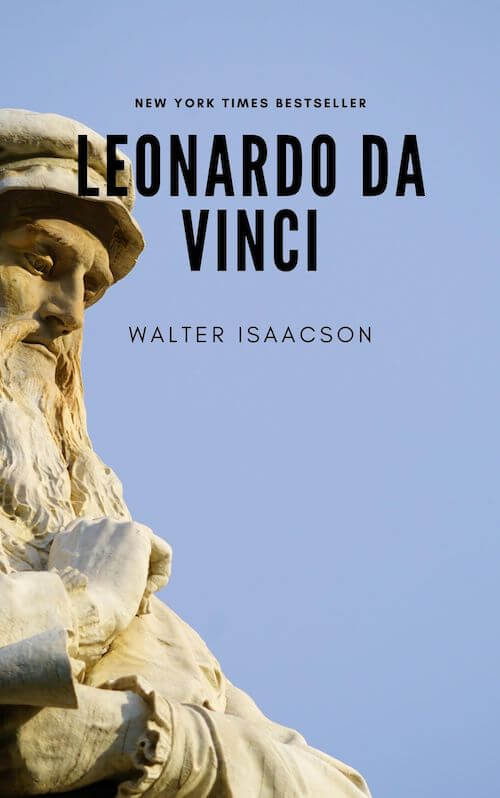
Leonardo Davinci Book Summary
This Leonardo Davinci Book Summary covers the key ideas, lessons, and takeaways in about 20 minutes.
Helps with these goals
Want the complete 20-minute summary?
- Full structured summary
- Video Summary
- Podcast Summary
- Audio summary
- Key takeaways
- Exercises
- Quiz
- Highlights and notes
- Ask the book with AI
What is in the Leonardo Davinci book summary?
Below is a preview of Sumizeit’s expert-written summary of Leonardo Davinci by Walter Isaacson. The full summary covers the book’s key ideas in text, audio, and video.
This biography tells the story of one of the greatest geniuses in history, Leonardo Da Vinci. Drawing on the notebooks of the master painter, engineer, architect, and theater producer, Isaacson pulls back the curtain on Da Vinci’s life, providing the historical context to his most important works and insight into how he developed his unique abilities through self-education and observing the natural world.
As a boy, Da Vinci dealt with a difficult background, but his isolation introduced him to self-education.
Leonardo Da Vinci was born in Florence in 1492. His father was Piero da Vinci while his mother was a 16-year-old peasant girl named Caterina Lippi. They never married, making Leonardo an illegitimate child.
Piero came from a line of notaries, a respectable job at the time. He handled business transactions and resolved disputes among merchants. In normal circumstances, Leonardo would have had to inherit this position from his father, but because he was illegitimate, he was free of that obligation.
In his boyhood, Leonardo felt like an outsider. He was left-handed, which carried a stigma in Renaissance Italy, and jailed several times for his homosexuality on sodomy. Because of his illegitimacy, he was not sent to formal school and had to teach himself. This left him free to pursue whatever interested him instead of learning Latin or studying ancient scholarship in the schools. He spent his days learning about the world through observation and experimentation.
Da Vinci began a painting and engineering apprenticeship at age 14 and later surpassed his master in ability.
In 1467, when Leonardo was 14, his father moved them from Vinci to Florence, a city famous for its resident artists. There were thirty painters living in the city and dozens of other craftsmen, not to mention the highest literacy rate in all of Europe.
Leonardo became apprenticed with Andrea del Verrocchio, a master painter, and sculptor who ran an important workshop in the city. In his workshop, Verrocchio was also a goldsmith selling things like doorknobs alongside his paintings.
Verrocchio had a talent for conveying motion in his sculptures, representing people and animals in movement, which gave Leonardo a strong education in portraying motion in his own paintings. Over the years, he developed his understanding of geometry, light, and perspective.
By the time he was 20, Leonardo seemed to surpass the skills of his master. In a painting that was a joint effort between the two artists, Da Vinci and Verrocchino each paint an angel in The Baptism of Christ. Leonardo’s angel is softer and more lifelike than Verrocchi0’s which seems two-dimensional in comparison. This softness was achieved through Leonardo’s signature “smufato” style, a blurring of lines of edges to better mimic the eye’s way of seeing. It’s said that Verrocchi0 was so impressed by the angel that he quit painting altogether.
Several of Da Vinci’s famous early works were painted in the studio in the early 1470s. He painted a portrait of Ginerva de Benci, a well-known Florentine woman sitting in a three-quarter pose.…
Want the complete 20-minute summary?
- Full structured summary
- Video Summary
- Podcast Summary
- Audio summary
- Key takeaways
- Exercises
- Quiz
- Highlights and notes
- Ask the book with AI
Who should read Leonardo Davinci?
Leonardo da Vinci by Walter Isaacson is ideal for anyone curious about creative genius, artistic mastery, and the Renaissance mind. This biography appeals to artists, engineers, historians, and innovators who want to understand how one person developed exceptional abilities across multiple disciplines. It's also for readers who appreciate deeply researched narratives that bring historical figures to life through primary sources and detailed storytelling.
Why does Leonardo Davinci matter?
Leonardo da Vinci remains one of history's most influential minds, and understanding his life offers insights into how genius develops and flourishes despite obstacles. In today's world of specialization, Leonardo's multidisciplinary approach to knowledge and creation—blending art, science, engineering, and observation—is increasingly relevant and inspirational. Isaacson's biography reveals how curiosity, self-education, and relentless observation can lead to groundbreaking discoveries and timeless masterpieces that still captivate us centuries later.
What are the key themes in Leonardo Davinci?
- Self-education and learning through observation
- The interdependence of art and science
- Turning adversity and outsider status into creative freedom
- The tension between ambition and completion
- The power of human relationships and intellectual exchange
- Optics, perspective, and how we perceive the world
- Unfinished work as a form of influence
- The pursuit of understanding nature's mysteries
What are the key lessons from the Leonardo Davinci book summary?
Illegitimacy and outsider status freed Leonardo from expectations
Being born illegitimate and left-handed in Renaissance Florence meant Leonardo wasn't bound by family tradition or formal schooling, allowing him to pursue his own intellectual interests instead of following a predetermined path.
Apprenticeship under a master accelerates skill development
Leonardo's training under Andrea del Verrocchio gave him foundational knowledge in geometry, light, perspective, and portraying motion—skills he then surpassed through his own refinement and innovation.
Unfinished work can be as influential as completed masterpieces
Leonardo's sketches for The Adoration of the Magi and The Battle of Anghiari attracted artists from across Europe despite never being finished, demonstrating that the ideas and artistry behind a work matter as much as its completion.
Personal charm and genuine curiosity attract valuable relationships
Leonardo's ability to listen, tell stories, and show authentic interest in others made him a magnet for collaborators and patrons who enriched his knowledge and supported his work.
Strategic self-marketing opens doors to opportunity
When Leonardo moved to Milan, he deliberately presented himself as a military engineer and designer to attract the Duke's patronage, showing the importance of matching your skills to what powerful people value.
Obsessive attention to detail produces technical mastery
Leonardo's willingness to spend months dissecting horse anatomy or experimenting with layers of glaze on paintings demonstrated that technical excellence comes from meticulous, repeated observation and practice.
Diverse intellectual friendships expand creative capabilities
Leonardo's relationships with mathematicians, architects, and anatomists allowed him to deepen his knowledge across disciplines, making him more capable of innovative thinking in his art and engineering.
Understanding human psychology enhances portrait painting
Leonardo's skill in capturing the subtle inner lives of his subjects—their mysterious expressions and psychological depth—separated his work from his contemporaries and made his portraits timeless.
Patience and repetition are more valuable than quick productivity
Leonardo's slow, deliberate working method frustrated his patrons but allowed him to achieve unprecedented depth and quality, even as it meant many projects remained unfinished.
Observing nature is the foundation of scientific and artistic knowledge
Leonardo's constant study of birds, water, anatomy, and the natural world informed both his paintings and his engineering designs, showing that direct observation is more reliable than inherited knowledge.
Dissection and detailed anatomical study reveal hidden truths
Leonardo's hands-on examination of corpses allowed him to discover circulatory and cardiac functions centuries ahead of his time, proving that firsthand investigation trumps theory.
Optics and perspective are tools for emotional and spiritual expression
Leonardo used his understanding of how light, blur, and focus work to create paintings that conveyed emotion and connection to the viewer, merging technical knowledge with artistic intent.
Abandoning destructive situations protects creative energy
Leonardo's decision to leave Cesare Borgia after witnessing military violence showed his willingness to step away from lucrative opportunities that conflicted with his values and well-being.
The mysterious and unknowable are more compelling than the obvious
The Mona Lisa's fame stems partly from Leonardo's portrayal of subtle ambiguity—a smile that isn't quite a smile, an inner knowledge that can't be fully defined—showing that mystery resonates more than clarity.
Royal patronage provides resources but can redirect your talents
While patrons gave Leonardo financial security and access to materials, they often asked him to design theater productions instead of pursuing his deeper interests in science and engineering.
Health challenges and aging don't necessarily diminish creative power
Even after suffering a stroke that impaired his right hand, Leonardo continued to produce some of his greatest masterpieces, proving that wisdom and skill can compensate for physical decline.
Carrying unfinished work and reflecting on it over time leads to perfection
Leonardo worked on the Mona Lisa for over a decade, carrying it with him across countries and refining it throughout his life, suggesting that some masterpieces require years of gradual improvement.
Interdisciplinary thinking produces innovation others cannot achieve
Leonardo's combination of artistic training, mathematical knowledge, anatomical study, and engineering thinking allowed him to solve problems and create works that specialists in single fields could not.
Documentation and notebooks preserve ideas even when projects fail
Leonardo's thousands of notebook pages recording observations, designs, and anatomical drawings ensured that his ideas survived even when patrons rejected his projects, creating a legacy that influenced future generations.
Isolation in youth can cultivate independent thinking and resourcefulness
Leonardo's lack of formal schooling and social exclusion as a boy forced him to teach himself, developing a self-reliant approach to learning that defined his entire career.
Want the complete 20-minute summary?
- Full structured summary
- Video Summary
- Podcast Summary
- Audio summary
- Key takeaways
- Exercises
- Quiz
- Highlights and notes
- Ask the book with AI
How can you apply ideas from Leonardo Davinci?
- Embrace your outsider status or limitations as permission to think differently and pursue unconventional paths
- Invest in mentorship and apprenticeship to quickly acquire foundational skills in your field
- Keep detailed notebooks or journals to record observations, ideas, and experiments—review them regularly for patterns and insights
- Practice sketching or diagramming problems before diving into execution to clarify your thinking
- Build relationships with people from different disciplines to expand your knowledge and creative capacity
- Study the fundamentals of your craft obsessively—anatomy for artists, user behavior for designers, physics for engineers—rather than relying on shortcuts
- Use patience and incremental refinement as your competitive advantage, especially for important work
What common mistakes do readers make with Leonardo Davinci?
- Assuming that finishing every project is more important than the quality and depth of what you create
- Neglecting the foundational technical skills in favor of moving quickly to higher-level work
- Isolating yourself intellectually instead of seeking out diverse collaborators and friends who challenge your thinking
- Accepting every patronage or commission without considering whether it aligns with your deepest interests and values
Sumizeit Exercises Apply what you've learned
Turn ideas from Leonardo Davinci into action with a short guided reflection: identify the biggest takeaway, connect it to your life, and commit to one step you can take in the next 24 hours.
What is the expert analysis of Leonardo Davinci?
Overview
Walter Isaacson’s Leonardo Da Vinci stands as a monumental biography of one of history’s most enigmatic and multifaceted geniuses. Isaacson, a seasoned biographer known for his works on figures such as Steve Jobs and Einstein, brings a multidisciplinary lens to Leonardo’s life, weaving together art, science, and history. The book’s significance lies in its comprehensive portrayal of Leonardo—not merely as a master painter but as a polymath whose curiosity spanned anatomy, engineering, optics, and psychology. Isaacson’s access to Leonardo’s voluminous notebooks allows readers an intimate glimpse into the mind of a Renaissance titan, contextualizing his achievements within the social and political turbulence of 15th-century Italy.
Core Thesis
The central argument of Isaacson’s biography is that Leonardo Da Vinci’s genius was rooted in his relentless curiosity and observational prowess, which transcended disciplinary boundaries. Leonardo’s identity as an outsider—illegitimate birth, left-handedness, and social marginalization—freed him from conventional educational constraints, enabling a self-directed approach to learning. Isaacson posits that Leonardo’s unique ability to synthesize art and science, coupled with his methodical study of nature and human anatomy, forged innovations that were centuries ahead of their time. The biography underscores how Leonardo’s unfinished projects and notebooks, often overshadowed by his completed masterpieces, are equally critical to understanding his enduring legacy.
Strengths
- Interdisciplinary Approach: Isaacson excels at demonstrating Leonardo’s synthesis of art, science, and engineering, providing a holistic view of his genius that defies compartmentalization.
- Rich Historical Context: The biography situates Leonardo’s work within the political and cultural milieus of Florence, Milan, and France, illuminating how patronage and social dynamics shaped his career.
- Use of Primary Sources: Drawing extensively from Leonardo’s notebooks, Isaacson offers readers direct access to Leonardo’s thoughts and sketches, enhancing authenticity and depth.
- Psychological Insight: The book thoughtfully explores Leonardo’s personal struggles and relationships, including his sexuality, illegitimacy, and friendships, adding nuance to the portrait of the man behind the myth.
- Accessible Yet Scholarly: Isaacson balances scholarly rigor with engaging narrative, making complex scientific and artistic concepts approachable without oversimplification.
Critiques & Counterarguments
- Romanticizing the Outsider Narrative: While Leonardo’s illegitimacy and marginalization are emphasized as liberating, some historians argue this perspective risks oversimplifying the societal constraints he faced and may underplay the privileges afforded by his father’s status.
- Unfinished Works as Genius vs. Procrastination: Isaacson frames Leonardo’s many unfinished projects as emblematic of visionary thinking; however, critics suggest this may romanticize what could also be interpreted as a pattern of distraction or inability to complete tasks.
- Scientific Contributions Overstated: Although Leonardo’s anatomical and engineering studies were pioneering, some scholars caution against attributing modern scientific breakthroughs to him, noting that his findings were unpublished and had limited immediate influence.
- Limited Engagement with Competing Interpretations: The biography largely accepts Leonardo’s notebooks at face value, without deeply interrogating the reliability or potential exaggerations within these self-curated documents.
- Patronage and Political Realities: Isaacson’s portrayal of Leonardo’s relationships with patrons like Ludovico Sforza and Cesare Borgia could benefit from a more critical analysis of how political expediency and court intrigue constrained his ambitions.
Who Should Read This
This biography is ideal for readers with a sophisticated interest in Renaissance history, art history, and the interplay between creativity and scientific inquiry. Scholars and enthusiasts of interdisciplinary studies will appreciate Isaacson’s nuanced exploration of how diverse fields coalesce in the figure of Leonardo. Additionally, those fascinated by the psychology of genius and the social contexts that shape creative minds will find this work illuminating. While accessible to general audiences, the book’s depth and breadth make it particularly rewarding for readers seeking a comprehensive and critical understanding of Leonardo Da Vinci’s life and legacy.
Frequently asked questions about the Leonardo Davinci book summary
What is Leonardo da Vinci about?
Leonardo da Vinci by Walter Isaacson is a comprehensive biography of the Renaissance master, exploring how he became one of history's greatest geniuses across art, science, and engineering. The book draws on Leonardo's personal notebooks to reveal his methods of observation, his relationships with patrons and collaborators, and his approach to creating masterpieces like The Last Supper and the Mona Lisa. It shows how his illegitimate birth, outsider status, and self-education freed him to pursue his own intellectual curiosity rather than following a predetermined path.
Who should read Leonardo da Vinci?
Anyone interested in Renaissance history, artistic genius, creative innovation, or scientific discovery will benefit from this biography. It appeals to artists, engineers, entrepreneurs, and students of human potential who want to understand how someone develops exceptional capabilities across multiple fields. The book is also valuable for readers seeking insights into how curiosity, observation, and persistence lead to lasting impact, making it relevant for anyone pursuing ambitious or unconventional goals.
What are the main takeaways from Leonardo da Vinci?
The main takeaways include: adversity and outsider status can be sources of creative freedom; self-education through observation is as valuable as formal training; unfinished work and the process of creation matter as much as finished products; interdisciplinary thinking and diverse relationships amplify innovation; and patience, detail-oriented work, and relentless curiosity are the foundations of mastery. The book also shows that true genius emerges from combining art and science, intuition and analysis, ambition and humility.
How did Leonardo da Vinci's illegitimate birth shape his life and work?
Leonardo's illegitimacy meant he was excluded from his father's profession as a notary, freeing him from family obligations and social expectations. This outsider status, combined with his left-handedness and other differences, prevented formal schooling but allowed him to pursue self-education through observation and experimentation. Rather than constraining him, this freedom to choose his own path became foundational to his ability to think independently and innovate across multiple disciplines.
What does Walter Isaacson reveal about Leonardo's unfinished projects?
Isaacson shows that Leonardo's unfinished works—such as The Adoration of the Magi and The Battle of Anghiari—were often as influential as his completed paintings. The sketches and preparatory drawings attracted artists from across Europe who came to study them, and they became more famous than many finished works. This demonstrates that the ideas, insights, and artistry in Leonardo's process mattered profoundly, even when the final product was never realized.
How did Leonardo da Vinci combine art and science in his work?
Leonardo studied anatomy, optics, fluid dynamics, and natural phenomena to inform his art, while using artistic skill to document his scientific observations. His anatomical drawings captured not just form but function; his paintings applied principles of perspective and light to create emotional depth; and his engineering designs reflected his artistic understanding of movement and proportion. This integration of disciplines allowed him to see and create things that specialists in single fields could not.
What role did mentorship and relationships play in Leonardo's development?
Leonardo's apprenticeship under Andrea del Verrocchio provided essential technical training in geometry, light, and portraying motion. Throughout his life, he actively sought relationships with mathematicians, architects, and anatomists who could teach him new skills in exchange for his expertise. These intellectual friendships—with figures like Luca Pacioli and Donato Bramante—expanded his knowledge across disciplines and directly contributed to his innovations and masterpieces.
Why is the Mona Lisa considered Leonardo's greatest achievement?
The Mona Lisa represents Leonardo at the height of his mastery, combining technical innovation with profound psychological insight. He spent over a decade refining it, using techniques like layered glazes, selective focus through blur, and subtle proportions to create an image that conveys mystery and inner knowledge. The painting's enduring fame stems from Leonardo's ability to capture something unknowable and mysterious—a quality that connects viewers across centuries and resists final interpretation.
About Sumizeit
Sumizeit is a profitable Scomy LLC company based in Miami, Florida. It has been helping readers learn from nonfiction books for 7 years with expert-written summaries in text, audio, podcast, and video.
Want the complete 20-minute summary?
- Full structured summary
- Video Summary
- Podcast Summary
- Audio summary
- Key takeaways
- Exercises
- Quiz
- Highlights and notes
- Ask the book with AI
Here's why readers love Sumizeit
Join thousands of learners getting smarter every day
"Great experience. Detailed summaries. Loved the gamification feature. Makes learning fun. Good customer service. I recommend Sumizeit to anyone. You'll learn a lot."
"I always felt busy but still wanting to keep up with the book discussion in my friend group. This was a great supplement to help me keep reading the books I find fun while keeping up with important books."
"I love this website. Instead of scrolling social media, I find myself learning a lot. I use it everyday. I recommend this app for anyone who is too busy and wants to get up to speed with their favorite books."
Leonardo Davinci Book Summary PDF
Looking for a Leonardo Davinci Book Summary PDF you can save and revisit offline? Our Leonardo Davinci Book Summary PDF captures the book’s core ideas in a clean, printable format — the key frameworks, takeaways, and structure without the fluff. Download the Leonardo Davinci Book Summary PDF when you want a reference you can annotate, share with your team, or review on the go. Get your Leonardo Davinci Book Summary PDF from the download page below.
Download Leonardo Davinci Book Summary PDFPeople also liked these summaries
Readers who explored Leonardo Davinci often enjoyed these titles next.




Want the complete 20-minute summary?
- Full structured summary
- Video Summary
- Podcast Summary
- Audio summary
- Key takeaways
- Exercises
- Quiz
- Highlights and notes
- Ask the book with AI
Featured Book Titles
Popular Book Summaries at sumizeit, leading book summary app
