


As an Amazon Associate, Sumizeit earns from qualifying purchases.
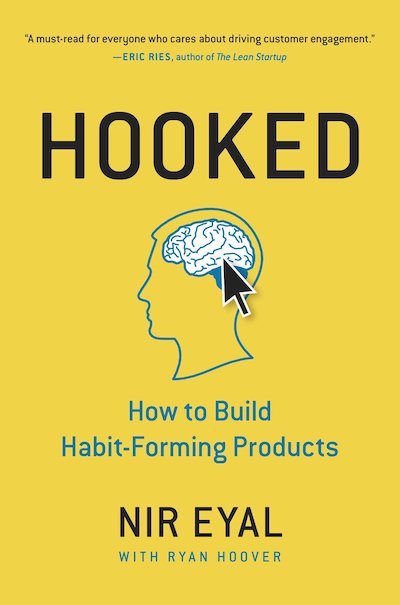
Hooked Book Summary
This Hooked Book Summary covers the key ideas, lessons, and takeaways in about 20 minutes.
Helps with these goals
Want the complete 20-minute summary?
- Full structured summary
- Video Summary
- Podcast Summary
- Audio summary
- Infographic
- Key takeaways
- Exercises
- Quiz
- Highlights and notes
- Ask the book with AI
What is in the Hooked book summary?
Below is a preview of Sumizeit’s expert-written summary of Hooked by Nir Eyal. The full summary covers the book’s key ideas in text, audio, and video.
Have you ever wondered why it is you can’t go the morning without your iPhone?
Or, even a few minutes?
How about why you can’t seem to start your day without a venti from Starbucks?
These items have made their way into your daily routine and now you have to have them or else your day just doesn’t feel right.
In “Hooked: How to Build Habit-Forming Products” Nir Eyal tells us how companies use their knowledge of psychology to properly advertise their products to the public.
And, if you have your own business, then you’ll definitely want to scoop up this knowledge in order to create a campaign that no one can resist and in turn maximize your profits.
You Can’t Always Change Old Habits
New habits are hard to form. And, that’s because the old ones are hard to break. Our minds automatically go to our old habits because that is what worked previously, so why not do it again?
The way to successfully adopt a new habit is by doing it over and over again. Once you begin to repeat the same activity, it will become routine.
Habit-Forming Products Produce High Revenues
A habit-forming product is one that makes its way into a consumer’s daily routine. Such as our iPhones, a laptop, or a watch.
“79 percent of smartphone owners check their device within 15 minutes of waking up every morning.” - Nir Eyal
Companies that sell habit-forming products usually have long-term customers. That’s because these products are in their everyday lives, so they must do the upkeep or get a new one if it breaks or its lost. Simply because they don’t know how to function without it.
These companies also get the benefit of word-of-mouth from their loyal customers who gush to their friends, families, and co-workers about these products. It’s like free advertisement. So less money out and more customers in!
Another perk of selling a habit-forming product is that it is hard to compete with. If consumers already love one product, it’s hard to get them to switch. Especially, if it’s a product that is in their daily routine.
Companies can also choose to charge more with habit-forming products because they understand that people rely on them.
The Four Stages
Nir Eyal tells us that there are four stages of the Hooked model. This model describes how consumers get addicted or hooked on a product.
These four stages are repeated over and over again. And, with this repetition, they start to internalize and become habit.
The Trigger Explained
The trigger is always external because it’s not in the person’s daily routine yet. This trigger could be an ad, but it could also be that another friend bought the product, so you just have to have it too!
“Users who continually find value in a product are more likely to tell their friends about it.” - Nir Eyal
A popular example of a trigger is when you get notifications from Facebook on your phone.
Want the complete 20-minute summary?
- Full structured summary
- Video Summary
- Podcast Summary
- Audio summary
- Infographic
- Key takeaways
- Exercises
- Quiz
- Highlights and notes
- Ask the book with AI
Who should read Hooked?
Hooked is essential for product managers, entrepreneurs, and marketers who want to understand why people develop strong attachments to certain products and services. It's also valuable for anyone curious about the psychological mechanisms behind habit formation and how companies leverage them to build loyal customer bases.
Why does Hooked matter?
In today's competitive digital economy, the difference between a successful product and a forgotten one often comes down to habit formation. Understanding the psychology behind why people return to certain apps, platforms, and products—and how to ethically apply these principles—has become critical knowledge for anyone building or marketing a business.
What are the key themes in Hooked?
- The psychology of habit formation and repetition
- External vs. internal triggers in consumer behavior
- The four-stage Hooked model that drives product adoption
- Balancing engagement with ethical responsibility
- Customer investment and perceived value creation
What are the key lessons from the Hooked book summary?
Habits Form Through Repetition of a Four-Stage Cycle
Nir Eyal's Hooked model consists of trigger, action, reward, and investment stages that repeat cyclically. When users cycle through these stages repeatedly, the behavior gradually becomes automatic and internalized.
External Triggers Must Transition to Internal Triggers
Products start with external cues like ads or notifications to prompt user action, but successful habit-forming products eventually create internal triggers based on user emotions, routines, or unmet needs.
Simplicity in Action Drives Conversion
Removing friction from the action step—such as one-click signups versus lengthy forms—significantly increases the likelihood that users will complete the desired behavior and move toward habit formation.
Rewards Must Align With Core Human Motivations
Effective rewards tap into universal human desires: seeking pleasure and avoiding pain, pursuing hope and avoiding fear, and gaining social acceptance while avoiding rejection.
Investment Increases Perceived Value and Loyalty
The more time or money users invest in a product, the more they psychologically value it and integrate it into their daily lives, even if they could manage without it.
Multiple Reward Types Strengthen Habit Loops
Combining different types of rewards—such as social interaction, personal achievement, and entertainment value—creates a more compelling and habit-forming product experience.
Variable Rewards Create Stronger Habits Than Consistent Ones
Unpredictability in rewards generates stronger engagement than predictable rewards because users develop anticipation and continue seeking the next reward.
Understanding Your Customer Is Foundational
Successful habit-forming products begin with deep knowledge of target customers' pain points, desires, and routines rather than assumptions about what drives behavior.
Habit-Forming Products Command Pricing Power
Because customers rely on habit-forming products in their daily lives, companies can charge premium prices without losing customer loyalty.
Switching Costs Create Competitive Moats
Once a habit-forming product is integrated into a customer's routine, competitors find it extremely difficult to capture that customer due to the high psychological and practical switching costs.
Word-of-Mouth Becomes Free Marketing
Users who develop strong habits around a product naturally recommend it to friends and family, providing organic growth and reduced customer acquisition costs.
Notifications as External Triggers Must Deliver Value
While notifications effectively interrupt users and prompt action, they only create long-term habits if they consistently deliver genuine value or satisfaction.
Pain Relief Products Have Built-In Motivation
Products addressing real pain points have an inherent advantage in habit formation because users are actively seeking solutions and motivated to repeat the behavior.
Long-Term Success Requires Ethical Boundaries
Companies must distinguish between building genuinely useful habit-forming products and exploiting psychology in ways that damage user health or wellbeing, as crossing this line undermines long-term business sustainability.
Product Stickiness Relies on Consistent Promise Fulfillment
Habit-forming products must continuously deliver on their core promise to maintain user trust and prevent users from breaking the habit loop and switching to competitors.
Mental Associations Link Problems to Solutions
Successful companies train customers to mentally connect their specific pain points or desires with their product as the primary solution, making the product the automatic choice.
Breaking Old Habits Requires Replacing Them
Users cannot simply abandon established habits; they must replace them with new ones, which is why competing products must offer a more compelling habit loop than what users already practice.
Frequency of Use Predicts Habit Strength
Products that integrate into users' daily routines faster develop stronger habits and create more durable competitive advantages than those used occasionally.
Emotional Triggers Amplify Product Adoption
Appeals to emotion—whether through storytelling, aesthetics, or social connection—are more effective at driving the initial adoption and repeat action than rational appeals alone.
Want the complete 20-minute summary?
- Full structured summary
- Video Summary
- Podcast Summary
- Audio summary
- Infographic
- Key takeaways
- Exercises
- Quiz
- Highlights and notes
- Ask the book with AI
How can you apply ideas from Hooked?
- Map your product's user experience against the four-stage Hooked model to identify where users drop off and optimize each stage for smoother progression.
- Audit your notifications and external triggers to ensure they consistently deliver value; remove those that interrupt without purpose, which erodes trust and reduces habit formation.
- Simplify signup and onboarding processes to reduce friction in the action stage, recognizing that every additional step can significantly decrease conversion rates.
- Design variable reward systems that keep users engaged through unpredictability, such as random discovery, social surprises, or achievement-based recognition.
- Develop customer personas based on deep research into your target audience's pain points and motivations, then ensure your product and marketing messaging directly address those needs.
- Create multiple touchpoints for user investment—both time and money—that increase perceived value and make the product feel indispensable to daily routines.
- Build feedback loops that demonstrate to users how their investment (time, data, money) is creating value, reinforcing the habit loop and increasing long-term retention.
What common mistakes do readers make with Hooked?
- Relying too heavily on external triggers without building internal triggers; users will forget your product once the notifications stop.
- Creating friction-heavy action steps that are too complicated, causing potential users to abandon the process before experiencing the reward.
- Delivering inconsistent or underwhelming rewards that fail to fulfill the product's core promise, breaking user trust and the habit loop.
- Neglecting to understand your specific customer base and instead assuming that psychological triggers work uniformly across all users regardless of demographics and needs.
Sumizeit Exercises Apply what you've learned
Turn ideas from Hooked into action with a short guided reflection: identify the biggest takeaway, connect it to your life, and commit to one step you can take in the next 24 hours.
What is the expert analysis of Hooked?
Overview
Hooked: How to Build Habit-Forming Products is authored by Nir Eyal, a prominent figure in behavioral engineering and psychology applied to business and technology. With an academic background from Stanford and a presence in esteemed publications such as Harvard Business Review, Eyal brings a rigorous yet accessible approach to understanding how products become integral to consumers’ daily lives. This book holds significance for entrepreneurs, marketers, and product designers seeking to leverage psychological insights to create compelling, habit-forming products that drive sustained user engagement and profitability.
Core Thesis
Eyal’s central argument is that successful habit-forming products follow a predictable four-stage cycle—Trigger, Action, Reward, and Investment—that, when effectively designed, embed themselves into users’ routines by tapping into internal and external psychological cues. By understanding and ethically applying this “Hooked” model, companies can cultivate user habits that foster loyalty, reduce churn, and generate long-term revenue. The book contends that habit formation is not accidental but a deliberate design process grounded in behavioral psychology.
Strengths
- Clear Framework: The four-stage Hooked model provides a lucid and actionable structure for understanding habit formation, making complex psychological concepts accessible to practitioners.
- Interdisciplinary Integration: Eyal effectively synthesizes insights from psychology, behavioral economics, and marketing, offering a holistic view of consumer behavior.
- Practical Relevance: The book is rich with relatable examples—from smartphones to social media—that illustrate how theory translates into real-world product design.
- Ethical Considerations: Unlike some works that glorify manipulation, Eyal acknowledges the fine line between habit formation and addiction, urging responsible application of these techniques.
- Focus on User Motivation: Emphasizing the importance of internal triggers and emotional rewards, the book highlights why products that solve genuine pain points or provide pleasure are more likely to succeed.
Critiques & Counterarguments
- Overemphasis on Habit Formation: While habits are powerful, not all consumer decisions are driven by habitual behavior. Rational choice theory and situational factors can disrupt the Hooked cycle, suggesting the model may oversimplify complex decision-making.
- Limited Attention to Negative Externalities: The book lightly touches on ethical concerns but does not deeply engage with the societal consequences of habit-forming technologies, such as digital addiction or privacy erosion.
- Evidence Base and Generalizability: Some critics argue that the book relies heavily on anecdotal examples and lacks robust empirical validation across diverse product categories and cultures.
- Competing Theories: Alternative models like BJ Fogg’s Behavior Model emphasize motivation, ability, and triggers differently, suggesting that habit formation is more nuanced than a linear four-step process.
- User Autonomy and Resistance: Psychological reactance theory posits that users may resist perceived manipulation, which the Hooked model underestimates, especially in increasingly privacy-conscious markets.
Who Should Read This
This book is indispensable for product managers, UX designers, marketers, and entrepreneurs aiming to deepen their understanding of consumer psychology and build products that resonate on a habitual level. Additionally, behavioral scientists and students of business psychology will find Eyal’s synthesis insightful for bridging theory and practice. However, readers seeking a critical or ethical deep dive into the societal impacts of habit-forming technologies may need to supplement this with more specialized literature.
Frequently asked questions about the Hooked book summary
What is Hooked about?
Hooked: How to Build Habit-Forming Products by Nir Eyal is a guide to understanding and applying the psychology of habit formation to product design and marketing. The book presents a four-stage model—trigger, action, reward, and investment—that explains how successful products become integrated into users' daily routines, creating loyal customers and sustainable business value.
Who should read Hooked?
Hooked is ideal for product managers, entrepreneurs, startup founders, marketers, and business strategists who want to build products or services that users return to repeatedly. It's also valuable for anyone interested in understanding the psychological mechanisms that drive human behavior and habit formation in the digital age.
What are the main takeaways from Hooked?
The main takeaways include understanding the four-stage Hooked model that drives habit formation, recognizing how external triggers must eventually transition to internal triggers, optimizing user experience to remove friction, and leveraging psychological principles responsibly. Importantly, the book emphasizes that successful habit-forming products require deep knowledge of your customer and must deliver genuine value to maintain ethical boundaries.
What is the Hooked model and how does it work?
The Hooked model consists of four stages repeated cyclically: trigger (external or internal cue prompting action), action (the behavior required to use the product), reward (the fulfillment or satisfaction received), and investment (the time or money users contribute). Through repetition of this cycle, products become habitual and integrated into users' daily routines.
How do companies use psychology to make habit-forming products?
Companies apply psychological principles by tapping into core human motivations like seeking pleasure and avoiding pain, creating variable rewards that maintain engagement, simplifying the action required to use products, and building emotional associations between customer pain points and product solutions. When done responsibly, these techniques create products users genuinely want to integrate into their lives.
What's the difference between external and internal triggers?
External triggers are outside cues like advertisements, notifications, or friend recommendations that prompt initial product use. Internal triggers are mental associations formed over time—like boredom leading you to check social media or morning routines triggering coffee purchases—that eventually replace the need for external prompts and signal true habit formation.
Why is understanding your customer important in building habit-forming products?
Deep customer understanding allows you to identify their real pain points, emotional drivers, and existing routines, which enables you to design products that deliver genuine value and integrate naturally into their lives. Without this understanding, you risk building features or messaging that miss the mark and fail to create meaningful habits.
About Sumizeit
Sumizeit is a profitable Scomy LLC company based in Miami, Florida. It has been helping readers learn from nonfiction books for 7 years with expert-written summaries in text, audio, podcast, and video.
Want the complete 20-minute summary?
- Full structured summary
- Video Summary
- Podcast Summary
- Audio summary
- Infographic
- Key takeaways
- Exercises
- Quiz
- Highlights and notes
- Ask the book with AI
Here's why readers love Sumizeit
Join thousands of learners getting smarter every day
"Great experience. Detailed summaries. Loved the gamification feature. Makes learning fun. Good customer service. I recommend Sumizeit to anyone. You'll learn a lot."
"I always felt busy but still wanting to keep up with the book discussion in my friend group. This was a great supplement to help me keep reading the books I find fun while keeping up with important books."
"I love this website. Instead of scrolling social media, I find myself learning a lot. I use it everyday. I recommend this app for anyone who is too busy and wants to get up to speed with their favorite books."
Hooked Book Summary PDF
Looking for a Hooked Book Summary PDF you can save and revisit offline? Our Hooked Book Summary PDF captures the book’s core ideas in a clean, printable format — the key frameworks, takeaways, and structure without the fluff. Download the Hooked Book Summary PDF when you want a reference you can annotate, share with your team, or review on the go. Get your Hooked Book Summary PDF from the download page below.
Download Hooked Book Summary PDFPeople also liked these summaries
Readers who explored Hooked often enjoyed these titles next.



Want the complete 20-minute summary?
- Full structured summary
- Video Summary
- Podcast Summary
- Audio summary
- Infographic
- Key takeaways
- Exercises
- Quiz
- Highlights and notes
- Ask the book with AI
Featured Book Titles
Popular Book Summaries at sumizeit, leading book summary app