

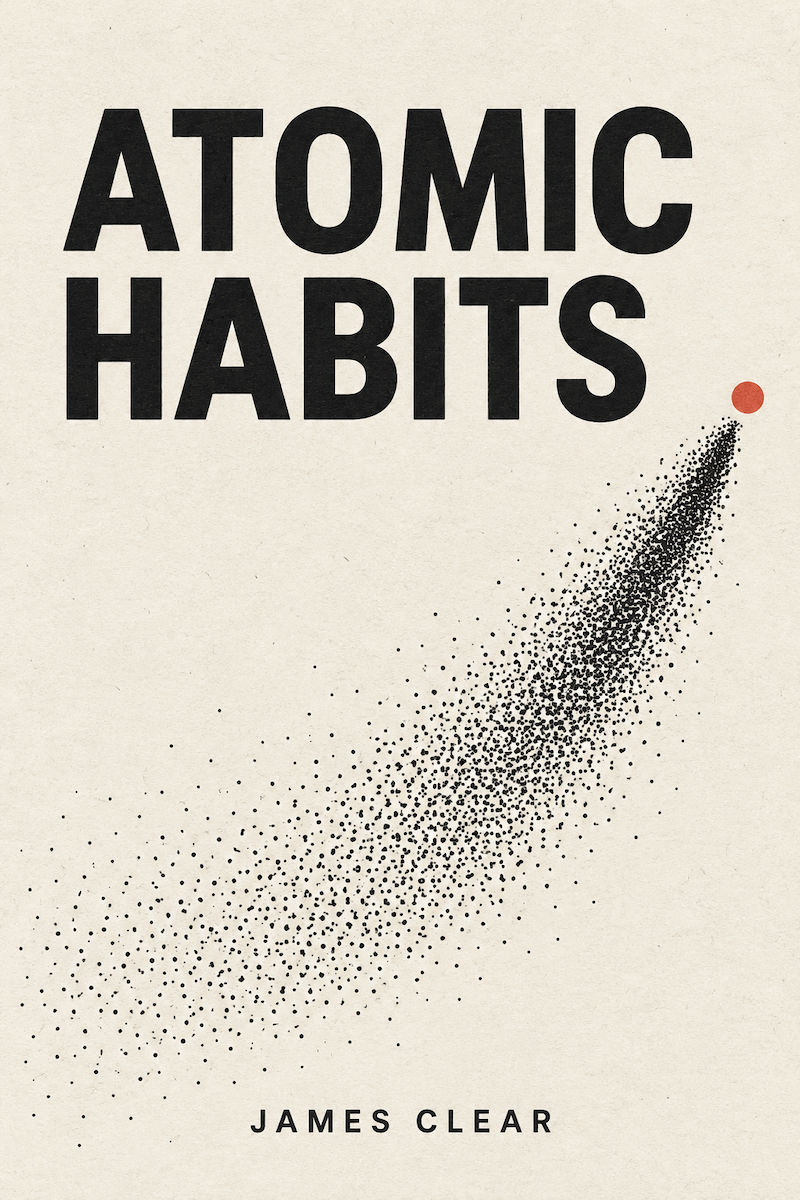
Atomic Habits shows that transformation doesn’t come from willpower or lofty goals—it comes from small, consistent, intentional actions that compound over time. The book’s philosophy is both scientific and practical: by mastering the Four Laws (make it obvious, attractive, easy, and satisfying) and shaping your environment, you can reprogram your habits to work for you instead of against you.
The key insight: success is a system, not a goal. You don’t need to overhaul your life—just improve slightly, every day. Whether it’s writing one paragraph, running for five minutes, or choosing a salad over fries, each small decision compounds into remarkable change. Over time, your habits shape your identity, and your identity drives your destiny.
Helps with these goals
As an Amazon Associate, Sumizeit earns from qualifying purchases.
In Atomic Habits, James Clear dismantles the myth that success requires massive, sweeping change. Instead, he argues that true transformation comes from the compounding effect of tiny, consistent improvements—what he calls “atomic habits.” Like atoms, these small behaviors are the building blocks of larger systems. Improving by just 1% each day may feel insignificant, but after one year, those small gains compound into a 37x improvement. The same principle applies to negative habits: if you become 1% worse each day—by procrastinating, eating poorly, or skipping small tasks—the cumulative effect can quietly erode your potential.
Clear uses the metaphor of the ice cube to describe this phenomenon. Imagine a cube sitting in a freezing room: at 25°F, nothing happens. At 26°, 27°, 28°—still nothing. Only at 32° does it suddenly melt. Change was happening all along; it was just invisible. This illustrates what Clear calls the Plateau of Latent Potential—the period of apparent stagnation before a breakthrough. Successful people don’t give up in this “valley of disappointment”; they persist through it.
Examples abound:
A writer who writes 100 words daily might not notice improvement for months, but in a year, they’ll have a 36,500-word manuscript.
A runner adding 100 meters each week might not feel faster immediately but will eventually complete marathons with ease.
A student studying an extra 15 minutes daily may outperform peers by the end of the semester.
These examples show that the compounding power of small, daily actions—positive or negative—defines our long-term outcomes.
Clear insists that lasting transformation begins not with goals or results, but with identity. Most people focus on what they want to achieve (“I want to lose 20 pounds”), or the process (“I’ll go to the gym daily”), but the deepest and most enduring form of change focuses on who you want to become (“I’m a healthy and disciplined person”). Every small action is a vote for the type of person you want to be.
For instance:
Instead of saying, “I want to run a marathon,” say, “I am a runner.”
Instead of, “I want to read more books,” say, “I am a reader.”
Instead of, “I want to quit smoking,” say, “I am not a smoker.”
The more “votes” you cast through repeated actions, the stronger your new identity becomes. Over time, your behaviors become natural expressions of who you believe you are.
Clear draws from neuroscience to show why this works: our self-image influences the brain’s predictive models. When your actions align with your self-concept, they feel effortless; when they contradict it, they require willpower. That’s why it’s easier for a person who identifies as a reader to pick up a book than for someone trying to “start reading more.”
He gives the example of an overweight man who lost over 100 pounds by simply asking himself one question before every meal: “What would a healthy person do?” By repeatedly choosing the healthy option, he gradually began to think and act like a healthy person.
Clear breaks down the habit loop into four stages: cue, craving, response, and reward.
Cue: The trigger that initiates a behavior. For example, a notification sound may cue you to check your phone.
Craving: The desire to change your state. The phone buzz creates the craving for connection or novelty.
Response: The action you take to satisfy the craving—picking up the phone.
Reward: The satisfaction from fulfilling the craving—reading a message or seeing likes—reinforces the loop.
This sequence repeats until it becomes automatic. Every habit, from brushing your teeth to scrolling social media, follows this loop.
To break a bad habit, you must interrupt the loop. For example:
If you always snack while watching TV, move snacks out of sight (remove the cue).
If you check your phone too often, silence notifications (remove the craving trigger).
If you overspend online, delete shopping apps (increase effort).
To build a good habit, strengthen each stage of the loop so it becomes automatic and rewarding.
Clear introduces the Four Laws of Behavior Change, a set of principles for building good habits and breaking bad ones:
Make it Obvious
Design your environment so good cues are visible and bad ones are hidden.
Example: If you want to eat healthier, keep fruit on the counter and store junk food in the pantry.
If you want to practice guitar, keep it on a stand in the middle of the room instead of in a case.
If you want to stop watching TV late at night, unplug it after each use.
The brain is a visual machine. By designing your surroundings thoughtfully, you remove the need for willpower.
Make it Attractive
Use temptation bundling—pair a desired habit with an enjoyable one.
Example: Only watch your favorite show while exercising or only listen to music while cleaning.
Reframe habits as opportunities rather than obligations.
“I get to work out,” instead of “I have to.”
Surround yourself with people who embody your desired behavior. If you want to learn guitar, hang out with musicians—their habits will rub off on you.
Make it Easy
Reduce friction between you and your desired habit.
Example: Lay out workout clothes the night before.
Keep your workspace clean to encourage productivity.
Apply the Two-Minute Rule: every habit should start with an action that takes less than two minutes.
“Read before bed” becomes “Read one page.”
“Run every morning” becomes “Tie your running shoes.”
Focus on showing up, not perfection. Momentum builds naturally once you start.
Make it Satisfying
Attach immediate rewards to habits. Humans crave instant gratification, not delayed results.
After a workout, drink a smoothie or check off your progress in a habit tracker.
Use visual cues like calendars to mark completed days—it’s satisfying to see your streak grow.
Example: The comedian Jerry Seinfeld maintained his writing habit by crossing off each day he wrote jokes on a big wall calendar. His rule: Don’t break the chain.
When used in reverse, these laws also break bad habits: make them invisible, unattractive, difficult, and unsatisfying.
Clear emphasizes that environment trumps motivation. Most people think they lack willpower when in reality, they live in environments that work against their goals. Willpower is a short-term strategy; environmental design is a long-term one.
Examples:
To eat healthier, pre-cut vegetables and store them at eye level.
To study more, keep your books open on your desk rather than in your bag.
To avoid social media, log out or move apps to a separate screen.
Your environment should make good habits frictionless and bad ones inconvenient. For example, if you always stay up too late watching Netflix, unplug your TV after use or put the remote in another room.
Clear’s advice echoes the saying: “You do not rise to the level of your goals. You fall to the level of your systems.”
The Two-Minute Rule is one of Clear’s most famous techniques. It states that every new habit should take less than two minutes to do. The goal isn’t to master the habit immediately but to start easily and build consistency.
Examples:
“Do 30 minutes of yoga” → “Roll out my yoga mat.”
“Study for class” → “Open my notebook.”
“Write a novel” → “Write one sentence.”
These micro-actions are gateway habits —small steps that lead to larger behavior. Once you begin, momentum takes over. As Clear notes, “A habit must be established before it can be improved.”
Habit stacking leverages the brain’s existing routines to create new ones. The formula: After [current habit], I will [new habit].
Examples:
After I pour my morning coffee, I will meditate for one minute.
After I brush my teeth, I will floss one tooth.
After I sit down at my desk, I will write my top three priorities.
After I close my laptop, I will plan tomorrow’s tasks.
This method builds predictable sequences that require little thought. Over time, small stacks evolve into full systems of productivity—like a morning ritual that automatically primes you for success.
Humans are wired for immediate gratification. We repeat behaviors that feel rewarding and avoid those that don’t. The problem is that most good habits have delayed rewards (saving money, eating healthy), while bad habits offer instant pleasure (spending, snacking).
Clear suggests bridging this gap with immediate positive reinforcement:
Reward yourself with a relaxing bath after exercising.
Transfer $10 to a “fun fund” every time you stick to your budget.
Use habit-tracking apps to see instant progress.
Conversely, make bad habits immediately painful. For instance, have an accountability partner fine you if you skip workouts. One example Clear shares is of a couple who charged each other $100 if they broke their diet commitments. The discomfort of immediate loss kept them consistent.
Tracking your habits creates visible proof of your progress, turning abstract goals into tangible momentum. Whether through apps, journals, or calendars, habit tracking provides instant satisfaction and accountability.
Benefits include:
Reminders: It keeps the behavior top of mind.
Motivation: Seeing streaks encourages continuation.
Reflection: Tracking data highlights patterns and helps you adjust strategies.
Clear’s rule is simple: Never miss twice. Missing once is an accident; missing twice begins a new pattern. For example, if you skip a workout today, do even a 5-minute stretch tomorrow to stay on track.
Clear acknowledges that we’re not all wired the same way. Genetics and personality shape which habits come naturally. Extroverts might thrive in group workouts, while introverts prefer solo runs. Creative types might visualize goals through mind maps, while analytical thinkers may prefer spreadsheets.
Rather than fight your nature, align your habits with your strengths.
A morning person should schedule deep work early.
A night owl might reserve evenings for creativity.
Someone who loves structure can use checklists, while spontaneous personalities can rely on flexible triggers.
Your biology doesn’t determine success—it clarifies where you can achieve it most effectively.
Clear introduces the Goldilocks Rule, which states that humans experience peak motivation when working on tasks that are just challenging enough—not too easy or too hard. If a task is too simple, it causes boredom; too difficult, it leads to frustration.
For example:
A pianist practices slightly more complex pieces to stay engaged.
A runner increases distance by small increments to remain challenged.
A programmer takes on slightly harder projects to maintain focus.
Clear suggests operating at about a 50% success rate—where failure is possible but not guaranteed. This balance fosters engagement, creativity, and flow.
Atomic Habits shows that transformation doesn’t come from willpower or lofty goals—it comes from small, consistent, intentional actions that compound over time. The book’s philosophy is both scientific and practical: by mastering the Four Laws (make it obvious, attractive, easy, and satisfying) and shaping your environment, you can reprogram your habits to work for you instead of against you.
The key insight: success is a system, not a goal. You don’t need to overhaul your life—just improve slightly, every day. Whether it’s writing one paragraph, running for five minutes, or choosing a salad over fries, each small decision compounds into remarkable change. Over time, your habits shape your identity, and your identity drives your destiny.
James Clear is an American author, speaker, and productivity expert known for translating behavioral science into practical strategies for everyday improvement. A former baseball player who rebuilt his life after a devastating injury, Clear developed a deep interest in psychology, neuroscience, and habit formation. His weekly newsletter reaches millions of readers globally, and Atomic Habits has sold over 15 million copies and been translated into more than 50 languages.
Through his writing, Clear advocates for continuous, incremental growth. His central message is timeless: success doesn’t come from sudden breakthroughs but from mastering the small, invisible habits that build the foundation for extraordinary results.
Looking for a Atomic Habits Book Summary PDF you can save and revisit offline? Our Atomic Habits Book Summary PDF captures the book’s core ideas in a clean, printable format — the key frameworks, takeaways, and structure without the fluff. Download the Atomic Habits Book Summary PDF when you want a reference you can annotate, share with your team, or review on the go. Get your Atomic Habits Book Summary PDF from the download page below.
Download Atomic Habits Book Summary PDFGet full access to 2,500+ book summaries with audio and video
Start Free Trial →